
Last Updated on September 23, 2026 by Justin Bryant
AI training can be a flexible way to earn money from home, but choosing a platform is harder than the advertisements make it look. A site might show attractive rates while accepting very few applicants. Another might be easy to join but offer too little work to count on.
I compared 14 AI-training platforms I have reviewed and ranked them by the same six-part Self-Made Success scorecard. Mercor ranks first overall at 74%, followed by Micro1 at 65% and Mindrift at a provisional 62%. That does not mean Mercor is the best first application for a beginner. Its entry score is only 2 out of 5.
These ratings judge the opportunity for a prospective contributor, not whether the company is legitimate or whether its AI product is good. None of these platforms guarantees acceptance, projects, hours, or income. The comparison was prepared on September 23, 2026; application status, pay, and task supply can change.

AI training platforms ranked overall: quick comparison
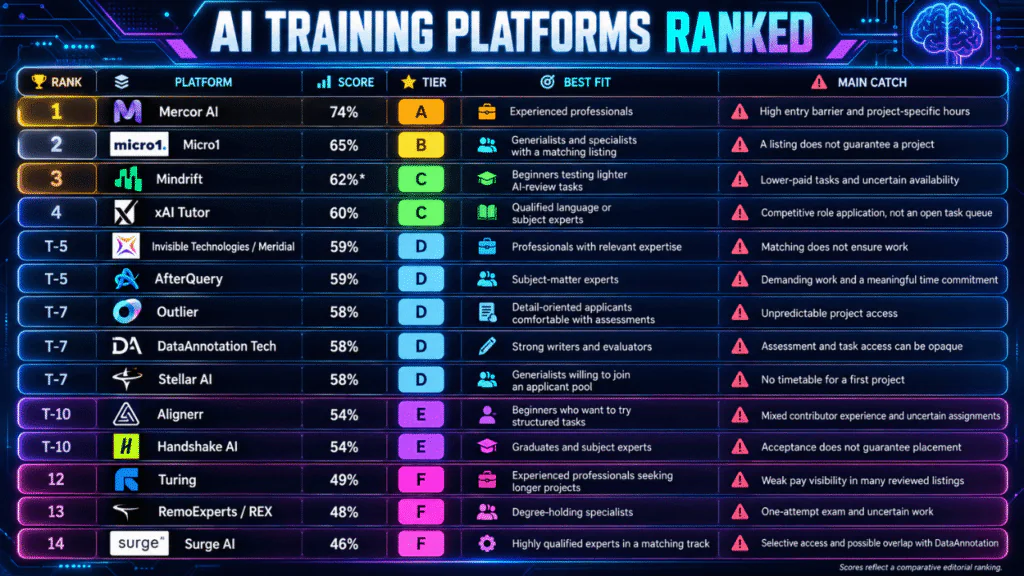
*Mindrift's 62% is a provisional update to my earlier 55% assessment. Its new all-access route is easier to enter, but I have not independently confirmed what tasks a new eligible account will actually see.
How I calculated the overall scores
I rated each platform from 1 to 5 in six categories. Higher always means better for the contributor; for work difficulty, a higher number means the work is easier for someone who qualifies.
- Barrier to entry: How realistic is it to qualify and begin?
- Work consistency: Is there evidence of a useful, recurring task or project pipeline?
- Pay transparency: Can you see meaningful rates and payment terms before committing time?
- Work difficulty: How demanding are the tasks, instructions, and quality standards?
- Flexibility: Can you choose your schedule, or do assignments require set hours?
- Reputation: What does the broader contributor record suggest about the experience?
Reputation is 50% of the overall score. Each of the other five categories is 10%. The weighted score is converted to a percentage out of 5. The tier bands in this comparison are F: 45%–49%; E: 50%–54%; D: 55%–59%; C: 60%–64%; B: 65%–69%; and A: 70%–74%. A small score difference is an editorial judgment, not a precise prediction of what you will earn.
I kept tied scores tied. These 14 platforms come from the AI Training category of my review scorecard. Data-annotation/search-evaluation sites, microtask platforms, transcription services, paid-research sites, and app-testing sites are separate comparisons. The boundaries are not perfect: xAI Tutor is a role rather than an open marketplace, and some Mindrift all-access work resembles data annotation.
1. Mercor AI: A tier (74%)
Mercor's expert marketplace offers AI-training and evaluation opportunities across professional fields. It is my top overall pick because its 4.5/5 reputation score and 4/5 pay-transparency score outweigh the difficult entry process in this weighting system. The listings can be attractive if your actual work history matches a project's needs. They are not evidence that a new generalist will qualify or earn a posted upper-end rate.
Score breakdown: Entry 2/5 · Work 3/5 · Pay 4/5 · Difficulty 3/5 · Flexibility 2.5/5 · Reputation 4.5/5.
Best for: A qualified professional willing to go through screening and wait for a suitable match.
Skip it as a first choice if: you need quick, beginner-level work or completely casual hours. See my full Mercor review for the underlying assessment.
2. Micro1: B tier (65%)
Micro1 has a broader mix of AI-training opportunities than a purely expert-only network. That gives it a stronger entry score while still offering specialist work. In my overall ranking, it is the more balanced starting point for readers who can find a role that genuinely fits their background. Do not assume that a visible listing means immediate acceptance or a steady stream of assignments.
Score breakdown: Entry 4/5 · Work 3/5 · Pay 3/5 · Difficulty 4/5 · Flexibility 3.5/5 · Reputation 3/5.
Best for: Applicants who can match a current generalist, writing, evaluation, or specialist listing.
Main catch: Project terms and hours vary. Check a specific role on the official site, then read my Micro1 review before applying.
3. Mindrift: C tier (provisional 62%)
My earlier Mindrift review focused on its specialist route: CV, assessment, and a wait for a match. In July 2026, Mindrift introduced an all-access route without that application process. It includes lighter tasks such as comparing AI outputs, alongside general data-annotation work. That change raised my entry score from 2 to 4 and helped lift its overall rating from 55% to a provisional 62%.
Score breakdown: Entry 4/5 · Work 2/5 · Pay 3/5 · Difficulty 3.5/5 · Flexibility 3.5/5 · Reputation 3/5.
This is not an easy route to the higher rates advertised for specialized projects. Mindrift's FAQ says all-access tasks tend to pay less, the fixed reward is visible before each task, and work can run out. Payment is for accepted tasks. Geographic and project-level eligibility also apply. I have not tested the live task queue as a new contributor, so treat this placement as provisional.
4. xAI Tutor: C tier (60%)
xAI's Human Data careers page lists AI Tutor roles that can suit qualified language and subject experts. This is not the same arrangement as registering for an open freelance task dashboard. You apply for a specific role, meet its location and expertise requirements, and work under that role's terms if selected.
Score breakdown: Entry 2/5 · Work 3.5/5 · Pay 3/5 · Difficulty 3/5 · Flexibility 3.5/5 · Reputation 3/5.
The possible upside is a more sustained engagement than a thin task queue. The downside is a competitive application and less universal flexibility. Verify the exact position before relying on any advertised rate or remote eligibility. My xAI Tutor review explains the tradeoffs.
Tied for 5th. Invisible Technologies / Meridial: D tier (59%)
Meridial by Invisible Technologies connects independent contractors with AI-training engagements. The current official page emphasizes recognized expertise, written reasoning, and project-specific pay terms. It also says that joining the network does not guarantee an engagement. Those details matter more than the number of project categories shown on a landing page.
Score breakdown: Entry 3/5 · Work 2/5 · Pay 3/5 · Difficulty 4/5 · Flexibility 2.5/5 · Reputation 3/5.
Best for: A professional whose skills align with a visible project.
Main catch: You can be eligible and still wait for a suitable match. This 59% is the existing score from my Invisible/Meridial review; the current expert emphasis is worth checking again before publication.
Tied for 5th. AfterQuery: D tier (59%)
AfterQuery is a better fit for someone who can bring real subject knowledge to AI evaluation than for a casual beginner seeking simple clicks. Its stronger pay-transparency score is offset by a narrower applicant pool, more demanding assignments, and commitments that may not fit every side-hustle schedule.
Score breakdown: Entry 2.5/5 · Work 3/5 · Pay 4/5 · Difficulty 2.5/5 · Flexibility 2.5/5 · Reputation 3/5.
If a current expert opportunity matches your background, review the specific rate, location, and expected hours rather than extrapolating from one impressive listing. See my AfterQuery Experts review for the fuller assessment.
Tied for 7th. Outlier: D tier (58%)
Outlier has real AI-training work and does a relatively good job of displaying pay information. Its bigger weakness is not the existence of tasks, but whether suitable tasks will stay available to a particular contributor. Project changes, screening, and quality rules can make the experience less predictable than the flexible-work pitch suggests.
Score breakdown: Entry 2/5 · Work 2/5 · Pay 4/5 · Difficulty 3/5 · Flexibility 3/5 · Reputation 3/5.
Best for: Detail-oriented applicants who can handle assessment and changing projects.
Do not count on: a stable weekly paycheck. The full Outlier review explains why its visible rates do not make it a top overall choice.
Tied for 7th. DataAnnotation Tech: D tier (58%)
DataAnnotation also earned 58%, with exactly the same six category scores as Outlier in this comparison. Both have clear advertised rates, but neither earned a high consistency or entry score. For DataAnnotation, the assessment and uncertainty about access to projects are the practical bottlenecks.
Score breakdown: Entry 2/5 · Work 2/5 · Pay 4/5 · Difficulty 3/5 · Flexibility 3/5 · Reputation 3/5.
If you decide to apply, use its official signup route and do not interpret an advertised role rate as a promise of acceptance or paid hours. I cover the application and task tradeoffs in my DataAnnotation review.
Tied for 7th. Stellar AI: D tier (58%)
Stellar AI offers a generalist route, which gives it a much better entry score than Outlier or DataAnnotation. But its own FAQ explains that people enter an applicant pool and are onboarded when projects fit their skills. There is no set timeline for a first assignment. A visible generalist rate does not solve that waiting problem.
Score breakdown: Entry 4/5 · Work 2.5/5 · Pay 4/5 · Difficulty 3/5 · Flexibility 3/5 · Reputation 2.5/5.
Best for: Generalists who want another application in their mix and can wait.
Main catch: Thin contributor evidence and uncertain matching. Read my Stellar AI review before treating the posted rate as likely income.
Tied for 10th. Alignerr: E tier (54%)
Alignerr has a relatively accessible AI Training Specialist listing for structured rating and annotation work. That explains its 4/5 entry and difficulty scores. The challenge is converting an application into reliable paid assignments, while interpreting a wide advertised rate range carefully.
Score breakdown: Entry 4/5 · Work 2.5/5 · Pay 2.5/5 · Difficulty 4/5 · Flexibility 4/5 · Reputation 2/5.
I would consider it as one beginner application, not as a dependable income plan. The lower reputation score carries substantial weight here. My Alignerr review goes deeper into contributor feedback and the limits of its pay claims.
Tied for 10th. Handshake AI: E tier (54%)
Handshake AI ties Alignerr overall but serves a different applicant. It is more compelling for students, graduates, and people with relevant subject expertise than for someone with no background who wants instant tasks. Handshake's application guidance says project invitations depend on fit and partner demand; submitting an application does not guarantee placement.
Score breakdown: Entry 2/5 · Work 2.5/5 · Pay 3/5 · Difficulty 3/5 · Flexibility 4/5 · Reputation 2.5/5.
That makes it a possible supplemental opportunity for a qualified applicant, not a fast or stable beginner job. See my Handshake AI review.
12. Turing: F tier (49%)
Turing's talent marketplace covers a wider range of remote professional work, including AI-related projects. The breadth of its catalog and the possibility of longer engagements helped its work-consistency score. In the opportunities I reviewed, though, pay was often not visible before the application process, and many projects favored experienced specialists.
Score breakdown: Entry 2.5/5 · Work 3/5 · Pay 1.5/5 · Difficulty 2/5 · Flexibility 3/5 · Reputation 2.5/5.
Best for: Someone with strong credentials who can evaluate a specific role on its merits.
Not ideal for: A beginner comparing transparent, quick-start AI-training options. My Turing review explains why a large job catalog did not translate into a strong overall score.
13. RemoExperts / REX: F tier (48%)
REX can be interesting when a specialist opportunity matches your field, but its degree requirement, one-attempt entry exam, and lack of guaranteed projects make it a poor first recommendation for the average beginner. A high rate on one specialized posting would not remove those barriers.
Score breakdown: Entry 2/5 · Work 1.5/5 · Pay 3/5 · Difficulty 2/5 · Flexibility 3/5 · Reputation 2.5/5.
Best for: A degree-holding professional willing to complete screening for a specific project.
Main catch: Passing an exam still may not lead to paid work. See my RemoExperts review for the process and payment context.
14. Surge AI: F tier (46%)
Surge's consultant program advertises specialist tracks and visible rates, which is why pay transparency is its strongest category. But these are selective opportunities, not a broad beginner task board. The official program also says it manages applications and projects through DataAnnotation, so readers should not assume that applying to both creates two independent sources of work.
Score breakdown: Entry 2/5 · Work 2/5 · Pay 4/5 · Difficulty 2/5 · Flexibility 3/5 · Reputation 2/5.
Best for: A specialist with a direct fit for a current track.
Main catch: Selective access and uncertain distinct value if you already use DataAnnotation. My Surge review is the source of the existing reputation assessment; its page needs a final manual check before this article goes live.
Which AI training platform should you try first?
If you have substantial professional expertise: Start by comparing a real Mercor opportunity with current roles at xAI Tutor, AfterQuery, Meridial, and Handshake AI. Qualifications, location, and expected hours matter more than a platform-wide score.
If you are newer to AI training: Micro1, Mindrift's all-access AI-review route, Stellar's generalist application, and Alignerr may be easier starting points. Mindrift's easier tasks generally pay less than its specialist projects, and I have not verified a new account's live task supply.
If you need dependable income soon: Do not build your plan around any one of these platforms. Even a legitimate company with attractive posted rates may offer no suitable work when you need it. Use the full reviews above to narrow your applications, check current eligibility on the official site, and compare the actual terms offered to you.
Frequently asked questions
What is the best AI training platform overall?
Mercor ranks first under my weighted scorecard at 74%. It is strongest for a qualified professional, not necessarily for a beginner. Micro1 is second at 65%, while Mindrift's provisional updated score is third at 62%.
Which AI training platform is easiest to start with?
There is no universal answer. Mindrift's all-access route removes the CV and assessment for lighter tasks; Stellar and Alignerr also have more accessible generalist routes. Easy registration does not guarantee that useful paid work is available.
Are these AI training jobs or side hustles?
Most are project-based contractor opportunities rather than guaranteed jobs with set hours. xAI Tutor is the main exception in this list because you apply for a particular role. Always read the terms of the exact opportunity.
Why do some high-paying platforms rank poorly?
A posted rate is only one factor. My scorecard also weighs entry, work availability, task difficulty, flexibility, and especially reputation. If you cannot get accepted or cannot find tasks, a high advertised rate has limited practical value.