
Last Updated on August 20, 2026 by Justin Bryant
Outlier has quickly become one of the most searched platforms for AI training jobs. On the surface, it promises flexible remote work and competitive pay. But once you look closer, the experience is more mixed. I’ve broken it down across key areas to see whether it actually lives up to the hype.
Key Takeaways
- Outlier is a legitimate platform with real AI training work
- Pay can be competitive, especially for specialized roles
- Work is inconsistent and not reliable as a primary income
- Most roles have higher-than-average entry requirements
- Best suited as a side income, not a full-time replacement

What Outlier AI Jobs Are Like
Outlier focuses on AI training tasks. This includes writing, coding, reviewing outputs, and helping improve language models.
The work is usually project-based. You are not hired as a traditional employee. Instead, you work as a freelancer or contractor.
From what I’ve seen, the biggest appeal is flexibility. You can work when you want, and there are no strict hour requirements. But that flexibility comes with trade-offs, especially around consistency.
Barrier to Entry
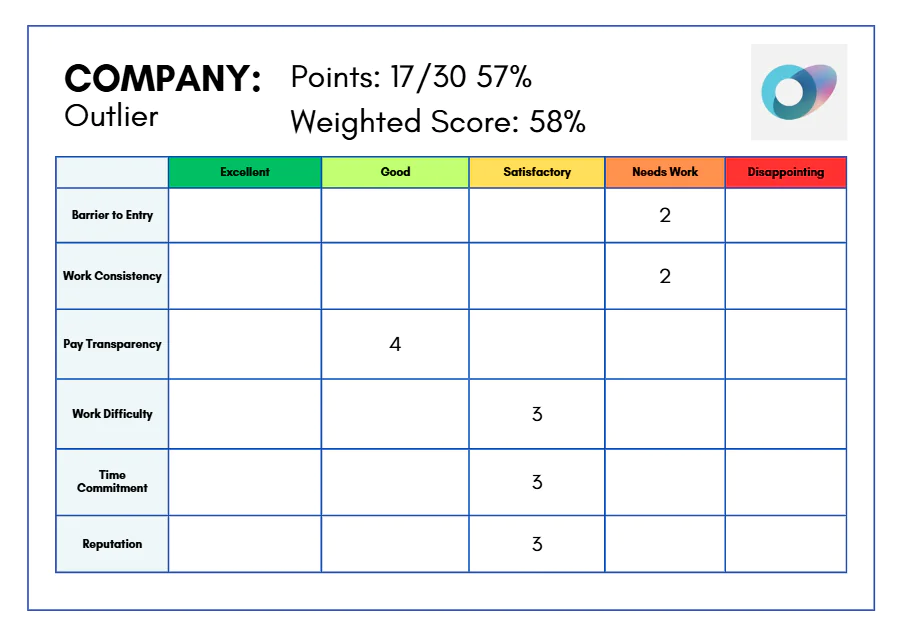
Score: 2 out of 5
Getting started with Outlier is harder than most freelance platforms.
Many roles require:
- A master’s degree or higher
- Professional experience in writing, coding, or a specific field
- Strong technical or analytical skills
Even the more general roles still prefer candidates with some background in writing or research.
I’ve seen a lot of freelance platforms, and this is definitely on the stricter side. For a “side hustle” type platform, the requirements are relatively high.
Work Consistency
Score: 2 out of 5
This is where most of the problems show up.
Work is not steady. You may have tasks available one week and nothing the next. Some users report long gaps with no assignments at all.
There are also mentions of sudden offboarding or losing access to projects without much notice.
If you are expecting reliable hours or income, this will likely be frustrating. I would not count on this as a stable source of earnings.
Pay Transparency
Score: 4 out of 5
Outlier does a decent job of showing pay ranges upfront.
Typical ranges include:
- Around $16 per hour for generalist roles
- $20 to $30 per hour for coding or technical work
- $30 to $50 per hour for highly specialized roles
The rates vary by country and task type, but the structure is clear.
Most people who complete tasks report that they do get paid. The main issue is not the payment itself, but how often work is available.
Work Difficulty
Score: 3 out of 5
The difficulty depends heavily on the type of task.
- Specialist roles can be challenging
- Coding tasks depend on your experience
- General tasks are more accessible
What stands out is that the work is not necessarily hard, but it requires precision.
You need to follow the instructions carefully. Small mistakes can affect whether your work is accepted. It can feel repetitive and detail-heavy at times.
Time Commitment
Score: 3 out of 5
There is no fixed schedule, which is both a benefit and a drawback.
Some tasks take:
- A few minutes
- 10 to 20 minutes
- Up to a couple of hours
The issue is that pay is often tied to expected completion time. If a task takes longer than expected, you may not be paid extra for that additional time.
So while it is flexible, your efficiency matters a lot.
Reputation
Score: 3 out of 5
Outlier appears to be a legitimate company.
The platform looks professional, and there are no major red flags in how it operates. Many users confirm they have been paid for completed work.
However, reviews are mixed overall.
Common positives:
- Flexible schedule
- Interesting AI-related work
- Reliable payments when tasks are available
Common complaints:
- Inconsistent work
- Limited support
- Unclear communication at times
The biggest theme across reviews is instability, not fraud.
Final Verdict
Overall Score: 17 out of 30
This equates to a 5.6 out of 10.
Outlier sits right in the middle.
It is not a scam, and it does offer real opportunities to earn money with AI training tasks. But it falls short on reliability.
I would personally treat it as a supplemental income source, not something to depend on.
If you already have a steady income and want flexible remote work on the side, it can be worth trying. But if you need consistent hours and predictable pay, this is probably not the right fit.
Similar Companies to Consider
If you are considering Outlier AI, there are several other platforms that offer similar AI training, data annotation, and model evaluation opportunities. Each platform has its own strengths, requirements, and tradeoffs.
DataAnnotation is probably the closest competitor to Outlier for many workers. The platform focuses on AI training tasks such as evaluating responses, writing prompts, comparing outputs, and providing feedback to improve language models.
Many workers report higher-than-average pay rates compared to traditional microtask sites. However, acceptance can be competitive, and available work may vary depending on your skills and location.
Alignerr focuses heavily on expert-level AI training work. Many projects target professionals with specialized knowledge in areas such as mathematics, programming, science, law, finance, and writing.
The barrier to entry is generally higher than Outlier, but compensation can also be significantly higher for qualified contributors.
Invisible Technologies operates large-scale AI training and operations projects for major technology companies. Through its contributor marketplace, workers may perform tasks such as AI evaluation, content review, research, and quality assurance.
The platform tends to attract workers looking for more structured projects than traditional microtask platforms.
Remotasks provides data annotation and AI training opportunities across categories such as image labeling, segmentation, transcription, and content evaluation.
The platform has historically been popular among workers looking to build experience before applying to higher-paying AI training companies.
Formerly known as Lionbridge AI, TELUS Digital offers AI training and evaluation projects across many countries. Opportunities often include search engine evaluation, content moderation, data labeling, and quality assessment tasks.
These roles are typically more structured than microtask platforms and may offer longer-term project assignments.
Conclusion
Outlier AI training jobs can be useful, but they do not fully live up to the hype.
The platform works best for people who value flexibility and do not mind inconsistency. If you go in with the right expectations, it can be a helpful way to earn extra income and gain experience in AI-related work.