
Last Updated on July 14, 2026 by Justin Bryant
Artificial intelligence has created an entirely new category of online work, and data annotation sits right in the middle of it.
Companies developing AI models need real people to review responses, label data, verify information, compare outputs, and help train the systems that power today's most advanced AI tools. That's created dozens of platforms offering data annotation and AI training work.
The problem is that not all of these platforms are worth your time.
After reviewing dozens of AI training companies over the past year, I've noticed a pattern. Many platforms look similar on the surface, but once you dig deeper, the differences become obvious. Some are beginner-friendly but rarely have work. Others advertise excellent pay but are extremely difficult to get into. A few have decent project variety but struggle with transparency or reputation.
That's why I decided to compare the most popular data annotation platforms using the same evaluation criteria.
If you'd rather watch my complete breakdown, here's the full video. Below that, you'll find the expanded written version with additional details, comparisons, and my latest recommendations.

Rather than focusing on hype or marketing claims, I scored each company based on the factors I think matter most to job seekers.
These include:
- Barrier to entry
- Work consistency
- Pay transparency
- Work difficulty
- Time commitment
- Reputation
I also use a weighted scoring system that gives extra importance to reputation.
Over time, I've realized reputation matters more than almost anything else. A platform can offer high pay or easy work, but if contributors consistently report poor communication, payment issues, or unreliable projects, those advantages quickly disappear.
One thing you'll notice immediately is that I didn't give any platform an S Tier rating.
That wasn't an accident.
While there are several companies I genuinely like, I don't think any data annotation platform has solved the biggest problem facing this industry.
Project availability remains inconsistent almost everywhere.
No matter which company you choose, I wouldn't recommend relying on it as your only source of income.
Instead, think of these platforms as opportunities to earn supplemental income while contributing to AI development.
With that in mind, here's how I ranked the ten most popular data annotation platforms from worst to best.
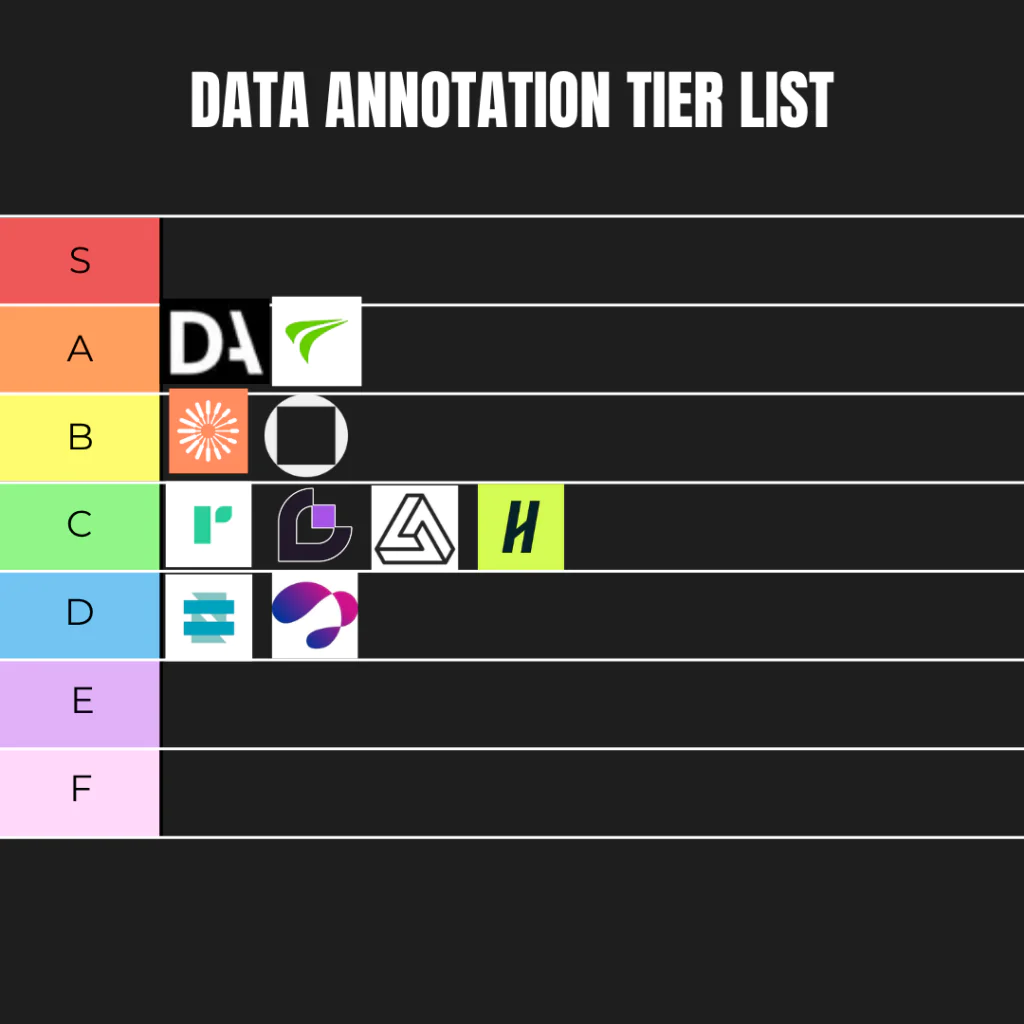
Table of Contents
D Tier: Platforms I Wouldn't Recommend Starting With
The platforms in this tier aren't necessarily scams, and I'm not saying you should never sign up for them. They're legitimate companies with real projects, but after comparing them against the rest of the industry, I don't think they offer enough advantages for most people to make them a top choice.
In my opinion, these platforms have too many weaknesses in the areas that matter most, whether that's inconsistent work, poor transparency, or concerns about reputation.
If you're serious about getting into data annotation, I think there are simply better places to start.
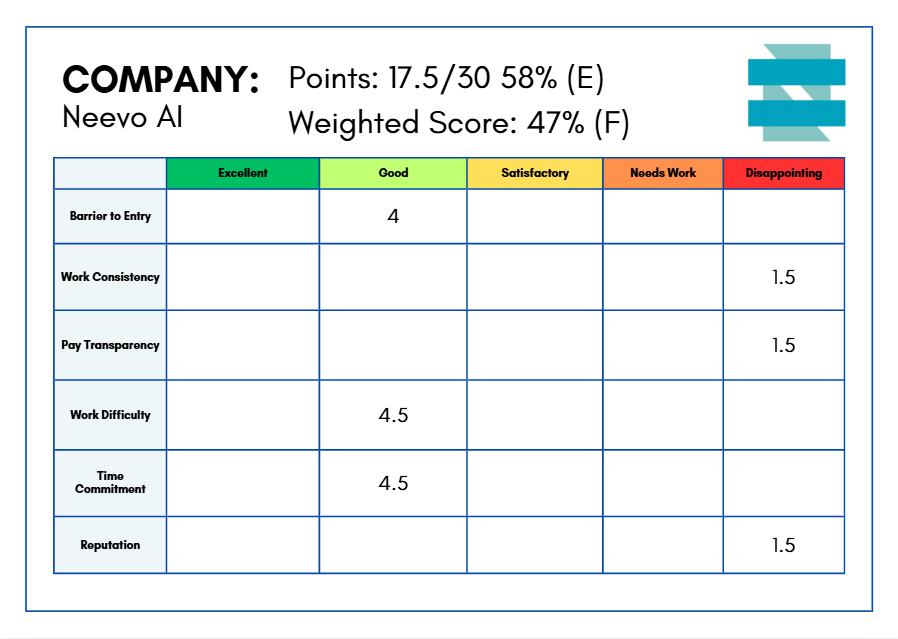
10. Neevo AI
Weighted Score: 47%
Overall Tier: D
If you've been researching data annotation jobs for any length of time, you've probably come across Neevo AI.
Neevo AI is operated by Defined.ai and focuses primarily on AI data collection and annotation projects. Depending on what's available, you might find tasks involving audio validation, speech recording, transcription, translation, text annotation, image tagging, or video validation. Most of these projects fall into the broader category of AI microtasks, meaning they're relatively short assignments that contribute to training machine learning models.
On the surface, Neevo AI actually looks fairly appealing.
One of the biggest strengths I found is that the platform appears to be very beginner-friendly.
Unlike some AI training companies that expect applicants to have specialized knowledge or advanced degrees, Neevo's projects generally don't require extensive experience. Most people should be able to qualify for at least some of the available work.
I also don't think the tasks themselves are particularly difficult.
Many projects involve following instructions carefully rather than applying expert knowledge, which makes the platform much more approachable for someone who has never done data annotation before.
Flexibility is another positive.
If you're only looking for something to do during evenings or weekends, Neevo AI could fit into your schedule fairly easily because many projects don't require a large weekly time commitment.
Unfortunately, that's where the positives mostly end.
The biggest problem I found with Neevo AI is work consistency.
This is already an industry where projects come and go, but Neevo seemed noticeably weaker than many of the other platforms I reviewed.
One week, you may have something available.
The next week, there may be nothing at all.
That unpredictability makes it very difficult to rely on the platform for consistent supplemental income.
Pay transparency is another area where I think Neevo needs significant improvement.
When evaluating AI training companies, I always appreciate platforms that clearly tell applicants what they can expect to earn before they invest time applying.
Neevo doesn't always do that very well.
In many cases, compensation isn't particularly clear until later in the process, making it harder to compare opportunities with competing platforms.
Then there's the issue of reputation.
As I researched contributor experiences across various review sites and discussion forums, I found enough mixed feedback that it lowered my overall confidence.
That doesn't mean every contributor has a bad experience.
It simply means there wasn't enough consistently positive feedback for me to rank the platform higher.
What I Like
- Beginner-friendly projects.
- Low barrier to entry.
- Flexible scheduling.
- Simple task types.
What I Don't Like
- Very inconsistent project availability.
- Weak pay transparency.
- Mixed reputation among contributors.
- Limited earning potential.
Who I Think Neevo AI Is Best For
I think Neevo AI is best suited for someone who simply wants to experiment with AI microtasks and isn't dependent on the income.
If you're looking for steady work or a platform you can grow with over time, I believe there are much stronger options further down this list.
My Verdict
Although Neevo AI does a good job keeping the barrier to entry low, that advantage isn't enough to overcome its inconsistent work and weaker reputation.
For that reason, I ranked it last with a weighted score of 47%.
9. OneForma
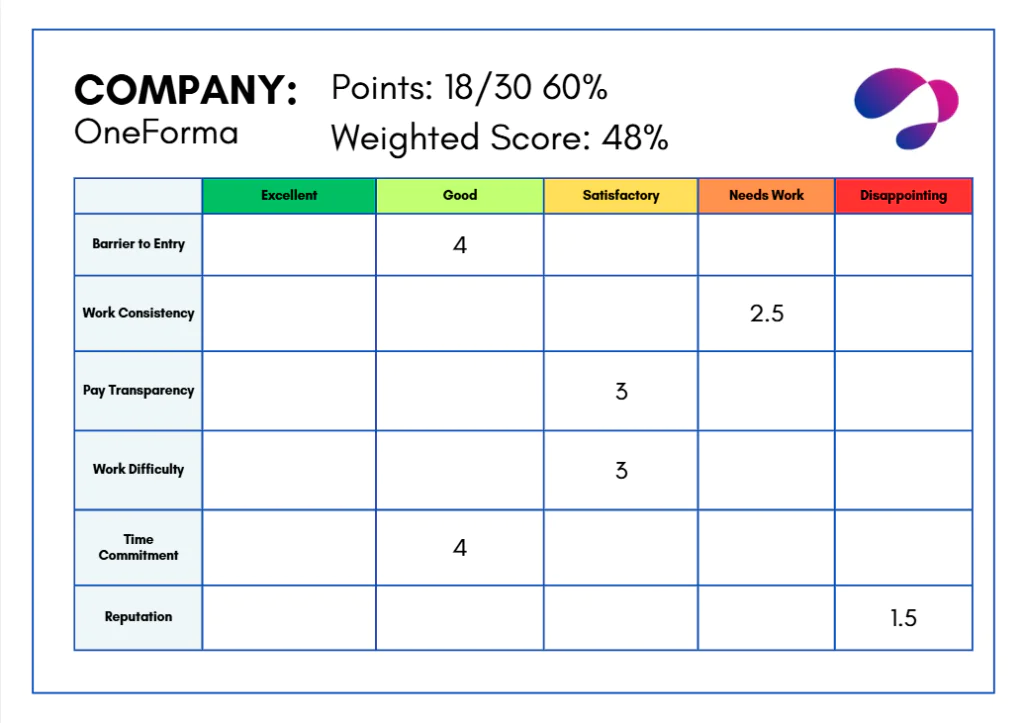
Weighted Score: 48%
Overall Tier: D
OneForma was actually one of the more difficult platforms for me to rank.
On paper, it looks like it should perform much better.
The platform offers one of the widest selections of AI-related project types that I found during my research.
Depending on current demand, contributors may work on:
- Data annotation.
- Data collection.
- Image labeling.
- Audio labeling.
- Translation.
- Transcription.
- Language evaluation.
- Search relevance.
- AI training projects.
It's also backed by Centific, a legitimate technology company with years of experience in AI data services.
From a purely operational standpoint, OneForma checks a lot of boxes.
The barrier to entry is relatively low.
Most projects don't require advanced degrees.
The work itself generally isn't overly difficult.
There's plenty of flexibility because many assignments are project-based rather than requiring fixed weekly schedules.
If I had only looked at those categories, OneForma probably would have landed somewhere in the middle of my rankings.
So why did it finish in the D Tier?
The answer is reputation.
This was actually one of the platforms that caused me to rethink how I evaluate AI training companies.
Originally, I weighted every category more evenly.
But after researching companies like OneForma, I realized something important.
A platform can have easy work.
It can have flexible scheduling.
It can offer interesting projects.
None of that matters if contributors consistently report poor experiences.
That realization led me to place much greater emphasis on reputation in my scoring system.
While researching OneForma, I encountered enough mixed contributor feedback that it ultimately outweighed many of the platform's strengths.
That's an important lesson for anyone comparing AI training companies.
It's easy to get excited about the variety of projects or the advertised opportunities.
What's harder to evaluate is what happens after you're accepted.
Communication.
Project management.
Support.
Reliability.
Those factors ultimately matter much more over the long term.
What I Like
- A wide variety of AI project types.
- Beginner-friendly opportunities.
- Legitimate parent company.
- Flexible project structure.
What I Don't Like
- Reputation lowers my confidence.
- Average work consistency.
- Pay transparency could be stronger.
- Doesn't stand out compared to higher-ranked competitors.
Who I Think OneForma Is Best For
If you're interested in trying a wide range of AI-related work, OneForma offers more variety than many of the other platforms on this list.
However, I wouldn't make it the first platform I applied to.
There are simply stronger alternatives that inspire more confidence.
My Verdict
OneForma has plenty of potential, but potential isn't enough.
For me, reputation is one of the most important factors when evaluating any AI training company, and that's ultimately what kept OneForma in the D Tier despite doing several other things reasonably well.
It finished with a weighted score of 48%, placing it just ahead of Neevo AI but still well below the platforms I would recommend first.
C Tier: Good Platforms With Noticeable Tradeoffs
The companies in this tier aren't platforms I'd avoid.
In fact, several of them came surprisingly close to moving into the B Tier.
The problem is that every one of them has at least one weakness that prevents me from recommending it ahead of the higher-ranked platforms.
For some, it's inconsistent work.
For others, it's reputation.
A few simply don't do enough to separate themselves from the competition.
If you already have an account with one of these companies, I don't think you necessarily need to stop using it.
I just wouldn't make any of them my first choice if I were starting over today.
8. Remotasks
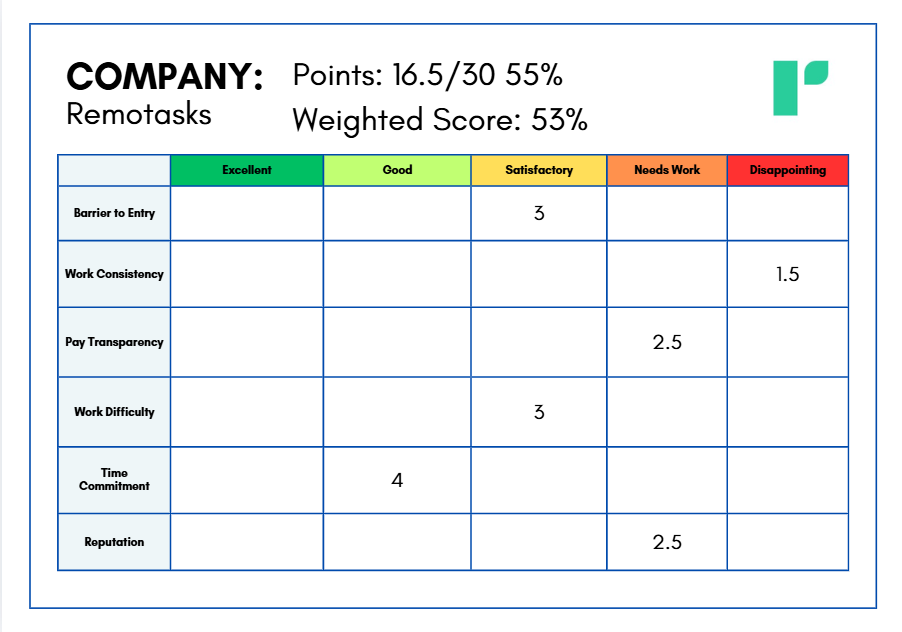
Weighted Score: 53%
Overall Tier: C
Remotasks is probably one of the most recognizable names in AI training, largely because of its connection to Scale AI.
That relationship gives the platform immediate credibility. Scale AI has become one of the biggest companies supplying training data for artificial intelligence systems, so it's no surprise that many people eventually discover Remotasks when looking for data annotation work.
The platform offers a broad range of AI training tasks.
Depending on the project, you may find yourself:
- Evaluating AI responses.
- Comparing multiple outputs.
- Reviewing images or videos.
- Rating content quality.
- Writing feedback for AI models.
- Completing various data labeling projects.
One thing I like is that the work generally isn't overly complicated.
Most projects are designed so that someone without years of professional experience can learn the required guidelines and begin contributing after completing any necessary assessments.
I also found the platform reasonably flexible.
Many projects don't require strict schedules, making it possible to work when assignments are available.
Unfortunately, Remotasks struggles with the same issue affecting nearly every platform in this industry.
Project availability.
During my research, inconsistent work came up repeatedly.
Some contributors reported having plenty of projects.
Others described long stretches with little or no work at all.
That uncertainty makes it difficult to recommend as anything more than supplemental income.
Pay transparency also left me wanting more.
I generally prefer companies that clearly publish compensation ranges before contributors spend time applying or completing assessments.
Remotasks could certainly improve in that area.
The reputation wasn't terrible, but it wasn't strong enough to separate itself from competing platforms either.
What I Like
- Backed by Scale AI.
- Beginner-friendly tasks.
- Flexible scheduling.
- A wide variety of AI training projects.
What I Don't Like
- Inconsistent project availability.
- Average pay transparency.
- Reputation is only average.
- Difficult to rely on consistently.
Who I Think It's Best For
If you're interested in learning AI training work without a steep learning curve, Remotasks can be a reasonable place to start.
Just don't expect a steady stream of work.
My Verdict
Remotasks isn't a bad platform.
It simply doesn't outperform enough competitors for me to rank it any higher than the middle of the list.
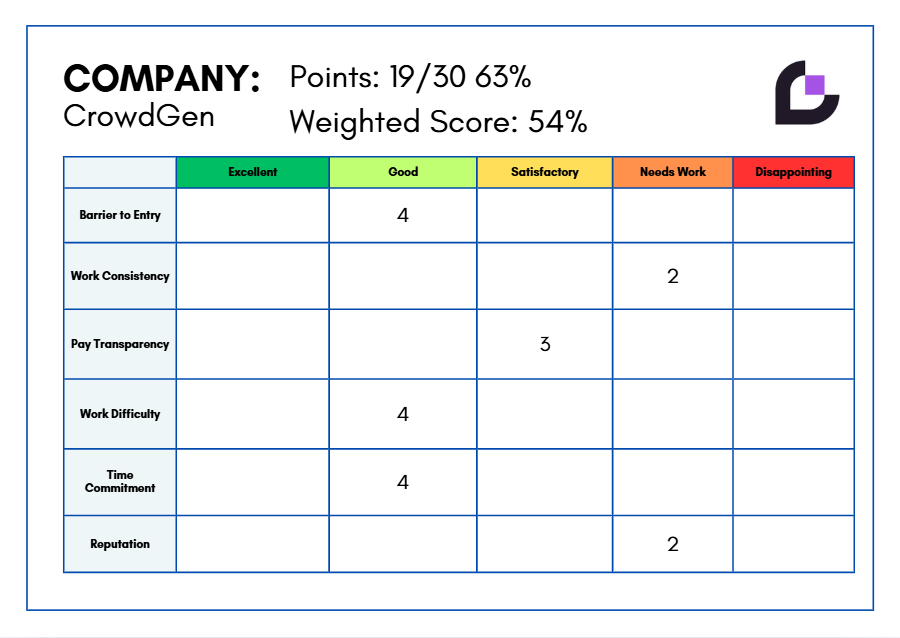
7. CrowdGen
Weighted Score: 53%
Overall Tier: C
CrowdGen is the AI training platform operated by Appen, one of the oldest and most established companies in the AI data industry.
That immediately gives it an advantage in terms of legitimacy.
Unlike newer startups trying to enter the market, Appen has spent years working with organizations that need large amounts of human-labeled training data.
CrowdGen focuses on many different types of AI projects, including:
- AI training.
- Data collection.
- Audio recording.
- Conversation evaluation.
- Content review.
- App testing.
- Search evaluation.
One thing that stood out to me is how many projects are relatively short.
Rather than asking contributors to commit for months at a time, many assignments only last a few hours, several days, or a couple of weeks.
I actually see that as a strength.
Not everyone wants another long-term commitment.
Some people simply want occasional freelance work that fits around school, another job, or family responsibilities.
CrowdGen works well for that type of flexibility.
The downside is that availability depends heavily on where you live.
Certain countries seem to receive significantly more opportunities than others.
That's something I always encourage readers to consider before getting too excited about any AI training platform.
Just because projects exist doesn't necessarily mean they'll exist in your country.
Like most companies on this list, work consistency remains the biggest challenge.
Some projects appear regularly.
Others disappear without much warning.
Reputation also held CrowdGen back.
Although I don't think it's among the weakest companies I researched, contributor experiences were mixed enough that I couldn't justify ranking it any higher.
What I Like
- Backed by Appen.
- Flexible short-term projects.
- Beginner-friendly work.
- A large variety of project types.
What I Don't Like
- Country availability varies.
- Reputation could be stronger.
- Work consistency remains average.
- Earnings fluctuate depending on project availability.
Who I Think It's Best For
CrowdGen is a good option if you're looking for occasional AI projects without committing to a long-term schedule.
My Verdict
CrowdGen does several things well, but it doesn't stand out enough to move beyond the middle of the rankings.
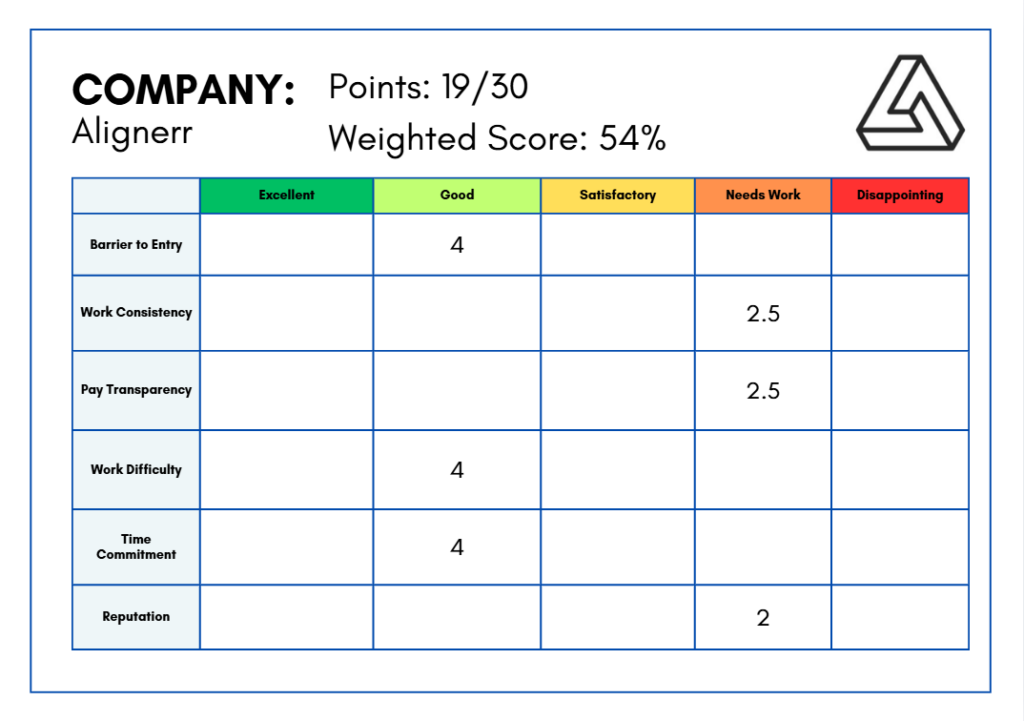
6. Alignerr
Weighted Score: 54%
Overall Tier: C
Alignerr has become one of the fastest-growing names in AI training, and it's probably one of the platforms I'm asked about most often.
Overall, I came away fairly impressed.
The platform offers work involving:
- Reviewing AI outputs.
- Correcting training data.
- Audio projects.
- Data annotation.
- Model evaluation.
- Other AI improvement tasks.
Compared to many competitors, I think the barrier to entry is quite reasonable.
Most people shouldn't find the work especially difficult, and many projects appear designed for contributors without extensive experience.
That makes Alignerr more approachable than expert-focused platforms that primarily recruit professionals with advanced credentials.
Flexibility is another positive.
Many assignments don't require fixed weekly schedules, making it easier to fit projects around your existing commitments.
So why didn't it reach the B Tier?
Mostly because it doesn't clearly outperform the competition in the categories I value most.
Work consistency remains average.
Pay transparency is decent but still leaves room for improvement.
And while I don't think its reputation is poor, I also don't think it's quite strong enough yet to place it alongside my top recommendations.
What I Like
- Modern AI training platform.
- Beginner-friendly projects.
- Flexible scheduling.
- A wide variety of work.
What I Don't Like
- Average project consistency.
- Reputation still developing.
- Pay transparency could improve.
Who I Think It's Best For
If you're looking for a newer AI training platform with a relatively low barrier to entry, Alignerr is certainly worth considering.
My Verdict
Alignerr came surprisingly close to earning a B-tier ranking.
With stronger long-term contributor feedback and more consistent project availability, I could easily see it moving higher in the future.
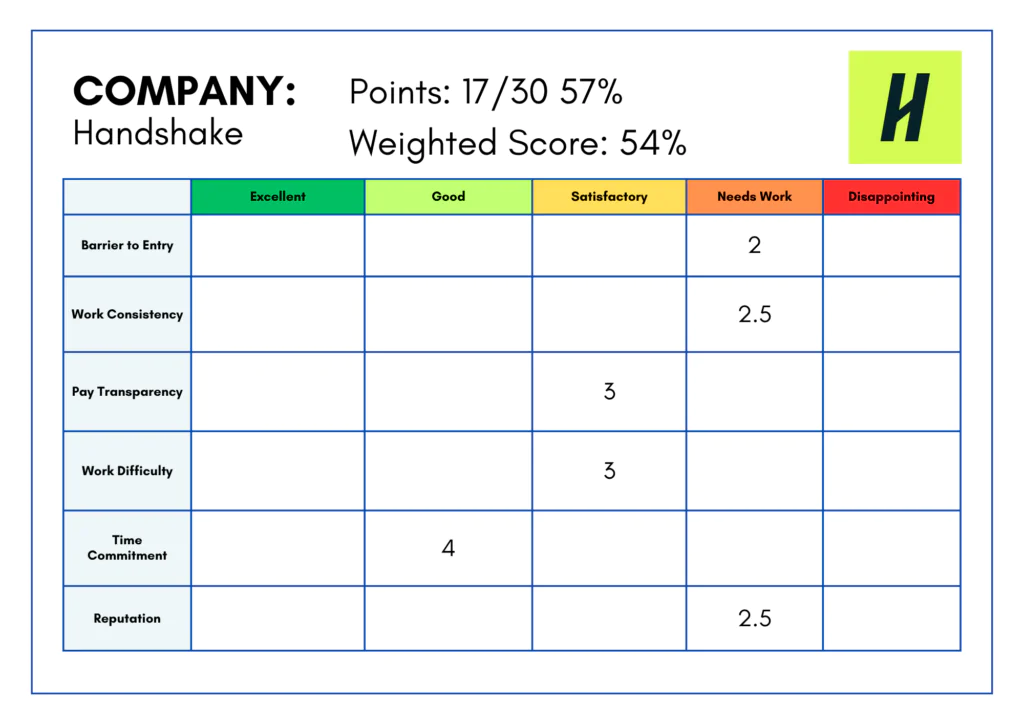
5. Handshake
Weighted Score: 54%
Overall Tier: C
Handshake is a little different from the other platforms on this list.
Rather than targeting the broadest possible audience, many of its opportunities seem geared toward students, recent graduates, and contributors with specialized knowledge.
Projects often involve:
- Evaluating AI responses.
- Comparing multiple model outputs.
- Data annotation.
- Reviewing factual accuracy.
- Writing detailed feedback.
The biggest factor holding Handshake back is its barrier to entry.
While it isn't nearly as selective as some expert-only platforms, I still think the average applicant will have a harder time qualifying compared to many of the companies I've already discussed.
That's especially true if you don't have a college background or experience in a specialized subject.
Beyond that, most categories landed right around the industry average.
Work consistency wasn't particularly strong.
Pay transparency was acceptable.
The work itself shouldn't be overly difficult once accepted.
Time commitment also seemed fairly manageable.
The reputation, however, remained somewhat mixed.
Not bad enough to significantly hurt the platform, but not strong enough to become one of my top recommendations either.
What I Like
- Interesting AI evaluation work.
- Flexible project structure.
- Good opportunities for students and specialists.
What I Don't Like
- Higher barrier to entry.
- Mixed contributor reputation.
- Average project consistency.
Who I Think It's Best For
I think Handshake makes the most sense for students, graduates, or people who already have expertise in specific subjects.
My Verdict
Handshake sits right in the middle of my rankings.
It's a legitimate platform with worthwhile opportunities, but it doesn't quite separate itself from the competition enough for me to recommend it over the higher-ranked companies.
B Tier: Strong Platforms That Still Have Room for Improvement
The platforms in this tier are the ones I would feel comfortable recommending to most people.
That doesn't mean I think they're perfect.
Like every company in this industry, they still struggle with inconsistent project availability, and there are areas where I'd like to see more transparency or flexibility.
The difference is that these companies do enough things well to separate themselves from the middle of the pack.
If you're planning to sign up for multiple data annotation platforms, I think both of these deserve a spot on your shortlist.
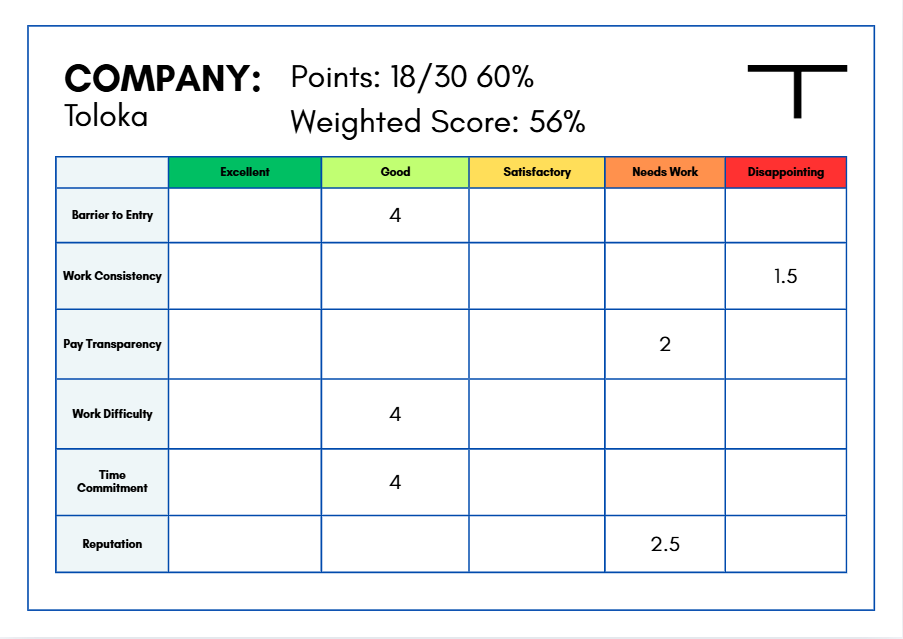
4. Toloka
Weighted Score: 56%
Overall Tier: B
Toloka is probably one of the oldest names people associate with online microtasks and data annotation.
Over the years, the platform has expanded well beyond simple surveys and now offers a wide variety of AI training work. Depending on the project, you may find yourself labeling images, evaluating search engine results, verifying business information, categorizing content, recording short videos, rating AI responses, or completing other data annotation tasks that help train machine learning models.
One thing I appreciate about Toloka is how approachable it is.
The barrier to entry is relatively low compared to many other AI training platforms.
You don't usually need an advanced degree or years of professional experience just to qualify for basic projects. For someone completely new to data annotation, that's a major advantage.
The work itself also tends to be straightforward.
Many assignments focus more on following detailed instructions than demonstrating specialized expertise. As long as you're patient and pay attention to quality guidelines, most people should be able to complete the tasks successfully.
Flexibility is another area where Toloka performs well.
Most projects allow you to work when tasks are available rather than requiring fixed schedules or long weekly commitments. If you're looking for occasional side income instead of another part-time job, that flexibility can be very appealing.
Unfortunately, Toloka still suffers from one of the biggest problems in this entire industry.
Project availability.
Historically, work has been inconsistent.
Some contributors report having plenty of tasks available, while others experience long periods where very little work appears.
Since recording my review, Toloka has also shifted many of its AI projects over to Mindrift. That change could improve project availability over time by consolidating AI work onto one platform, but it's still something I'd encourage people to monitor rather than assume has been completely solved.
Pay transparency is another area I'd like to see improved.
While some projects clearly explain compensation, others provide very little information before you begin. I generally prefer platforms that tell contributors exactly what to expect before they invest their time.
Reputation was another category that prevented Toloka from moving into the A Tier.
I wouldn't describe its reputation as poor, but I also don't think contributor feedback is consistently strong enough to place it alongside my highest-ranked recommendations.
What I Like
- Low barrier to entry.
- Beginner-friendly work.
- Flexible scheduling.
- A large variety of microtasks and AI projects.
- One of the easiest platforms for new contributors to learn.
What I Don't Like
- Historically inconsistent project availability.
- Pay transparency could be better.
- Reputation is respectable but not exceptional.
- Earnings can fluctuate significantly from month to month.
Who I Think Toloka Is Best For
If you're completely new to AI training and want a platform that's relatively easy to learn, Toloka is one of the better places to start.
I don't think it's strong enough to become your only platform, but I do think it's worth adding to your rotation if you're trying to maximize your opportunities.
My Verdict
Toloka does many things well.
It's accessible, flexible, and offers a wide range of projects.
If work consistency and transparency improved, I could easily see it becoming one of the best platforms in the industry.
For now, though, I think a B Tier ranking accurately reflects both its strengths and its remaining weaknesses.
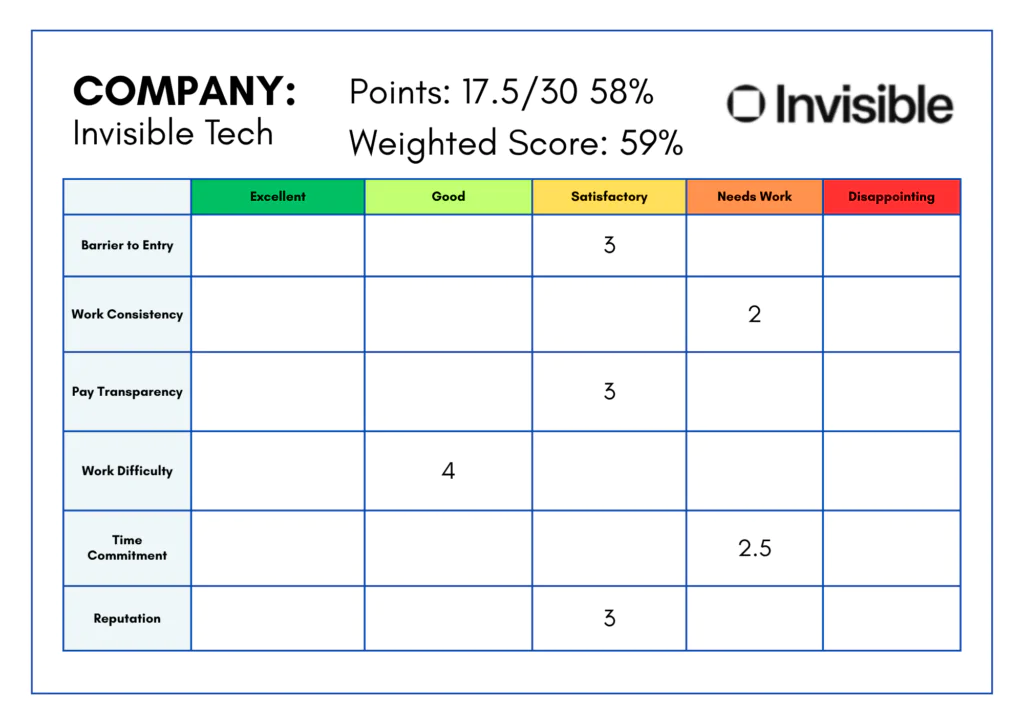
3. Invisible Technologies
Weighted Score: 59%
Overall Tier: B
Invisible Technologies is one of the more unique companies on this list because it isn't built around simple AI microtasks alone.
Instead, it focuses much more heavily on AI operations and enterprise services, with many contributor projects being managed through its Meridial platform.
That distinction matters.
While some companies primarily recruit people to complete short, repetitive annotation tasks, Invisible Technologies often looks for contributors who can handle more complex workflows, evaluate AI responses, improve datasets, review content for accuracy, and assist with larger AI operations.
Depending on the project, you may also encounter opportunities involving editing, prompt evaluation, multilingual work, and specialized quality assurance.
Compared to many other platforms I've reviewed, Invisible Technologies feels more structured.
That doesn't necessarily make it harder, but it does make it feel more like professional contract work than casual microtasking.
The barrier to entry is about average.
I don't think it's as beginner-friendly as Toloka or Neevo AI, but it's certainly much more accessible than highly selective expert-only platforms.
Once you're accepted, I don't think the work itself is especially difficult.
The bigger challenge is simply qualifying for the projects that match your background.
One area where Invisible Technologies performed better than many competitors was pay transparency.
I appreciate companies that provide realistic compensation ranges instead of advertising unrealistic maximum earnings that only apply to a tiny percentage of contributors.
Invisible Technologies generally does a better job of setting realistic expectations.
Project consistency, however, remains fairly typical for this industry.
Like almost every company I've reviewed, available work depends heavily on client demand.
Some contributors stay busy.
Others experience long gaps between assignments.
That's simply part of the current AI training landscape.
Where Invisible Technologies really separated itself from many competitors was in its reputation.
After researching contributor experiences across multiple review platforms, I found the overall feedback to be stronger than that of most of the companies I've already discussed.
That doesn't mean every review was positive.
No AI training platform enjoys universal praise.
But compared to much of the industry, contributor sentiment appeared more balanced and generally more favorable.
That stronger reputation ultimately pushed Invisible Technologies into my top three.
What I Like
- Better reputation than most competitors.
- More transparent compensation.
- Interesting AI operations projects.
- Professional project structure.
- Opportunities beyond simple data annotation.
What I Don't Like
- Work consistency still depends on project availability.
- Some projects require more specialized skills.
- Less flexible than certain microtask platforms.
- Not quite as beginner-friendly as some lower-barrier alternatives.
Who I Think Invisible Technologies Is Best For
I think Invisible Technologies is an excellent option for people who already have some experience with AI training, remote contract work, or complex online projects.
If you're looking for something that feels a little more professional than traditional microtask websites, this is one of the better choices.
My Verdict
Invisible Technologies came very close to earning an A-tier ranking.
Its stronger reputation, better transparency, and more structured projects give it several advantages over much of the competition.
Ultimately, what held it back was the same issue affecting nearly every platform in this industry.
Project consistency.
If contributors had access to more reliable long-term work, I think Invisible Technologies would easily rank among the very best data annotation platforms available today.
A Tier: The Best Data Annotation Platforms I've Reviewed
After comparing dozens of AI training companies, these are the two platforms I would recommend most often.
That doesn't mean I think they're perfect.
In fact, one of the biggest takeaways from this entire review is that I don't believe any data annotation platform has truly solved the biggest problem facing this industry.
Reliable project availability.
That's exactly why you won't find an S-tier ranking anywhere in this guide.
Even the best platforms still experience periods where work slows down, projects disappear, or contributors find themselves waiting for new assignments.
With that said, these two companies consistently performed better than the competition across the categories I care about most.
If I were advising someone where to start today, these would be my first recommendations.
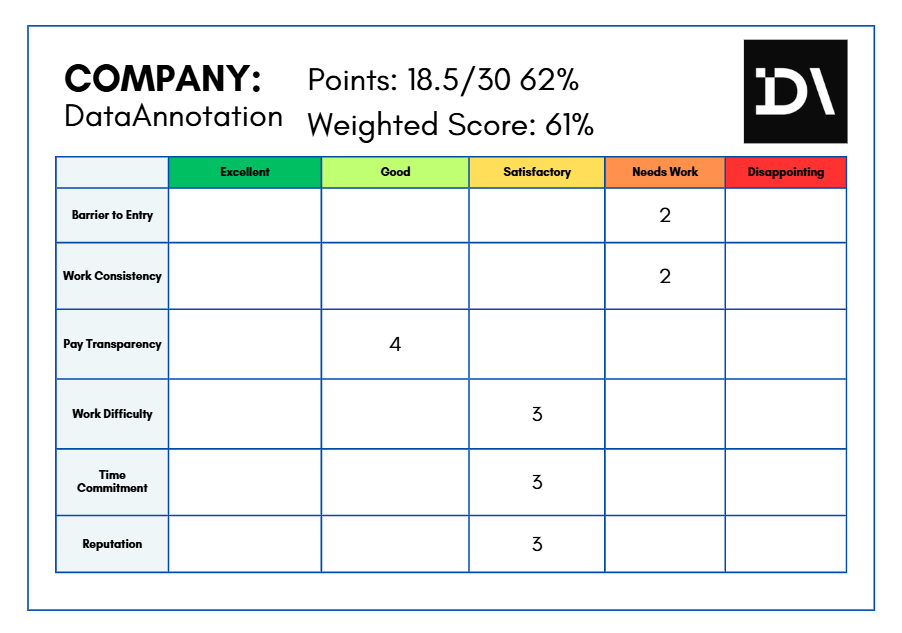
2. DataAnnotation.tech
Weighted Score: 61%
Overall Tier: A
If you've spent any amount of time researching AI training jobs, you've almost certainly come across DataAnnotation.tech.
In many ways, it's become the platform most people associate with data annotation work, and after researching it extensively, I understand why.
The platform offers a broad range of AI training projects.
Depending on your qualifications, you may be asked to:
- Evaluate AI responses.
- Rank multiple chatbot outputs.
- Rewrite content.
- Write prompts.
- Edit AI-generated text.
- Compare model responses.
- Help improve large language models through human feedback.
One thing I really like is that DataAnnotation.tech offers opportunities for both generalists and specialists.
Some projects can be completed by contributors without highly specialized backgrounds, while others target people with expertise in areas like programming, mathematics, science, writing, or other professional fields.
That creates much more opportunity than platforms focused exclusively on experts.
The tradeoff is that the barrier to entry is slightly higher than that of some of the beginner-focused companies earlier in this ranking.
Although there are general opportunities available, many of the highest-paying projects require applicants to demonstrate specialized knowledge or pass fairly rigorous assessments.
If you're brand new to AI training, getting accepted may take a little more effort.
Fortunately, several other categories help offset that challenge.
One of the areas where DataAnnotation.tech consistently impressed me was pay transparency.
The platform generally does an excellent job explaining compensation before contributors begin working.
I always appreciate companies that set realistic expectations instead of advertising unrealistic earning potential.
Compared to much of the industry, DataAnnotation.tech is one of the stronger performers in this area.
The work itself also strikes a nice balance.
Most projects are intellectually engaging without feeling overwhelmingly technical.
You're expected to think critically, follow detailed instructions, and produce quality work, but you don't necessarily need years of professional experience for every assignment.
Like every company in this guide, project availability can still fluctuate.
Some contributors report having steady work for months.
Others experience gaps between assignments.
Unfortunately, that's simply the nature of AI training right now.
The reputation is another reason this platform earned such a high ranking.
While you'll certainly find negative experiences if you search long enough, the overall contributor sentiment appears stronger than much of the competition.
No company receives perfect reviews.
What matters to me is the overall pattern.
In DataAnnotation.tech's case, I believe the positives outweigh the negatives.
What I Like
- Excellent pay transparency.
- Opportunities for both beginners and specialists.
- Interesting AI training work.
- Strong overall reputation.
- One of the industry's best-known platforms.
What I Don't Like
- Acceptance can be competitive.
- Project availability still fluctuates.
- Some of the best opportunities require specialized skills.
Who I Think DataAnnotation.tech Is Best For
I think this platform works well for almost anyone interested in AI training.
Whether you're a general contributor looking for flexible work or a specialist hoping to qualify for higher-paying projects, DataAnnotation.tech offers one of the broadest selections of opportunities I've seen.
My Verdict
DataAnnotation.tech has earned its reputation as one of the industry's leading AI training platforms.
Although it isn't perfect, I think it delivers one of the strongest overall experiences available today.
That's why it earned an A-tier ranking and finished second overall.
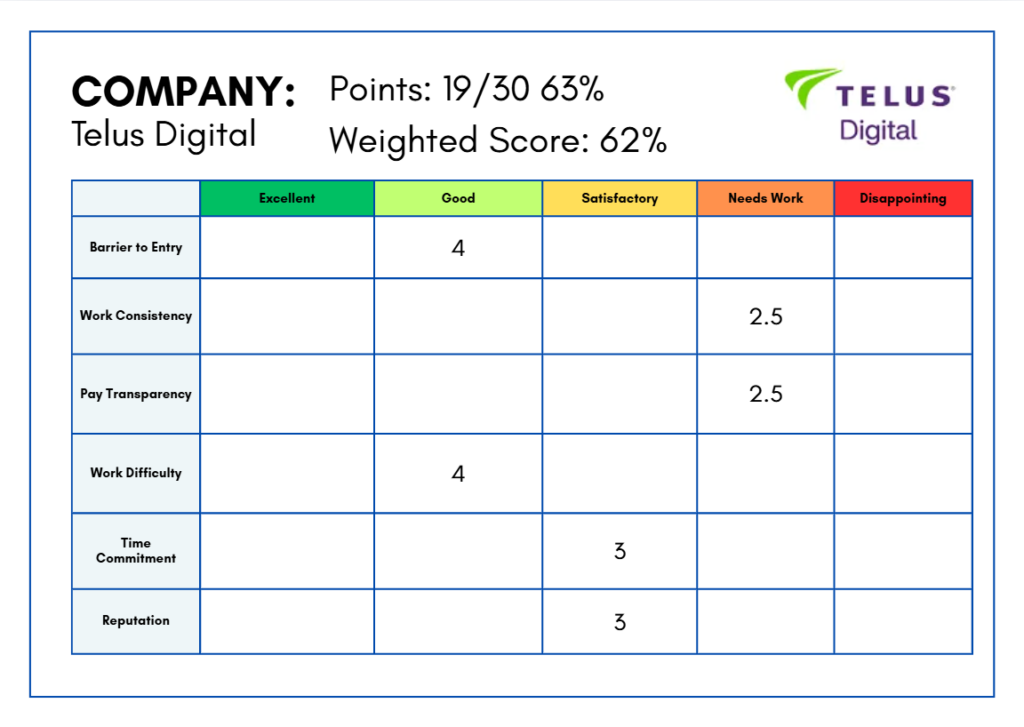
1. TELUS Digital
Weighted Score: 62%
Overall Tier: A
At the top of my rankings is TELUS Digital.
You may remember this company as TELUS International before it rebranded several years ago, but regardless of the name, it's one of the oldest and most established organizations involved in AI evaluation and data services.
That history matters.
One of the things I value most when reviewing AI training companies is long-term stability.
Platforms come and go.
Startups launch every year.
TELUS has been operating internationally for decades, and that gives me significantly more confidence than many newer companies trying to enter this space.
The company's AI Community offers a surprisingly wide variety of opportunities.
Depending on your location, you might find projects involving:
- Search engine evaluation.
- Ads rating.
- Maps evaluation.
- Online data analysis.
- AI response evaluation.
- Content quality review.
- Language-related projects.
- Other AI improvement work.
While not every assignment fits the traditional definition of data annotation, they're all closely related to helping improve AI systems through human evaluation.
One area where TELUS really stood out during my research was accessibility.
Compared to many competing platforms, the barrier to entry is refreshingly low.
Most AI Community positions don't require advanced degrees or years of professional experience.
That makes TELUS one of the easiest legitimate platforms for beginners to explore.
The work itself also tends to be relatively approachable.
Most projects emphasize careful attention to detail rather than specialized technical expertise.
If you're willing to learn the project guidelines and maintain consistent quality, the day-to-day work shouldn't feel overwhelming.
Work consistency remains fairly typical for the industry.
I don't think anyone should expect unlimited projects or guaranteed long-term income.
However, I also didn't find evidence suggesting TELUS performs significantly worse than its competitors in this category.
Pay transparency is one area where I'd still like to see improvement.
Some listings provide compensation details upfront.
Others don't.
Because of that inconsistency, I couldn't give the platform a perfect score in this category.
Compensation also varies considerably depending on your country and the specific project.
The category that ultimately pushed TELUS to the top of my rankings was reputation.
Compared to nearly every other company I researched, contributor feedback was generally stronger and more consistent.
Combined with the company's long operating history, that gave me much more confidence recommending it to new contributors.
What I Like
- Long-established international company.
- Lower barrier to entry than many competitors.
- Beginner-friendly work.
- Strong reputation.
- A wide variety of AI evaluation projects.
What I Don't Like
- Pay transparency varies by project.
- Project availability is still inconsistent.
- Some projects require minimum weekly hour commitments.
Who I Think TELUS Digital Is Best For
If you're looking for your first AI training opportunity, I think TELUS Digital is one of the best places to begin.
The combination of legitimacy, accessibility, and project variety makes it a strong starting point for most people.
My Verdict
TELUS Digital earned the highest score in my rankings because it consistently performed well across nearly every category without having any major weaknesses.
Is it perfect?
No.
Like every platform in this guide, it still struggles with inconsistent work and occasional gaps between projects.
But if someone asked me today which data annotation platform I'd recommend first, TELUS Digital would probably be my answer.
My Biggest Takeaway After Reviewing All 10 Platforms
After researching these companies, one conclusion became very clear.
No matter which platform you choose, you should treat data annotation as supplemental income rather than a replacement for a full-time job.
That's not because the work isn't legitimate.
It's because nearly every company in this industry struggles with project consistency.
Some weeks you'll have plenty of assignments.
Other weeks, you may have nothing at all.
That's simply how client-driven AI training platforms operate.
For that reason, I actually think the smartest strategy is to create accounts with several of the higher-ranked platforms instead of relying on just one.
If projects slow down on one platform, you already have other options available instead of starting your search from scratch.
Final Thoughts
The data annotation industry has created legitimate opportunities for people who want flexible online work while contributing to the development of artificial intelligence.
At the same time, it's important to set realistic expectations.
No platform in this guide earned an S Tier ranking because I don't believe any company has solved the industry's biggest challenge: providing consistent work over the long term.
That doesn't mean these platforms aren't worth joining.
It simply means you should approach them as a flexible side income rather than dependable full-time employment.
If you're completely new to AI training, I'd recommend starting with TELUS Digital or DataAnnotation.tech.
If you want additional opportunities, Invisible Technologies and Toloka are excellent platforms to add to your rotation.
And if you're willing to sign up for several companies at once, you'll put yourself in a much better position when project availability inevitably changes.
Ultimately, that's the strategy I'd follow if I were starting over today.