
Last Updated on July 8, 2026 by Justin Bryant
Surge AI has become one of the more talked-about AI training platforms lately, especially because some of its listings advertise pay rates that can reach hundreds of dollars per hour. Naturally, that gets people's attention.
After spending quite a bit of time researching the company, reading user experiences, comparing it to other AI training platforms, and digging through their current openings, I think Surge AI is one of the more interesting platforms in this space. At the same time, it's also one of the hardest platforms for me to recommend to the average person.
The biggest reason is that Surge AI isn't really designed for beginners. While many AI training companies have at least some entry-level opportunities, Surge AI focuses heavily on recruiting experts with significant professional experience. If you happen to be one of those experts, the earning potential can be impressive. If you're just looking for an easy AI side hustle, you'll probably have a difficult time getting accepted.
In this review, I'm going to break down exactly how Surge AI works, who it's designed for, what I like about it, what concerns me, and whether I think it's actually worth your time.
What Surge AI Actually Does
Before reviewing any AI training platform, I think it's important to understand what the company actually does.
Surge AI is an artificial intelligence data company that helps train and improve large AI models. Instead of building consumer AI products, they provide the human expertise that companies need to make their models more accurate, more reliable, and better at handling complex tasks.
Their parent company is Surge Labs Inc., which is headquartered in San Francisco, California. The company was founded by Edwin Chen, a former AI researcher who previously worked at companies including Twitter, Google, and Meta.
One thing that confused me initially was where to actually find the AI training jobs.
If you simply visit the main website, it isn't immediately obvious where freelancers apply. Instead, you have to navigate to their Expert Workforce section, which is where they list available projects for contractors.
Once you're there, you quickly notice something different about Surge AI compared to many other platforms.
Almost every opportunity is designed for specialists.

How the AI Training Works
Like most AI training companies, Surge AI hires independent contractors rather than traditional employees.
The work generally revolves around improving AI models through human expertise.
Depending on the project, contributors may be asked to:
- Review AI-generated responses.
- Rewrite model outputs.
- Compare multiple responses.
- Draft high-quality prompts.
- Evaluate factual accuracy.
- Improve reasoning and clarity.
- Provide detailed feedback that helps train future AI models.
Unlike simpler AI training platforms that often focus on image labeling or basic response ranking, many Surge AI projects require genuine expertise within a professional field.
For example, one project may ask a physician to evaluate medical responses generated by an AI model. Another may ask a university professor to review academic explanations for logical accuracy. Someone with an investment banking background might rewrite financial analyses into professional-quality reports.
This is much closer to expert consulting than traditional data annotation.
Why Companies Use Platforms Like Surge AI
Large language models don't become smarter on their own.
They need constant feedback from people who actually understand the subjects they're writing about.
That's where companies like Surge AI come in.
Instead of asking general workers to evaluate highly technical information, they recruit people with years of real-world experience.
That allows AI companies to improve their models using feedback from professionals who understand the nuances of medicine, finance, law, journalism, engineering, academia, and many other specialized fields.
From the company's perspective, this makes perfect sense.
If you're trying to build an AI model capable of answering complicated medical questions, you probably don't want random internet users reviewing those responses. You want physicians and specialists who can identify subtle mistakes that most people would completely miss.
That seems to be the philosophy behind Surge AI.
Quality appears to take priority over scale.
Why This Matters for Workers
Understanding this business model explains many of the strengths and weaknesses of Surge AI.
On one hand, specialized expertise allows the company to advertise some very impressive pay rates.
On the other hand, it creates a much higher barrier to entry than most competing platforms.
Many people searching for AI training jobs expect something similar to data annotation, where they can complete relatively simple tasks after passing a few assessments.
Surge AI is very different.
The company is actively looking for professionals with significant credentials rather than general workers.
That doesn't necessarily make it better or worse.
It simply means it's built for a much smaller audience.
If you happen to fit that audience, the opportunities could be excellent.
If you don't, there's a good chance you'll never qualify for the projects in the first place.
Is Surge AI Legit?
The short answer is yes.
Based on everything I found, I have no reason to believe Surge AI is a scam.
The company has a legitimate corporate history, identifiable leadership, and operates under Surge Labs Inc. It has received coverage from several major publications and appears to work with well-known AI companies.
One interesting detail I came across is that multiple sources report Surge AI has performed AI training work connected to Anthropic, one of the leading companies developing large language models. That doesn't automatically guarantee a perfect worker experience, but it does add credibility to the business itself.
I also found consistent information about the company's headquarters, leadership, and overall operations.
So if your biggest concern is whether Surge AI is a real company, I think the answer is clearly yes.
The bigger question isn't legitimacy.
It's whether the platform is actually a good opportunity for you.
And that's where things become much more complicated.
Barrier to Entry
The first thing I always look at when reviewing an AI training platform is how difficult it is to actually get accepted.
After going through Surge AI's current openings, I honestly think this is one of the biggest weaknesses of the platform.
Unlike companies that offer a mix of beginner and advanced opportunities, nearly every listing I found was looking for someone with significant professional credentials.
For example, one medical position required applicants to be board-certified physicians or senior subspecialty fellows affiliated with teaching hospitals or academic institutions.
Another opening for journalists wasn't simply asking for writing experience. It specifically mentioned contributors from publications like The New York Times, The New Yorker, and The Atlantic, along with recipients of prestigious journalism awards or writers with extensive long-form publishing experience.
The university professor positions had similarly high standards. Applicants were expected to be current or former professors at top-ranked universities or Ivy League institutions with published research and demonstrated expertise in their academic field.
Those are incredibly specific qualifications.
As I continued looking through the listings, I noticed the same pattern over and over again. Whether the position involved finance, medicine, law, engineering, or another specialty, Surge AI was almost always recruiting experts rather than general workers.
From the company's perspective, this makes sense.
If they're helping build advanced AI models, they naturally want people with years of real-world experience evaluating the responses.
Unfortunately, that also means the average person probably won't qualify.
I think that's important to understand before spending time on the application process.
A lot of people searching for AI training jobs are hoping to find something they can learn fairly quickly. Surge AI generally isn't built that way.
Because of that, I gave Surge AI a 2 out of 5 for barrier to entry.
That score doesn't mean it's a bad company.
It simply reflects how difficult it is for the average applicant to get through the front door.
Work Consistency
The next question I always ask is whether you'll actually have consistent work after getting accepted.
This is where things become much less clear.
One thing that surprised me while researching Surge AI was how little information the company provides about project availability.
Many competing AI training platforms at least give applicants some idea of what to expect. They'll often mention estimated weekly hours, minimum availability requirements, project duration, or whether new work is assigned regularly.
Surge AI doesn't really explain any of that.
Even after reading through several job listings and their information pages, I couldn't find much guidance regarding how many hours contributors typically receive or how long individual projects usually last.
That lack of transparency stood out to me.
To get a better picture, I started looking at discussions from people who had actually worked on the platform.
Across Reddit and other online communities, the overall theme was fairly consistent.
Some contributors reported getting work.
Others described long periods with little or nothing available.
Several people also mentioned that projects tend to be relatively short-term rather than ongoing.
That isn't unusual within the AI training industry.
Most freelance AI platforms experience fluctuating demand because project availability depends entirely on client needs.
Still, I wish Surge AI were more upfront about this before people invest time applying.
Based on everything I found, I think it's safest to assume this is supplemental freelance income rather than something you should depend on for a steady paycheck.
For that reason, I ended up giving work consistency a 3 out of 5.
Pay Transparency
This is actually one of the stronger areas for Surge AI.
One thing I appreciated almost immediately was that many job listings include an advertised pay range right on the application page.
Some projects listed compensation between $250 and $450 per hour.
At first glance, those numbers almost seem too good to be true.
However, after looking more closely, they actually make sense considering who these jobs are designed for.
These aren't entry-level AI training positions.
They're expert consulting roles requiring years of specialized experience.
When you think about it that way, the compensation becomes much more understandable.
Another thing I liked is that Surge AI generally provides both the low end and high end of the expected pay range.
That's surprisingly refreshing.
I've reviewed other AI training companies that advertise phrases like “earn up to $100 per hour” without telling applicants that the actual starting rate might be dramatically lower.
Providing a realistic range gives applicants a much better idea of what to expect.
As for payments themselves, the company appears to pay contributors every two weeks through direct deposit.
Some contributors have also mentioned PayPal being available in certain situations, although direct deposit appears to be the primary payment method.
Biweekly payments are pretty standard within this industry.
Some competitors only pay monthly, while others process payments weekly.
Surge AI falls somewhere comfortably in the middle.
That said, there is one important concern.
During my research, I came across reporting from the Los Angeles Times discussing allegations involving worker classification and compensation during onboarding. According to those reports, some contributors claimed they were not properly compensated for portions of the onboarding or training process.
Those reports don't necessarily mean every contributor will have that experience, but they are worth considering before applying.
Taking everything into account, I still think pay transparency is one of Surge AI's stronger categories because the advertised rates, payment schedule, and compensation ranges are generally disclosed better than many competing platforms.
I gave this category a 4 out of 5.
Work Difficulty
This is another category where Surge AI stands apart from many competitors.
In my opinion, these are some of the most demanding AI training jobs I've reviewed.
The difficulty doesn't come from learning how to use the platform.
It comes from the level of expertise expected once you're accepted.
For example, university professors may be asked to review AI-generated academic content for logical reasoning, conceptual accuracy, and scholarly rigor.
Investment banking experts might rewrite financial analyses into professional-quality reports while creating realistic business scenarios that help improve AI performance.
Medical specialists may evaluate highly technical clinical information where even small mistakes could have meaningful consequences.
This is very different from simpler platforms where you're ranking chatbot responses or labeling images.
Here, you're expected to think like an experienced professional in your field.
You'll often be reviewing complex material, rewriting responses, identifying subtle errors, and helping improve some of the most advanced AI systems currently being developed.
If you're already an expert, that work may actually feel enjoyable.
If you're not, it will probably be overwhelming.
Because the projects require such specialized knowledge, I believe Surge AI has one of the highest difficulty levels in the AI training industry.
Time Commitment
The final category I looked at before reputation was time commitment.
Interestingly, this was another area where I found very little information from the company itself.
Surge AI doesn't really explain how long projects last.
It doesn't tell applicants how many hours they're expected to work each week.
It also doesn't provide much guidance about minimum availability requirements.
Personally, I would have liked to see much more transparency here.
Most competing platforms provide at least some estimate so applicants can decide whether the work fits their schedule.
Based on everything I found, though, it doesn't appear that Surge AI requires contributors to commit to a fixed number of hours every week.
Instead, the platform seems to operate much like other freelance AI training companies, where work depends entirely on available projects.
That flexibility is certainly a positive.
The downside is that flexibility often comes with inconsistency.
Without knowing how long projects typically last or when new work becomes available, it's difficult to estimate what your long-term workload will actually look like.
For that reason, I landed right in the middle with a 3 out of 5 for time commitment.
The flexibility is appealing.
The lack of information isn't.
Reputation
In my opinion, reputation is the single most important category when evaluating any AI training platform.
It doesn't matter how much a company advertises that you can earn if people aren't actually getting paid or if the overall experience doesn't match what's being promised.
This is also the category where I found the most mixed information about Surge AI.
On the positive side, there are plenty of signs that this is a legitimate business.
The company has an identifiable leadership team, operates under Surge Labs Inc., has received coverage from major publications, and appears to provide AI training services for well-known clients. Multiple sources also report that Surge AI has worked with Anthropic, which certainly adds credibility to the company's business model.
When I looked at Glassdoor, the overall rating was around 3.7 out of 5, with roughly two-thirds of reviewers saying they would recommend working there. Those numbers aren't terrible, but I don't put too much weight on them because the sample size is relatively small.
That's one challenge with reviewing a company like Surge AI.
Since the hiring standards are so strict, there simply aren't as many workers leaving reviews compared to larger AI training platforms.
Because of that, I tried looking beyond just one review site.
I checked discussions on Reddit, Better Business Bureau, Indeed, and several news articles.
The results were mixed.
Some contributors praised the quality of the work and the opportunity to collaborate on cutting-edge AI projects.
Others complained about slow communication, inconsistent work, stressful deadlines, and difficulties during onboarding.
One thing I noticed while researching Reddit is that not every discussion about Surge AI actually referred to Surge AI.
Some users confused it with other AI training platforms, particularly DataAnnotation.tech. That made Reddit less reliable than usual because several conversations appeared to mix together completely different companies.
I also came across reporting from the Los Angeles Times discussing allegations involving worker classification and compensation during onboarding. According to those reports, some contributors claimed they weren't properly compensated for portions of the onboarding process.
There were also reports describing very strict timers on certain projects.
That's worth mentioning because many AI training platforms pay only for successfully completed work. If contributors run out of time before finishing a task, they may receive little or no compensation for that effort.
I also checked the company's Better Business Bureau profile.
There wasn't a large amount of information available. The company had very few complaints overall, although there was one complaint that apparently never received a response. Normally, that would concern me more, but with such a small sample size, I don't think it's fair to draw major conclusions from a single case.
Overall, I don't think the reputation is bad enough to suggest that Surge AI is a scam.
I also don't think it's strong enough to ignore the concerns that have been raised.
For me, the mixed worker experiences, limited transparency, and reports surrounding onboarding ultimately lowered my confidence.
That's why I ended up giving Reputation a 2 out of 5.
That score isn't saying the company is fake.
It's simply my assessment of the overall worker experience based on everything I found.
Overall Score Breakdown
Here's how Surge AI scored in each category.
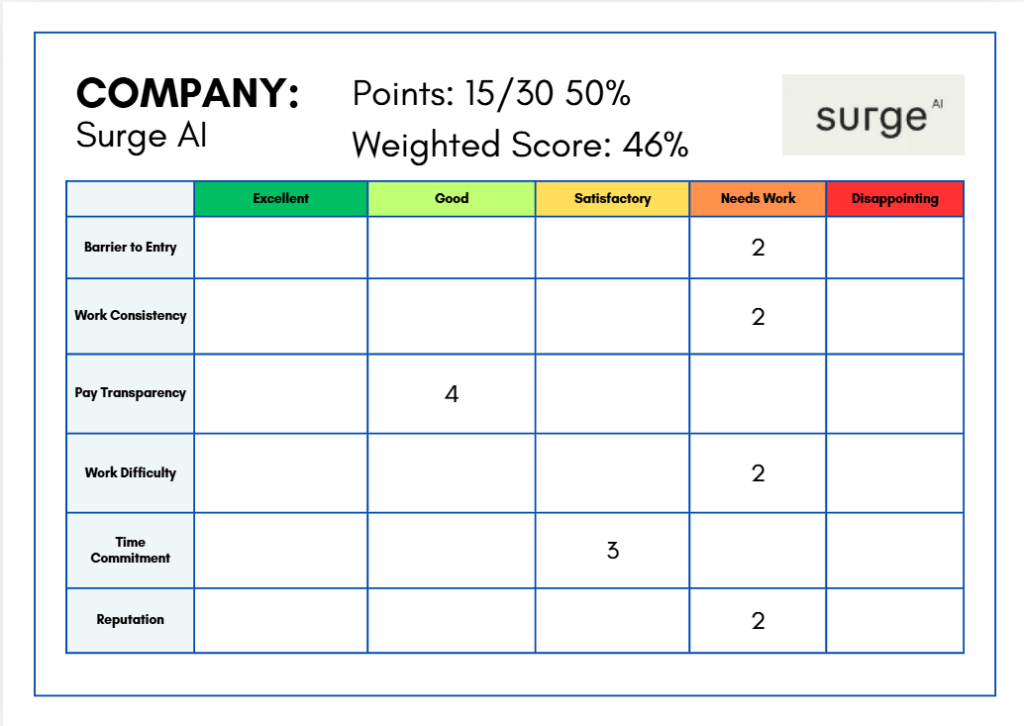
The weighted score places extra emphasis on reputation because I believe that's the most important factor when deciding whether to give a company your personal information and invest time applying.
My Final Verdict
After researching Surge AI from multiple angles, I came away with mixed feelings.
I don't question whether the company is legitimate.
I think it clearly is.
The bigger issue is whether it's the right platform for the average person looking for AI training work.
For most people, I don't think it is.
The biggest obstacle is simply getting accepted.
Nearly every opportunity I found required advanced education, extensive professional experience, published work, or highly specialized credentials. Unless you already have an impressive résumé in your field, your chances of qualifying appear fairly low.
Even if you do qualify, project availability still seems unpredictable.
The platform doesn't provide much information about expected hours, project duration, or long-term consistency, and user experiences suggest work can fluctuate significantly depending on demand.
That said, there is one group of people I think should seriously consider applying.
If you're already an established expert in medicine, finance, academia, journalism, law, engineering, or another highly specialized profession, Surge AI could provide an opportunity to earn exceptionally high hourly rates while contributing to some of today's most advanced AI systems.
Those opportunities simply aren't designed for everyone.
For me, Surge AI falls squarely into the category of a niche platform.
It's excellent for a small percentage of applicants.
It probably isn't worth the time for everyone else.
Who I Think Should Apply
I think Surge AI makes the most sense if you:
- Have advanced professional credentials.
- Hold a master's degree, doctorate, or similar qualifications.
- Have years of experience in a specialized field.
- Want occasional freelance consulting work.
- Are comfortable with inconsistent project availability.
Who Should Probably Look Elsewhere
I don't think Surge AI is a great fit if you:
- Are looking for your first AI training job.
- Need dependable weekly income.
- Don't have specialized professional experience.
- Want quick approval and immediate work.
- Prefer lower barriers to entry.
Frequently Asked Questions
Is Surge AI legit?
Yes.
Based on everything I researched, Surge AI is a legitimate AI data company. It has identifiable leadership, real business operations, and appears to work with established AI companies.
Is Surge AI a scam?
I don't believe so.
There are certainly worker complaints and some concerning reports about onboarding and communication, but I didn't find evidence suggesting the company itself is fraudulent.
How much does Surge AI pay?
Pay varies dramatically depending on the project.
Many expert-level positions advertise hourly ranges that can reach several hundred dollars per hour, although those opportunities are reserved for highly qualified professionals.
Does Surge AI pay weekly?
From what I found, contributors are generally paid every two weeks through direct deposit.
Is it difficult to get accepted?
Yes.
In my opinion, this is one of the hardest AI training platforms to get into because most openings require advanced credentials or extensive professional experience.
Can Surge AI replace a full-time job?
I wouldn't count on it.
Project availability appears inconsistent, and there isn't enough transparency about long-term work volume for me to recommend relying on it as your primary source of income.
Similar Platforms to Consider
If Surge AI doesn't seem like the right fit, there are several other AI training platforms worth exploring.
DataAnnotation.tech
This is still one of my favorite options for general AI training work.
The barrier to entry is significantly lower than Surge AI, and many people report receiving work without needing advanced professional credentials. While availability can still fluctuate, it's a much more realistic starting point for beginners.
Outlier AI
Outlier focuses on both generalist and specialist work.
If you have expertise in subjects like mathematics, programming, science, or writing, it can offer higher-paying projects than many competitors. Just be prepared for assessments and occasional periods without work.
Invisible Technologies (Meridial)
Invisible Technologies operates through its Meridial platform, connecting freelancers with AI training projects for enterprise clients.
Like Surge AI, work depends on project demand, but the barrier to entry is generally lower for many roles.
Alignerr
Alignerr is another platform that recruits subject matter experts across a wide range of disciplines.
If you have professional expertise but don't qualify for Surge AI's extremely selective openings, Alignerr may be worth considering.
TELUS Digital AI
TELUS Digital AI offers search evaluation, AI rating, language evaluation, and model improvement projects.
The work is usually less specialized than Surge AI, making it a better option for people without elite professional credentials.
Bottom Line
Surge AI is one of the most selective AI training platforms I've reviewed.
Its biggest strength is obvious. If you have elite credentials and qualify for one of its expert-level projects, the earning potential can be exceptional.
Its biggest weakness is equally obvious.
Most people will never qualify.
For that reason, I think Surge AI is best viewed as a niche opportunity rather than a general AI side hustle.
If you're an experienced professional who wants to contribute your expertise to cutting-edge AI development, it's absolutely worth exploring.
If you're simply looking for flexible online work, I think there are several other AI training platforms that offer a much better chance of getting started.