
Last Updated on June 9, 2026 by Justin Bryant
A lot of people are looking for flexible AI training jobs right now, and Telus Digital keeps coming up in that conversation. The company has been around for a long time, and unlike many newer AI gig platforms, it has an actual corporate history behind it.
The bigger question is whether these jobs are actually worth your time.
After reviewing the company's listings, user experiences, and the structure of the work itself, Telus Digital sits somewhere in the middle of the AI training industry. It is legitimate and easier to access than many competitors, but it still carries the same problems that affect most freelance AI platforms.

What Telus Digital Actually Is
Telus Digital is a large technology and outsourcing company focused on customer support, digital operations, and AI-related services. The company previously operated under the name Telus International before rebranding, and its parent company has existed for over a century. That history gives it more credibility than most smaller AI training startups right out of the gate.
One of the most popular categories within the company is called the AI Community, which is where they hire freelance workers for AI-related tasks. There are currently around 66 AI Community roles available across multiple countries, and most are remote and part-time.
What Kind of AI Work Will You Do?
The work here differs from more advanced AI training platforms that require specialized expertise or graduate-level education. Most Telus Digital AI jobs are closer to evaluation and feedback work. That includes things like:
- Rating ads or search results
- Reviewing AI-generated outputs
- Evaluating map or location data
- Checking content quality
- Providing feedback on online systems
- Helping improve recommendation systems
One role called Personalized Ads Evaluator asks workers to review and assess the relevance of online advertising. Another focuses on digital maps and online data analysis. In most cases, you are helping improve algorithms indirectly rather than deeply training AI models yourself.
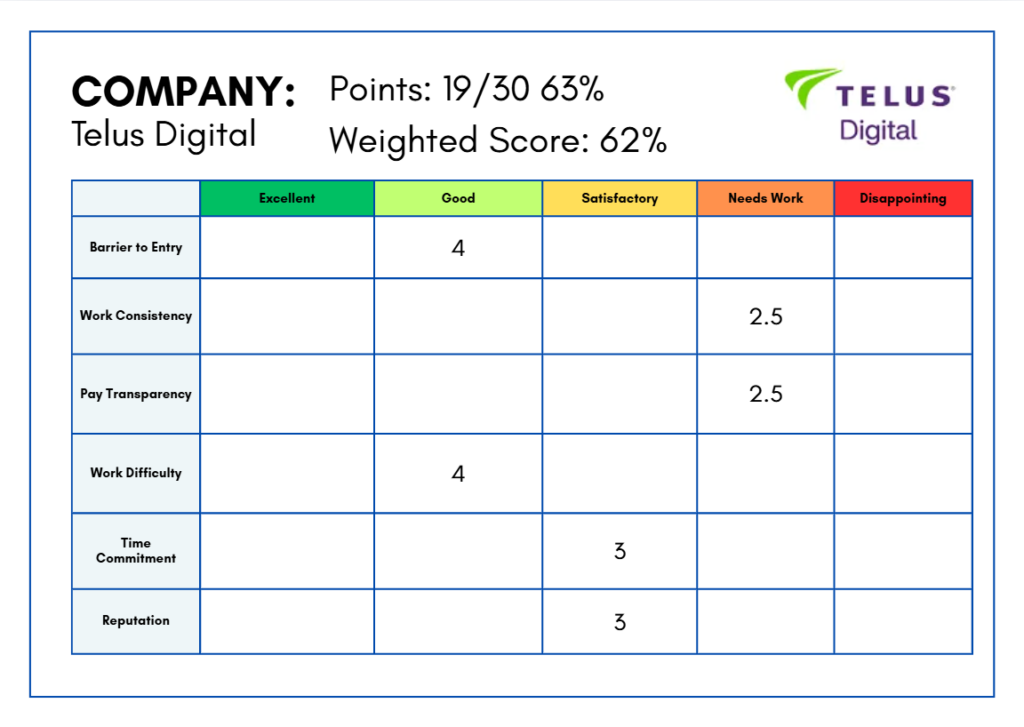
Barrier to Entry
This is one of the more appealing aspects of Telus Digital. Most roles do not require a college degree, professional experience, technical expertise, or a formal interview. Instead, applicants typically need to pass an assessment exam, which is usually open-book, meaning you are given materials to study throughout the process.
Compared to platforms that heavily favor specialists in coding, finance, law, or science, Telus Digital is far more accessible to entry-level applicants.
That said, acceptance is not guaranteed. The application process can take time, and the exams can be tedious. Some workers mention study materials exceeding 100 pages. Overall difficulty still appears lower than most competing platforms.
Work Availability
This is where things become less predictable. Telus Digital labels most of these roles as part-time freelance work, but there is rarely much clarity about guaranteed hours. Most reports suggest workers receive around 10 to 20 hours per week, with flexible scheduling and ongoing projects rather than short fixed contracts.
Workload can fluctuate significantly. Some workers report steady hours for long stretches, while others mention periods with little to no work available. There also appears to be an informal ceiling of around 20 hours per week on many projects, with some workers reporting that accounts were temporarily restricted after exceeding that without prior approval.
The main upside is flexibility. Most tasks can be completed on your own schedule, including late at night or early in the morning, which makes it easier to fit around another job or school. Even so, this is not something to treat as a reliable primary income source.
Pay and Payment Experience
Pay transparency varies quite a bit across listings. Some show hourly ranges upfront, while others barely mention compensation. Based on available information and user reports, most workers fall somewhere around:
- $11 to $20 per hour in the United States
- Lower rates internationally, depending on location
- Higher rates are occasionally available for specialized projects
The lower pay compared to some competitors reflects the lower barrier to entry. Platforms that require advanced expertise tend to pay more.
One issue that comes up repeatedly is payment timing. Workers often report that payments arrive the following month rather than shortly after work is completed. That schedule appears to be standard for the platform, though some people still report delays or slow processing.
Payment methods include PayPal, Payoneer, and Hyperwallet. Most complaints point to slow communication or delayed payments rather than outright nonpayment.
How Difficult Is the Work?
The tasks themselves are not overly difficult. Most projects involve structured feedback and following detailed guidelines. The harder parts tend to be passing the initial assessments, absorbing lengthy instructions, maintaining quality standards, and staying consistent with formatting requirements.
So while the work is generally straightforward, it can become repetitive and mentally tiring over time. You are not doing highly technical work, but you may spend long periods reviewing similar content under strict rules. That is probably the biggest tradeoff to be aware of.
Company Reputation
Overall reputation is mixed but fairly average for this industry. On platforms like Glassdoor and Indeed, Telus Digital tends to land around the mid 3-out-of-5 range.
The most common positives people mention are flexibility, remote work, and an easier entry process compared to competitors. The most common complaints center on slow onboarding, unclear communication, inconsistent workload, delayed payments, and low pay in certain countries.
What separates Telus Digital from newer AI training companies is its history and corporate structure. This is not an anonymous startup that appeared overnight. The company has a long operating history, large-scale infrastructure, and public corporate records going back many years. That does not make it an exceptional option, but it does reduce some of the risk that comes with lesser-known platforms in this space.
Who This Is Best For
Telus Digital makes the most sense as a source of side income for students, people who want flexible remote work, beginners trying to enter AI-related work, and workers without advanced credentials.
It is probably not the right fit for anyone seeking full-time income replacement, guaranteed hours, premium pay, or work that does not involve a fair amount of repetition.
Compared to many AI training platforms, this one is more accessible but less specialized. That can be a good or bad thing depending on what you are trying to get out of it.
Final Verdict
Telus Digital is a legitimate, fairly average AI training and evaluation platform. Its biggest strength is accessibility. Many AI companies now heavily prioritize specialized experts, advanced degrees, or technical backgrounds. Telus Digital still offers opportunities that regular applicants can realistically qualify for.
The downside is that lower barriers tend to come with lower pay and less stability. If you treat this as supplemental freelance income, it could be worth trying. If you expect reliable full-time work with strong pay, you will likely end up disappointed.
FAQs
Is Telus Digital legit? Yes. Telus Digital is a real company with a long business history. It previously operated as Telus International and is connected to the larger Telus corporate group.
Do you need experience to apply? Most AI Community roles state that no professional experience is required, though applicants usually need to pass an assessment.
How much does Telus Digital pay? Pay varies widely depending on country and project type. Most US-based reports fall around $11 to $20 per hour.
Can you work whenever you want? Generally yes. Most tasks are flexible and can be completed on your own schedule.
Is the work consistent? Not always. Workload depends heavily on project demand and client needs.
Are the qualification exams hard? Most people describe them as more tedious than difficult. The exams are usually open-book, but the guidelines can be very long.
Alternatives to Telus Digital
If you are comparing AI training platforms, a few other commonly discussed options include Outlier AI, DataAnnotation, Invisible Technologies, Alignerr, and Handshake. Each comes with similar tradeoffs around flexibility, inconsistent work, and varying pay rates. The safest approach with any of them is to treat the work as supplemental income rather than something to build a career around.