
Last Updated on July 28, 2026 by Justin Bryant
Artificial intelligence has created an enormous demand for human workers who can help train machine learning models. Behind every chatbot, image generator, and recommendation algorithm are thousands of people labeling images, reviewing text, evaluating AI responses, and completing other tasks that help improve these systems.
That's why data labeling jobs have become one of the fastest-growing remote side hustles over the past few years.
Unfortunately, finding a good platform isn't as easy as searching “best data labeling jobs” on Google.
Many comparison articles simply list the same companies without explaining how they actually differ. Some platforms are excellent for beginners, while others are designed for experienced professionals. Some offer steady opportunities, while others may leave you waiting weeks between projects. Reputation, pay transparency, and work availability can vary dramatically.
After reviewing dozens of AI training companies and publishing in-depth reviews of each platform, I wanted to create one resource that compares the most popular data labeling companies side by side.
Rather than relying on marketing claims, I scored each company using the same evaluation system I use in all of my reviews. Every platform was evaluated across six categories:
- Barrier to Entry
- Work Consistency
- Pay Transparency
- Work Difficulty
- Time Commitment
- Reputation
Unlike many rankings, I also give additional weight to reputation.
In my experience, contributor feedback tells you far more about a company than its recruiting page ever will. A platform can promise flexible work and competitive pay, but if thousands of workers consistently report payment issues, poor communication, or disappearing projects, that matters.
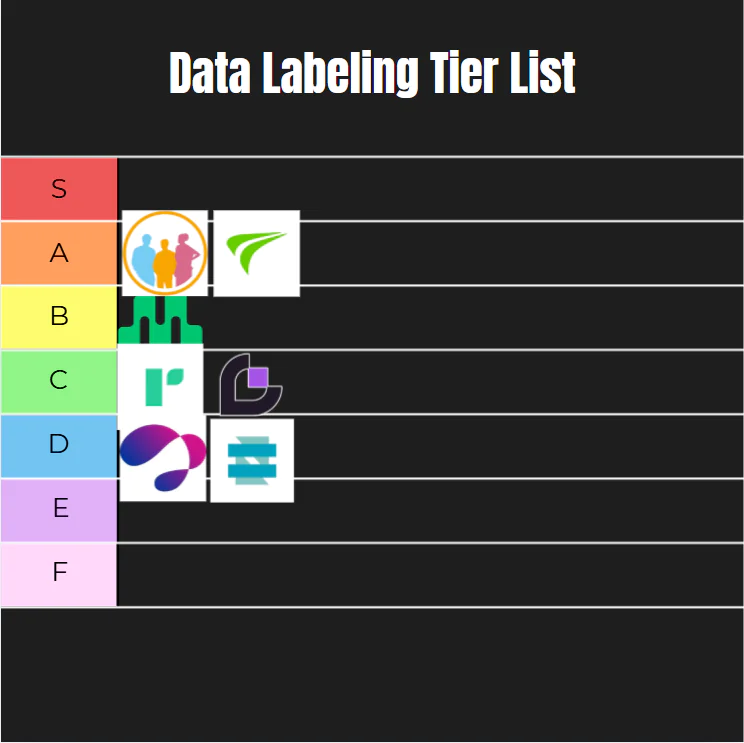
One thing you'll notice immediately is that none of these companies earned an S Tier rating.
That's intentional.
The AI training and data labeling industry is still relatively young, and every platform has trade-offs. Nearly all of them struggle with inconsistent work availability, project-based scheduling, or qualification requirements. My goal isn't to crown a perfect winner. It's to help you understand which platforms are worth your time and which ones I'd approach more cautiously.
If you're looking for a flexible remote side hustle, this guide should give you a realistic idea of what to expect.

Best Data Labeling Jobs Ranked
These rankings are based on my own standardized scoring system after reviewing each platform individually. The percentages aren't simply average review scores. They're weighted to place greater importance on long-term reputation and contributor experiences, since I believe those factors are often the best indicators of whether a platform is worth using.
What Is Data Labeling?
Data labeling is one of the simplest ways people contribute to artificial intelligence development.
When AI models are trained, they need enormous amounts of organized information. Humans provide that information by identifying objects, categorizing text, labeling images, transcribing audio, and completing similar tasks. Once enough examples have been labeled correctly, machine learning models begin recognizing patterns on their own.
It's helpful to think of AI work as three different levels.
Data Labeling
This is the easiest entry point for most people.
Typical tasks include:
- Tagging images
- Drawing bounding boxes around objects
- Categorizing products
- Labeling documents
- Identifying people, vehicles, or animals in photos
Most of these jobs require little or no previous experience, making them popular side hustles for beginners.
Data Annotation
Data annotation goes a step beyond simple labeling.
Instead of only identifying objects, you're often adding context or making judgment calls.
Examples include:
- Text annotation
- Audio annotation
- Sentiment analysis
- Content categorization
- Reviewing search results
These tasks generally require a little more attention to detail and sometimes additional training.
AI Training
AI training is the most advanced category.
Rather than simply labeling data, you're helping improve AI models by evaluating their responses, correcting mistakes, comparing outputs, or providing expert feedback.
Many AI training platforms now hire professionals with backgrounds in:
- Software development
- Mathematics
- Law
- Medicine
- Finance
- Science
- Writing
- Education
These roles often pay more than traditional data labeling jobs, but they're also much more competitive.
| Type | Difficulty | Typical Experience Needed |
|---|---|---|
| Data Labeling | Easy | None |
| Data Annotation | Moderate | Some training helpful |
| AI Training | Advanced | Often requires specialized knowledge |
Although people often use these terms interchangeably, they're not exactly the same thing. Understanding the differences will help you choose platforms that match your experience level and income goals.
How I Ranked These Platforms
One thing I dislike about many comparison articles is that they rarely explain how the rankings were created.
To make these rankings as fair and consistent as possible, I evaluated every company using the same six categories.
Barrier to Entry
How easy is it to get started?
I considered factors like application requirements, waitlists, assessments, qualification exams, and whether previous experience is required.
Work Consistency
Can you expect regular work, or are projects highly unpredictable?
This category measures how consistently contributors receive opportunities once they're accepted onto the platform.
Pay Transparency
Does the company clearly explain how much projects pay before you begin?
I generally score platforms higher when contributors know what they're earning upfront.
Work Difficulty
Some companies focus on simple image labeling while others require advanced reasoning or professional expertise.
This category evaluates how difficult the average project is to complete successfully.
Time Commitment
One of the biggest advantages of data labeling is flexibility.
Platforms that allow contributors to work on short, independent projects generally score better than those requiring ongoing weekly commitments.
Reputation
This is the category I value most.
Rather than relying solely on marketing materials, I look at contributor experiences, review websites, community discussions, and the company's overall track record.
In my scoring system, reputation receives additional weight because I believe it's one of the strongest indicators of whether a platform is worth your time.
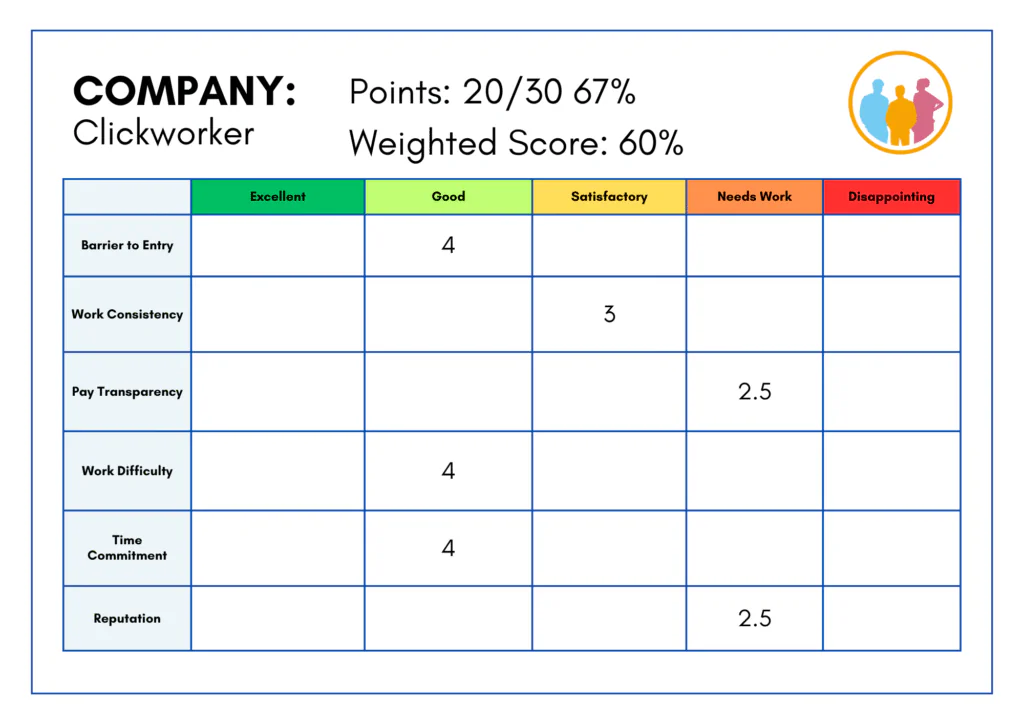
1. Clickworker
Overall Score: 67%
Tier: A
Best For: Beginners looking for flexible data labeling and microtask work
If you're completely new to data labeling, Clickworker is probably the platform I'd recommend starting with.
Unlike some AI training companies that expect specialized skills or professional experience, Clickworker focuses on smaller tasks that almost anyone can complete after creating an account. While not every project involves AI, the platform regularly offers data labeling, data annotation, image categorization, text collection, and other microtasks that contribute to training machine learning models.
One thing I like about Clickworker is the variety.
Instead of relying on a single type of project, the platform offers a mix of remote tasks that change over time. Depending on where you live and what's currently available, you might find opportunities involving image labeling, short writing assignments, internet research, product categorization, audio recordings, or AI-related annotation work.
That variety makes it easier to stay busy compared to platforms that only specialize in one type of task.
The work itself is also beginner-friendly.
Most projects don't require advanced technical knowledge, and the onboarding process is relatively straightforward. If you've never worked in AI training before, Clickworker offers one of the lowest barriers to entry among the companies on this list.
Of course, it isn't perfect.
Like nearly every data labeling platform, work availability can fluctuate. Some weeks you may have multiple projects waiting, while other weeks there may be very little available. That's simply the nature of task-based AI work.
Pay transparency is another area where I'd like to see improvement.
Some assignments clearly explain what you'll earn before you begin, while others provide much less information. I always prefer platforms that make compensation completely transparent upfront.
Still, when I compare Clickworker to most of its competitors, I think its strengths outweigh its weaknesses.
It offers a good balance of accessibility, flexibility, and overall reputation, which is why it earned the highest score in my rankings.
Pros
- One of the easiest platforms for beginners.
- Wide variety of microtasks and AI-related work.
- Flexible schedule with no fixed weekly hours.
- Lower barrier to entry than many AI training companies.
- Strong overall reputation compared to much of the industry.
Cons
- Work availability isn't always consistent.
- Some projects provide limited pay information.
- Earnings vary significantly depending on your location and available tasks.
Who Should Use Clickworker?
I think Clickworker is an excellent choice for:
- People new to data labeling.
- Students looking for flexible side income.
- Anyone wanting short, independent tasks.
- Freelancers who want another income source alongside other platforms.
If you're expecting full-time work, you'll probably be disappointed. But if your goal is to build a portfolio of reliable side-income platforms, Clickworker is one of the strongest places to begin.
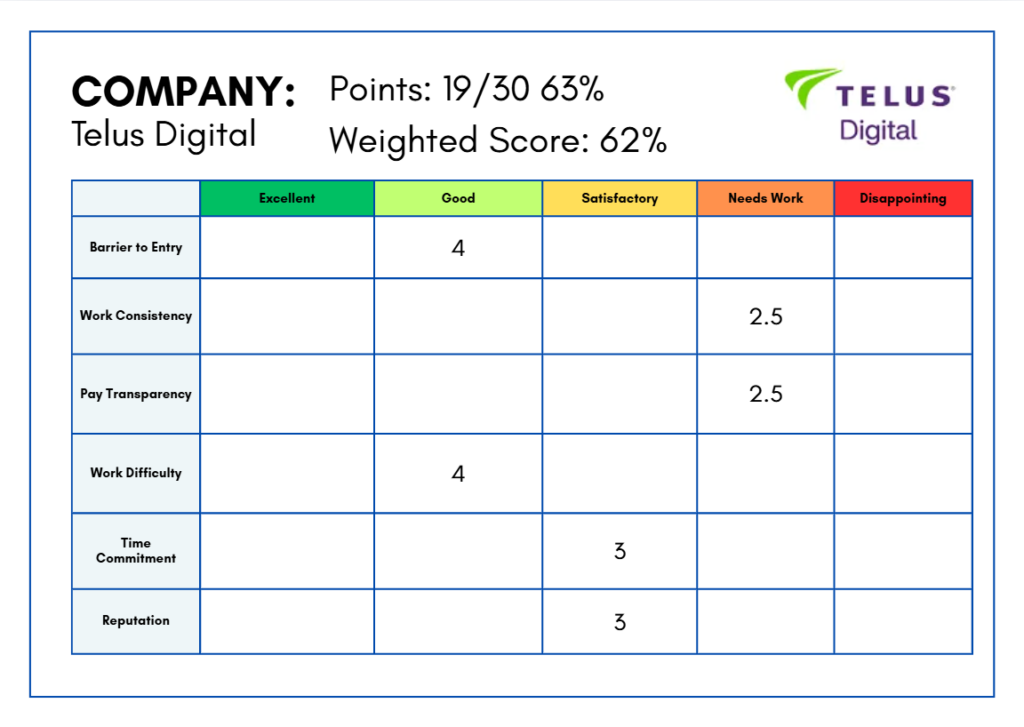
2. TELUS Digital
Overall Score: 62%
Tier: A
Best For: Contributors looking for higher-quality AI projects and established remote work opportunities
TELUS Digital earned the second highest score in my rankings because it consistently performs well across nearly every category.
While it doesn't always offer the simplest work, I think it's one of the most reputable companies in the AI training and data labeling industry.
Unlike Clickworker, which focuses heavily on microtasks, TELUS Digital offers a broader range of remote AI positions. Depending on your location, you may find opportunities such as:
- AI data annotation.
- Search quality rating.
- Online map evaluation.
- Content moderation.
- AI prompt evaluation.
- Internet safety roles.
- Data analysis projects.
Many of these positions involve helping improve search engines, recommendation systems, maps, and generative AI models rather than simply labeling images.
That variety makes the platform appealing for contributors who want to move beyond basic data labeling while still enjoying flexible remote work.
Another reason TELUS Digital ranked so highly is its reputation.
No company in this industry is perfect, but TELUS Digital has been operating for years and has built a stronger track record than many of the smaller platforms competing for AI workers today.
I also appreciate that many projects provide detailed job descriptions before you apply. Although pay transparency isn't perfect across every listing, contributors generally receive more information than they do on several lower-ranked platforms.
Where TELUS Digital loses points is in work consistency.
Like virtually every AI training platform I've reviewed, available projects depend heavily on your country, qualifications, and current client demand. Even after you're accepted, there may be periods where opportunities slow down considerably.
That's why I don't recommend relying on any single platform for steady income.
Instead, I think TELUS Digital works best as one part of a broader freelancing strategy.
Pairing it with platforms like Clickworker or Toloka can help smooth out those inevitable gaps in project availability.
Pros
- Excellent reputation within the industry.
- Wide variety of AI-related remote jobs.
- Flexible work schedule.
- Higher-quality projects than many entry-level platforms.
- Strong option for long-term contributors.
Cons
- Work availability still varies by location.
- Some positions require qualification exams.
- Pay transparency could be more consistent across all listings.
Who Should Use TELUS Digital?
I think TELUS Digital is a great fit for:
- People who already have some experience with AI or data annotation.
- Contributors looking for more advanced remote projects.
- Freelancers who want flexible work from an established company.
- Anyone building multiple income streams through AI platforms.
If you're comfortable completing qualification assessments and don't mind waiting for projects to become available, TELUS Digital is one of the strongest long-term options in this space.
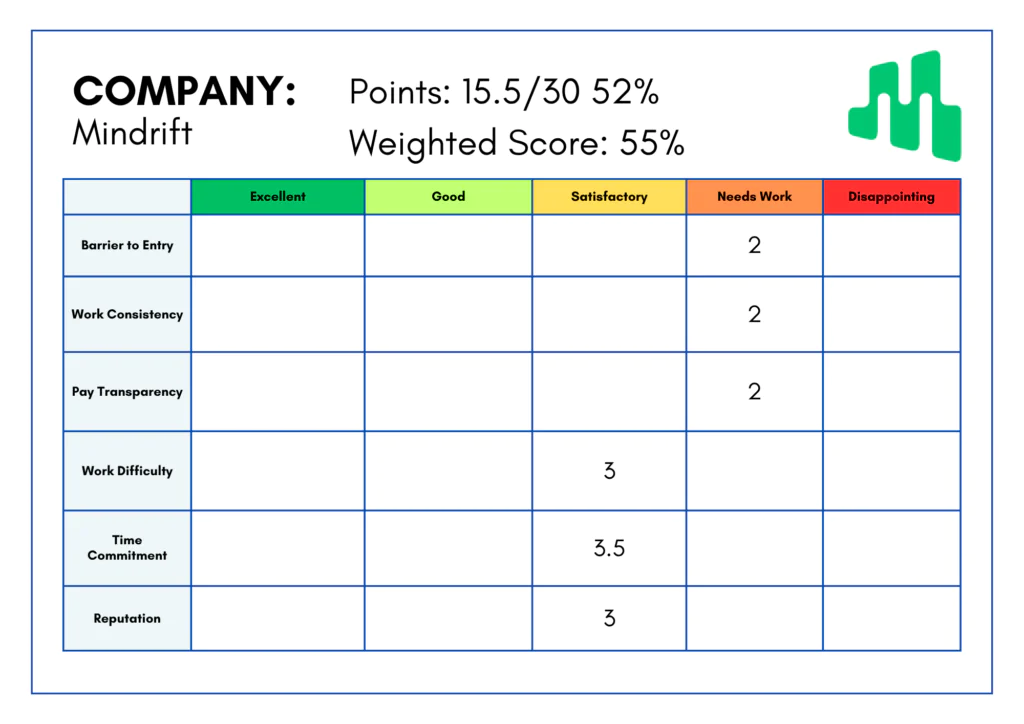
3. Mindrift
Overall Score: 55%
Tier: B
Best For: Contributors interested in AI evaluation and more advanced annotation work
Mindrift occupies an interesting position on this list because it's geared a little more toward AI training than traditional data labeling.
While you may still find annotation and labeling projects, many of the available opportunities focus on helping improve large language models by evaluating responses, reviewing outputs, or completing more detailed AI-related tasks.
That's one of the biggest differences between Mindrift and some of the beginner-focused platforms.
Rather than simply drawing boxes around images or tagging objects, you may be asked to apply more judgment when evaluating AI-generated content.
For contributors who enjoy analytical work, that's actually a positive.
The platform can provide more engaging projects than repetitive image labeling, and it offers a natural progression for people who eventually want to move into higher-paying AI training roles.
On the other hand, that additional complexity means Mindrift isn't always as beginner-friendly.
Some projects require qualification assessments, while others look for contributors with specific skills or educational backgrounds. Even if the work itself isn't extremely difficult, the application process can be more selective than what you'll find on platforms like Clickworker.
Like Toloka, Mindrift also suffers from inconsistent project availability.
I think that's worth repeating because it's probably the single biggest misconception people have about AI training jobs.
Many newcomers expect these platforms to provide a steady stream of work every day.
In reality, most AI companies operate on client demand. Projects begin, end, and pause throughout the year, which means workloads naturally fluctuate.
That doesn't make Mindrift a bad platform.
It simply means you shouldn't expect guaranteed hours.
Reputation is another area where Mindrift performs reasonably well. While it doesn't have the long history of companies like TELUS Digital, I didn't encounter the same level of concern that pushed some lower-ranked platforms into the C and D tiers.
Pros
- More advanced AI evaluation projects.
- Good opportunity to build AI experience.
- Flexible scheduling.
- Decent overall reputation.
- Potential pathway into higher-level AI work.
Cons
- More selective than beginner platforms.
- Project availability varies.
- Some roles require additional qualifications.
- Not ideal if you want immediate, consistent work.
Who Should Use Mindrift?
I'd recommend Mindrift for:
- People who already have some annotation experience.
- Contributors interested in AI evaluation.
- Anyone looking to move beyond basic image labeling.
- Freelancers building multiple AI income streams.
While I don't think Mindrift quite reaches the level of the A Tier platforms, it's still a respectable option. If you've already signed up for Clickworker and TELUS Digital, Mindrift is one of the next companies I'd consider adding to your list.
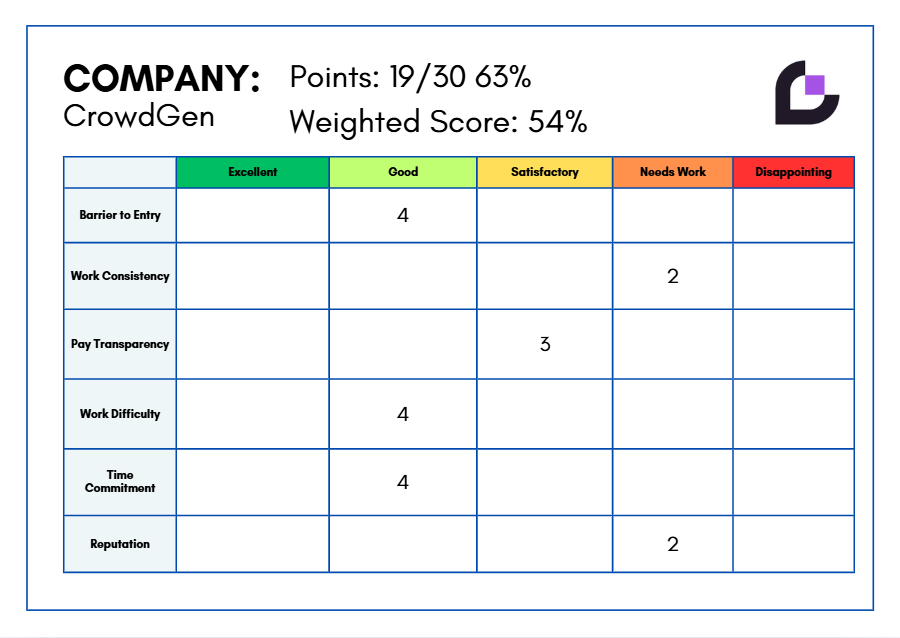
4. CrowdGen
Overall Score: 54%
Tier: C
Best For: Contributors looking for occasional annotation or data collection projects
CrowdGen is one of the more interesting platforms on this list because it's backed by Appen, a company that's been involved in AI data collection and search evaluation for many years. That connection gives it more credibility than some newer platforms, but it doesn't automatically make it one of my top recommendations.
Like many companies in this industry, CrowdGen offers a mix of projects rather than focusing exclusively on data labeling. Depending on what's available when you sign in, you might see opportunities involving:
- Data collection.
- Image annotation.
- Text labeling.
- Search evaluation.
- AI-related research tasks.
One thing I noticed while reviewing CrowdGen is that project availability can vary dramatically depending on your country and language skills.
For example, there may only be a handful of projects available for users in one country, while contributors in another region have significantly more options. That's fairly common across AI training platforms, but it's something worth keeping in mind before you create an account.
On the positive side, most projects aren't particularly difficult.
Many assignments are short, task-based jobs that don't require a major weekly commitment. If you're simply looking for occasional side income, CrowdGen can certainly serve that purpose.
Unfortunately, work consistency continues to be one of its biggest weaknesses.
Some contributors report having multiple opportunities available, while others may go long periods without qualifying for new projects. Since the work depends almost entirely on client demand, there simply isn't enough predictability for me to rank it alongside the stronger platforms.
Reputation also held CrowdGen back.
I don't think it's a platform I'd avoid completely, but I also didn't find enough consistently positive contributor experiences to justify moving it into the B Tier.
Pros
- Backed by the long-established Appen ecosystem.
- Wide variety of project types.
- Beginner-friendly tasks.
- Flexible schedule.
- Many projects require only a small time commitment.
Cons
- Work availability varies significantly by location.
- Limited opportunities in some countries.
- Average reputation compared to higher-ranked competitors.
- Project flow can be unpredictable.
Who Should Use CrowdGen?
I think CrowdGen makes the most sense for:
- People expanding beyond the larger platforms.
- Freelancers building multiple income streams.
- Contributors who don't mind checking for projects periodically.
- Anyone looking for occasional rather than consistent work.
It's a legitimate platform, but I wouldn't make it one of the first accounts you create if you're just getting started.
5. Remotasks
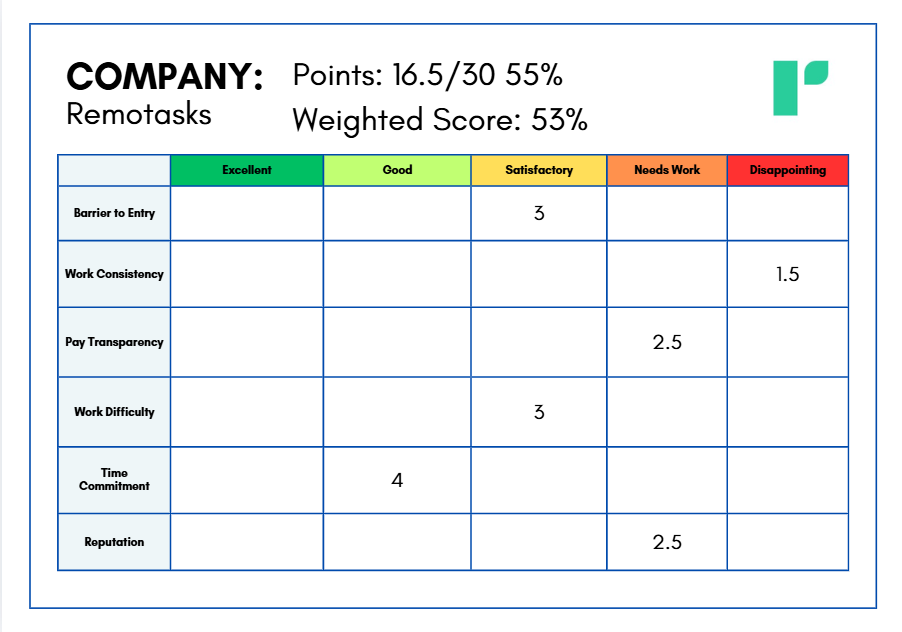
Overall Score: 53%
Tier: C
Best For: Beginners willing to accept inconsistent project availability
Remotasks has been one of the better-known names in data labeling for several years, particularly among beginners looking for an easy way to break into AI-related work.
The platform specializes in entry-level tasks such as:
- Image labeling.
- Data annotation.
- Transcription.
- Categorization.
- Other microtasks that help train AI systems.
Compared to more advanced AI training companies, the work itself is generally approachable.
Most contributors can learn the basics fairly quickly, and many projects don't require specialized education or professional experience.
Unfortunately, my biggest concern with Remotasks isn't the work itself.
It's whether you'll actually have any work to do.
During my review, I found that project availability can be extremely inconsistent. Some users report logging in and finding no available tasks at all, while others discover that certain projects simply aren't offered in their country. That's a frustrating experience, especially if you're hoping to earn money right away.
I also wasn't particularly impressed with the level of transparency before creating an account.
Some important details about available work and compensation only become visible after you sign in, and I generally prefer platforms that are more upfront about what contributors can realistically expect.
That said, Remotasks still has a few strengths.
Most assignments are relatively short, making it easy to fit them around a full-time job or school schedule. If flexibility is your top priority, the platform certainly delivers on that front.
The overall reputation, however, is fairly average.
I wouldn't describe it as a platform filled with major red flags, but I also don't think contributor experiences are consistently strong enough to rank it above the companies in the A or B tiers.
Pros
- Beginner-friendly tasks.
- Simple data labeling projects.
- Flexible schedule.
- Minimal time commitment for most assignments.
- Good introduction to AI-related work.
Cons
- Very inconsistent project availability.
- Limited opportunities in some regions.
- Pay information isn't always available upfront.
- Average overall reputation.
- Difficult to rely on for regular income.
Who Should Use Remotasks?
I think Remotasks is best suited for:
- People who want to learn basic data labeling.
- Beginners exploring AI side hustles.
- Contributors using several platforms at the same time.
- Anyone looking for occasional supplemental income.
If you're expecting steady work every week, I think there are better places to start. However, if you already have accounts with the higher-ranked companies and simply want another source of potential projects, Remotasks can still be worth adding to your rotation.
6. OneForma
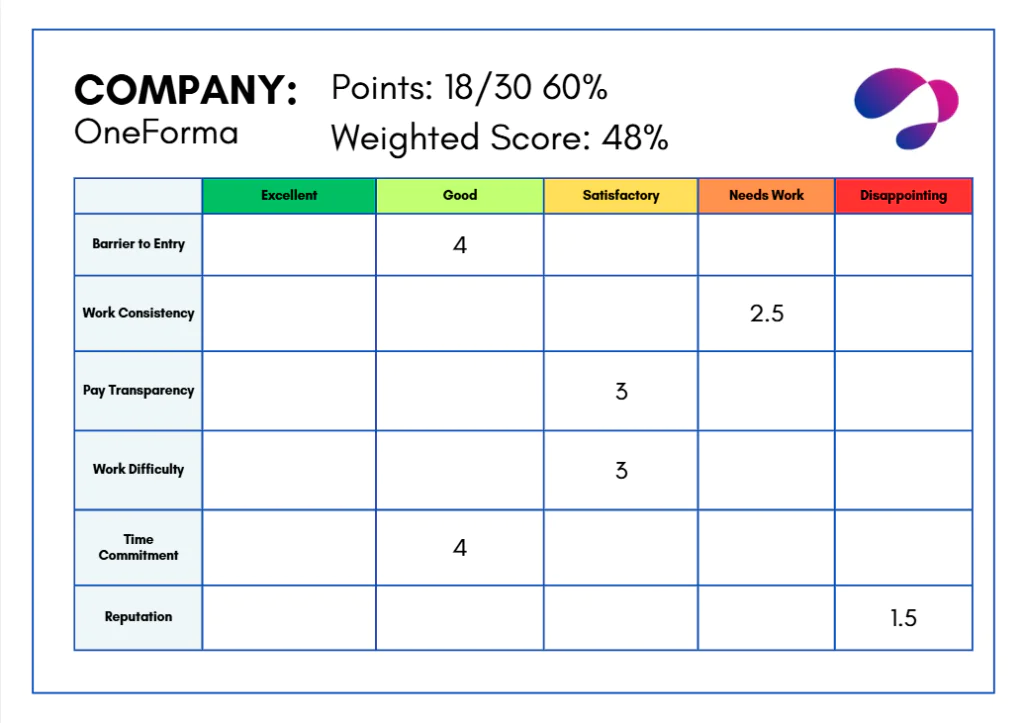
Overall Score: 48%
Tier: D
Best For: Experienced freelancers who have already exhausted better options
OneForma is probably the platform I had the hardest time ranking.
On paper, it actually looks fairly competitive.
The company offers a wide variety of AI-related opportunities, including:
- Data labeling.
- Data annotation.
- Data collection.
- Search evaluation.
- Language projects.
- AI training tasks.
For someone browsing the website for the first time, it wouldn't be unreasonable to think OneForma deserves a much higher spot on this list.
In fact, that's exactly why I changed my scoring methodology.
When I originally scored platforms by simply averaging each category, OneForma ranked much higher than I felt it deserved. The problem was that its decent scores in areas like barrier to entry and work difficulty were masking what I considered its biggest weakness: reputation.
That's ultimately why I introduced a weighted scoring system that places greater emphasis on contributor experiences.
Because at the end of the day, if a platform consistently raises concerns among contributors, I think that should matter more than how easy it is to sign up.
From a purely functional standpoint, OneForma isn't difficult to use.
Many of its projects are beginner-friendly, and most don't require a major weekly commitment. If you qualify for a project, the work itself is often straightforward and flexible.
The issue is that I found far too many recurring complaints during my research to justify placing it alongside stronger competitors.
While every AI platform receives criticism from time to time, OneForma stood out more than most.
That doesn't necessarily mean every contributor will have a bad experience.
It simply means I'd approach the platform with lower expectations, and I'd be much more comfortable recommending companies like Clickworker or TELUS Digital first.
Pros
- Large variety of AI-related projects.
- Beginner-friendly tasks.
- Flexible work schedule.
- Minimal ongoing time commitment.
- Opportunities in multiple countries.
Cons
- Reputation is one of the weakest on this list.
- Contributor experiences are inconsistent.
- Project availability varies significantly.
- Doesn't inspire the same confidence as higher-ranked platforms.
Who Should Use OneForma?
I think OneForma is best suited for:
- Experienced freelancers already using multiple AI platforms.
- Contributors who don't mind searching for occasional projects.
- People willing to accept additional risk in exchange for more opportunities.
Personally, I wouldn't recommend making OneForma your first choice.
There are simply too many stronger alternatives higher in these rankings.
7. Neevo AI
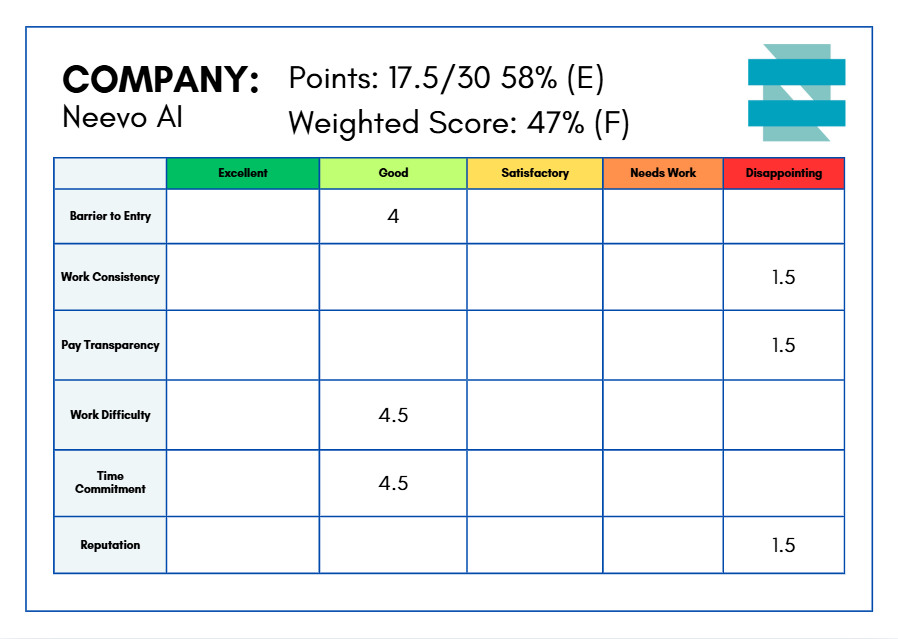
Overall Score: 47%
Tier: D
Best For: Occasional microtasks when other platforms don't have work available
Neevo AI rounds out this list with the lowest overall score.
That doesn't mean it's a scam.
It simply means I found fewer reasons to recommend it compared to the other companies reviewed here.
Like Clickworker and several of the other platforms on this list, Neevo focuses primarily on short, task-based work. Contributors may find opportunities involving:
- Image labeling.
- Text annotation.
- Audio transcription.
- Data collection.
- AI training support tasks.
Most of the assignments themselves are fairly simple.
In fact, work difficulty was actually one of Neevo's stronger categories. If you receive a project, chances are you won't need advanced technical knowledge to complete it successfully.
The biggest problem is getting enough work.
Neevo is a smaller platform than many of the companies above it, and that tends to show in project availability. Contributors frequently report long gaps between assignments, making it difficult to rely on the platform for anything beyond occasional supplemental income.
Transparency was another area that left me wanting more.
I generally prefer companies that clearly explain project details, expected earnings, and qualification requirements before contributors invest their time.
Neevo didn't perform as well in that category as several of its competitors.
Reputation also played a significant role in its final ranking.
While I didn't encounter enough evidence to dismiss the platform entirely, I also didn't find the kind of long-term contributor confidence that helped companies like Clickworker and TELUS Digital earn A Tier placements.
Pros
- Easy, beginner-friendly tasks.
- Flexible scheduling.
- Short projects.
- No major ongoing commitments.
Cons
- Limited project availability.
- Smaller platform with fewer opportunities.
- Average pay transparency.
- Lower overall reputation.
- Difficult to recommend over stronger competitors.
Who Should Use Neevo AI?
I think Neevo makes the most sense for:
- People who have already signed up for the higher-ranked platforms.
- Contributors looking for occasional extra tasks.
- Freelancers who don't mind waiting between projects.
As a primary platform, though, I think there are simply better choices available.
Best Data Labeling Platform by Category
Looking strictly at overall rankings doesn't always tell the whole story.
Some platforms excel in one area while falling short in another. If your priorities differ from mine, one of these companies may actually be a better fit for your specific goals.
One thing I hope these rankings make clear is that there isn't a perfect platform.
Every company on this list has strengths, and every company has weaknesses.
The biggest challenge isn't usually learning how to do the work.
It's finding enough consistent projects to turn these platforms into reliable income sources.
That's why I generally recommend signing up for several of the higher-ranked companies instead of relying on just one. When projects slow down on one platform, you may find opportunities available on another, giving you a much better chance of earning consistently over time.