
Last Updated on June 11, 2026 by Justin Bryant
Mindrift AI has been coming up more frequently in conversations about remote AI training work, the kind of flexible, work-from-anywhere side hustle that a lot of people are chasing right now. But a platform showing up in those conversations doesn't necessarily mean it's a good fit for you.
I dug into how Mindrift actually works: what the requirements look like, what real workers say about it, and what you can reasonably expect before you invest time applying. Here's the full picture.

What Is Mindrift AI?
Mindrift is an AI training platform owned by Toloka AI, a data services company that's been operating since 2014. The basic model is the same as most AI training marketplaces; freelancers complete tasks that help improve generative AI models, but Mindrift leans toward specialized expert roles rather than general-population gig work.
Workers typically fall into a few categories: AI tutors, reviewers, writers, and subject matter experts. Day-to-day tasks can include writing and evaluating prompts, reviewing AI-generated responses, editing or correcting AI outputs, and solving domain-specific problems in fields like biology, finance, engineering, or software development.
One example of a typical task: you're given two AI-generated answers to the same question and asked to determine which is better and why. More complex projects might involve building prompts specifically designed to stress-test a model in a technical area.
Is Mindrift Legitimate?
Yes. Nothing about Mindrift looks like a scam. It's backed by Toloka AI, a real and established company, and the platform is transparent about how its application process, project matching, and payment systems work. Workers are getting paid for completed tasks, and active projects are available.
The real questions aren't about legitimacy; they're about whether you'll qualify, whether work will be there when you need it, and whether the pay is worth your time.
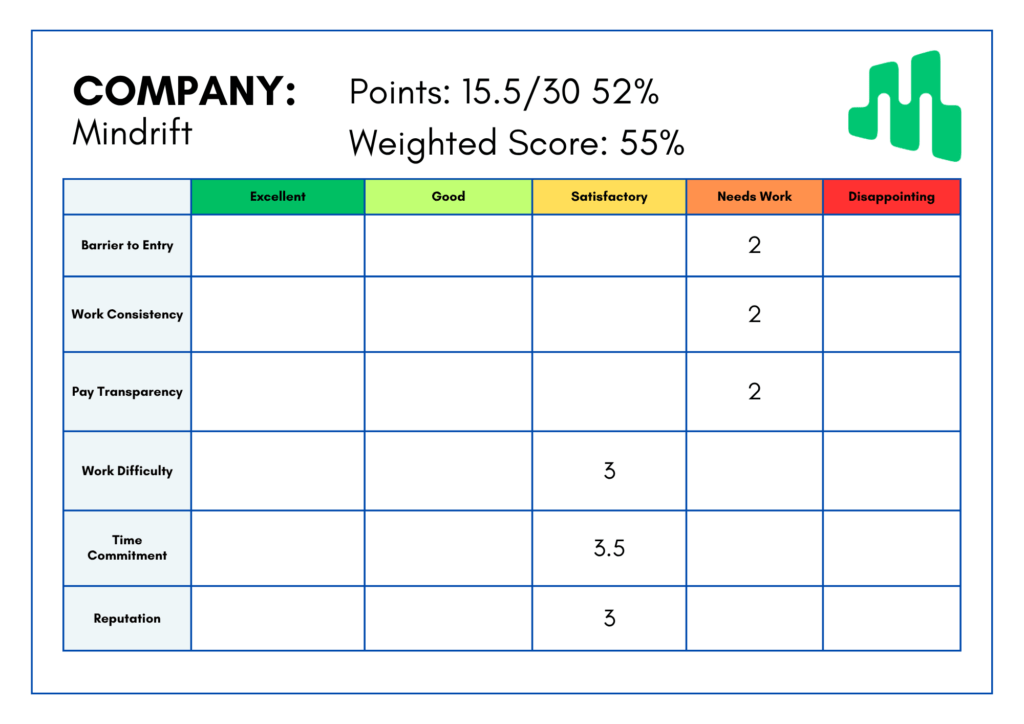
Barrier to Entry
This is where Mindrift starts to narrow the field considerably.
Unlike some AI training platforms that accept most applicants and ease them into simple tasks, Mindrift's project catalog skews toward specialized expertise. Many listings require a bachelor's or master's degree, several years of relevant experience, or both. Examples I came across included roles requiring biology expertise combined with Python skills, AI workflow engineering backgrounds, and other technical niches.
If you're a generalist looking for a low-barrier entry point into AI training work, Mindrift probably isn't your best starting place. There just aren't many beginner-friendly options visible on the platform.
The onboarding process itself is also more involved than typical gig apps. You'll need to submit a CV, complete assessments, verify your identity, and apply individually to projects you want to join. None of that is unreasonable, but it's a real-time investment before you see any return.
If you already have deep expertise in a field with active demand, coding, technical writing, or STEM research, your chances improve meaningfully.
Work Consistency
Mindrift is upfront about this: task availability fluctuates with demand across the AI industry, and there are no guaranteed hours. Workers are placed into talent pools and matched to projects based on their skills and availability.
In practice, that means some people land projects fairly quickly while others sit in limbo for weeks or longer. This isn't unique to Mindrift; it's a pattern across nearly every AI training platform right now, but it's worth internalizing before you start planning around it financially.
Treat this as supplemental income. If you go in expecting a predictable workload, you'll be disappointed.
Pay
Mindrift advertises up to $80 per hour on certain projects. That number is real, but it belongs at the top of a very wide range.
Actual pay depends on your location, the project type, your assessed skill level, and current demand. Some workers report lower training rates and tasks that take longer than expected relative to what they pay out. Others doing specialized technical work report reasonable earnings. The honest answer is that it's genuinely hard to predict without being inside an active project.
A few concrete details that are consistent: payments go out twice a month, and both PayPal and Payoneer are supported. Rates also vary by country, which is common across this category of work.
Don't assume you'll hit anywhere near the ceiling rate unless your background is highly specialized and in active demand.
Work Difficulty
Workers and platform materials describe the actual tasks as manageable if you know your subject area. You're not learning a new field on the job, you're applying existing expertise to evaluate, improve, or generate AI training data.
That said, the range is broad. Some tasks are quick and straightforward. Others involve extended problem-solving, technical accuracy checks, or nuanced judgment calls about AI output quality.
One thing worth noting: Mindrift offers a Discord community and quality assurance support, so workers aren't entirely left to figure things out alone. That's not universal in this space, and it matters for staying oriented when guidelines shift or questions come up mid-project.
Time Commitment
This is genuinely one of Mindrift's strengths. The platform runs around the clock, and there are no set schedules. Some projects may ask for a rough weekly hour commitment during active phases. 10 to 20 hours is a common range that gets mentioned, but you generally have latitude in when those hours happen.
For anyone building a side hustle around an existing job or irregular schedule, that flexibility is real and useful.
Reputation
Mindrift's public reputation is mixed but not alarming. It sits around the mid-3-out-of-5 range on Glassdoor, with a similar spread on Reddit and Trustpilot.
The positives people mention consistently: it's a legitimate company, payments arrive reliably, the work is genuinely interesting, and the schedule flexibility is real.
The complaints are also consistent: project availability is unpredictable, pay can fall short of expectations, and the assessment or onboarding process occasionally has technical issues. A few people mention limited support responsiveness.
None of that adds up to a red flag. It mostly reflects the inherent tradeoffs of project-based AI training work.
The Verdict
Mindrift AI is a real platform with real projects and real pay. But it's built for people with specific expertise, not a general audience looking for easy entry-level work.
It makes sense if you:
- Have deep experience in a technical or specialized field
- Want flexible remote work to supplement existing income
- Are comfortable with unpredictable availability and variable pay
It's probably not the right fit if you:
- Need stable, predictable income
- Are new to AI training work with no specialized background
- Can't afford to wait through dry spells between projects
If you do qualify, I'd treat Mindrift as one option in a broader mix rather than your only source of AI training income. Platforms like Outlier AI, Data Annotation, and Invisible Technologies are worth looking at alongside it; most have similar tradeoffs, and spreading across a few gives you better odds of having work available at any given time.
Frequently Asked Questions
Is Mindrift AI legitimate? Yes. It's connected to Toloka AI, an established data services company, and workers receive regular payments for completed work.
How much can you earn? Rates vary widely by project, expertise level, and location. Some specialized roles advertise up to $80/hour, but actual earnings for most workers will be lower and harder to predict.
Do you need a degree or experience? For many projects, yes. Mindrift leans toward specialized expert roles, and a significant portion of available work requires technical backgrounds or advanced degrees.
Can this replace a full-time job? For most people, no. Availability is project-based and inconsistent. It's better suited as supplemental income.
Is the schedule flexible? Yes. The platform operates 24/7 with no fixed hours, and workers generally choose when they complete tasks.
Similar Companies
If you are looking for other AI training job options like Mindrift, you might like these: