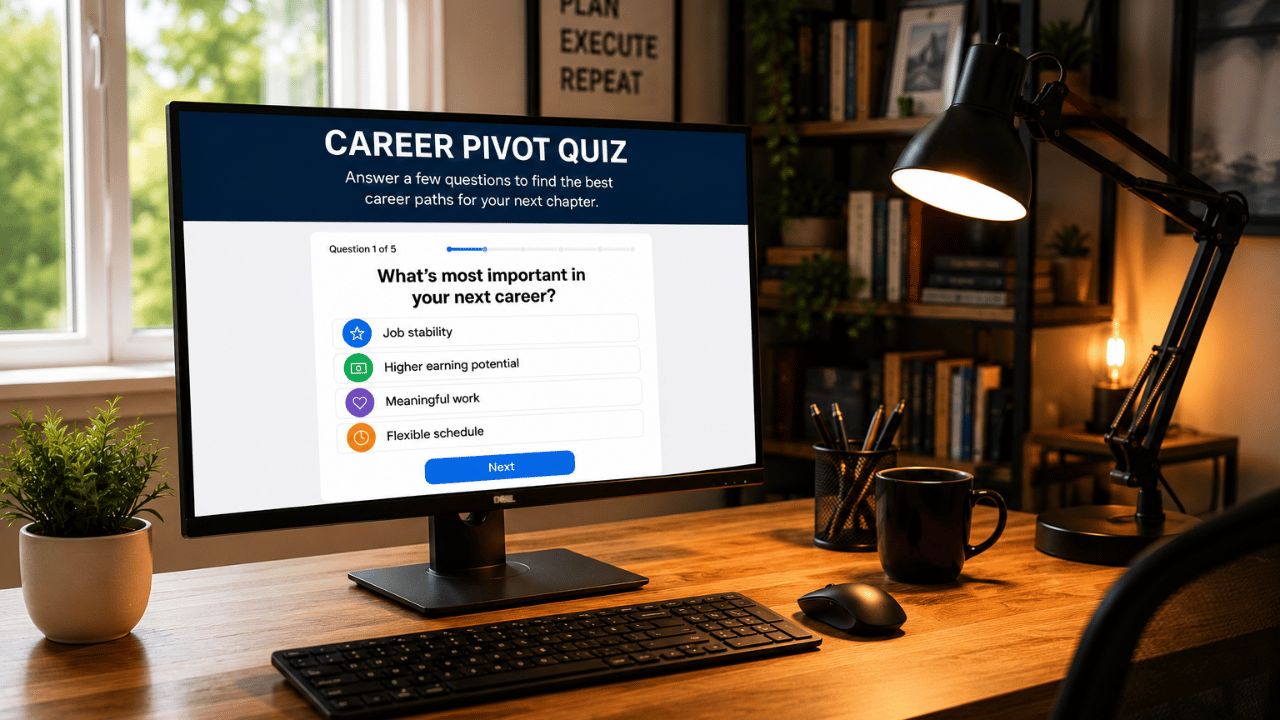
Free Career Reset Quiz
Find a Safer Career Pivot Without Going Back for a Four-Year Degree
Compare 67 realistic employee careers across remote work, healthcare, government, technology, utilities, and skilled trades.
Building your results
Separating good ideas from realistic next moves…
Comparing your work preferences.
Your Career Reset Matches
Your strongest options balance fit with the realities of starting over.
Full Comparison
Your top 12 eligible careers
How to Choose a Safer Career Pivot Without Going Back for a Four-Year Degree
Losing a job or realizing that AI may change your current career sooner than expected can make almost any alternative sound appealing.
That is also when bad career advice becomes especially dangerous.
Generic lists of the “best jobs for starting over” often rank careers as if everyone has the same priorities, abilities, financial situation, and tolerance for risk. A remote insurance job may be a practical pivot for one person and a miserable fit for someone who cannot stand phone work. A union apprenticeship may offer excellent long-term stability, but it will not help someone who physically cannot do the work. A two-year healthcare program may have a strong payoff, but it is not an immediate solution for someone who needs income next month.
That is why I created the free Career Reset Quiz.
Instead of telling everyone to pursue the same trendy career, the quiz compares 67 employee-based career paths against your actual constraints and preferences. These include remote jobs, healthcare careers, skilled trades, government and utility jobs, technical roles, finance operations, customer support, and other paths that normally do not require a four-year degree.
The goal is not to choose your career for you. It is to help you narrow a confusing list of possibilities into a few realistic options worth researching.

Why a Career Pivot Quiz Can Be More Helpful Than a “Best Jobs” List
A traditional career ranking asks one broad question:
Which jobs look best overall?
The Career Reset Quiz asks a more useful question:
Which careers make the most sense for this particular person?
Those are not the same thing.
Some careers have excellent pay but require two years of preparation. Others are easier to enter but have lower long-term earnings. Some offer remote flexibility but face more automation pressure. Others may be difficult for AI to replace but involve heat, ladders, driving, overnight shifts, or physically demanding work.
The quiz considers these tradeoffs instead of hiding them behind one universal ranking.
The Quiz Compares 67 Realistic Employee Careers
The quiz is intentionally broader than the 12 careers covered in my original “jobs for people starting over” video.
If the result pool only included the same careers featured in the video, the quiz would feel predetermined. It could tell you which of those 12 options fits best, but it could easily miss a more suitable career in a related field.
The larger library includes paths such as:
- Healthcare administration and patient support
- Insurance and financial operations
- Bookkeeping, payroll, billing, and records work
- Sales and customer success
- IT support and data-center infrastructure
- Medical technical and support careers
- Skilled trades and paid apprenticeships
- Advanced manufacturing and industrial maintenance
- Clean energy and electrical infrastructure
- Government, utilities, transportation, and public safety
These are employee careers—not businesses, side hustles, or “become an entrepreneur after getting laid off” advice.
Factor 1: How Quickly You Need Income
Someone who needs a paycheck within 30 days should receive different recommendations from someone who can spend two years preparing for a new field.
The quiz asks how soon you need to be earning income and how long you are willing to train.
This helps separate the results into practical readiness categories:
- Apply now: You may already meet many common entry requirements.
- Small skills upgrade: A short certification, software skill, or focused preparation could make you more competitive.
- Build toward: The career may fit you, but it commonly requires meaningful training, licensing, or an associate-level program.
- Apply to a paid training path: The occupation may use an apprenticeship or employer-sponsored training route.
This distinction matters because being interested in a career does not mean you are currently qualified for it.
Factor 2: Your Training Time and Budget
Career-change advice often focuses on the eventual salary while ignoring what it costs to get there.
The quiz asks:
- How much time you can realistically spend training
- How much you could afford to spend
- Whether you would consider an associate degree
- Whether you are open to certification, licensing, screening, or an apprenticeship
A career should not rank highly if its required path conflicts with the limits you marked as firm.
For example, diagnostic medical sonography may offer strong pay and demand, but it is not a quick no-training pivot. An electrician apprenticeship can provide paid training, but admission may be competitive and the apprenticeship takes years to complete. Medical billing may require less preparation, but the pay ceiling may be lower.
The point is not to declare one path superior. It is to compare the opportunity with the cost of reaching it.
Factor 3: Your Minimum Acceptable Pay
Pay is important, especially for someone recovering from a layoff.
However, salary data can be misleading when it is presented without context. A national median is not a guaranteed starting salary, and actual earnings vary by location, employer, experience, credentials, overtime, commission, and specialization.
The quiz uses typical national pay as one consideration while also accounting for:
- Entry barriers
- Job-market size
- Stability and outlook
- Advancement potential
- Whether attractive earnings depend on unusual outcomes
If a career’s typical pay falls below the minimum you selected, the result should warn you rather than quietly pretending the mismatch does not exist.
Factor 4: How Important Remote Work Is to You
Remote work is not treated as a simple yes-or-no filter.
You can indicate that remote work is:
- Required
- Strongly preferred
- Slightly preferred
- Not important
- Less desirable than working in person
This distinction prevents two common problems.
First, someone who genuinely needs to work from home should not receive a list dominated by on-site trades and healthcare careers. Second, someone who wants to leave office work should not have remote administrative jobs pushed to the top merely because remote work is popular.
The quiz also avoids labeling a career “remote-friendly” because a few rare employers occasionally offer it from home. The remote score is meant to represent credible availability across the occupation.
Factor 5: Physical Demands and Work Environment
Some people want to leave desk work behind. Others have health, mobility, caregiving, or energy limitations that make physical work unrealistic.
The quiz asks about your tolerance for:
- Standing and walking
- Lifting and physically demanding work
- Heat, noise, dirt, or weather
- Ladders, crawl spaces, or uncomfortable environments
- Safety exposure
- Local driving and travel
These factors can radically change whether a career is sustainable.
HVAC work may be practical, local, and difficult to automate, but it can involve attics, crawl spaces, heat, on-call schedules, and physically uncomfortable conditions. A field-service or fiber technician may combine technical troubleshooting with driving, ladders, weather, and customer locations. Sterile processing is indoors and healthcare-based, but it can involve standing and repetitive work.
Those are not small details. They are part of the job.
Factor 6: Schedule and Stress Tolerance
“Stable” does not always mean “comfortable.”
Public safety, healthcare, transportation, utilities, and infrastructure jobs may provide dependable demand while requiring schedules that many people would dislike.
The quiz considers whether you can accept:
- Fixed schedules
- Evenings or weekends
- Rotating shifts
- Overnight work
- On-call responsibilities
- Emergencies and constant urgency
- Conflict or emotionally difficult situations
A 911 dispatcher may not need a degree, but the job can involve rotating shifts, mandatory overtime, trauma exposure, and intense responsibility. A respiratory therapist may have strong demand and good pay, but hospital schedules and urgent clinical situations are not a fit for everyone.
Stability only helps if the day-to-day reality is sustainable for you.
Factor 7: Phone Work, Customer Contact, and Sales Pressure
Remote work is sometimes advertised as if it automatically means quiet, independent work.
In reality, many of the fastest-entry remote jobs involve:
- Constant phone calls
- Upset customers
- Strict performance monitoring
- Service metrics
- Sales quotas
- Rejection
The quiz separately asks how much customer interaction, phone work, and sales pressure you can tolerate.
This is especially important for sales development representative and business development representative roles. These jobs can offer fast entry and remote opportunities, but the quality varies enormously. Base pay, realistic quotas, training, turnover, management, and workplace culture all matter.
Someone who enjoys persuasion and handles rejection well may see sales roles rise. Someone who marks sales as a hard “no” should not receive them simply because the income potential is attractive.
Factor 8: The Kind of Work You Actually Like
Practical constraints are only part of the decision.
The quiz also asks which types of tasks feel most satisfying:
- Helping people solve problems
- Organizing records and processes
- Working with numbers and accuracy
- Learning technology and systems
- Troubleshooting and repairing
- Building, installing, or working with your hands
- Following rules and safety standards
- Persuading, negotiating, or selling
These answers contribute to your Personal Fit score.
Someone who enjoys detail, numbers, and structured processes may match with bookkeeping, payroll, medical coding, or records work. A technically curious problem-solver may prefer IT support, medical equipment repair, industrial controls, or data-center work. Someone who wants hands-on work may be more satisfied in HVAC, electrical, diesel, maintenance, or field-service roles.
Factor 9: Your Transferable Experience
Starting over does not mean starting from zero.
Experience from one industry can transfer into another even when the job titles look unrelated.
The quiz asks whether you have experience in areas such as:
- Customer service
- Administration and scheduling
- Healthcare or insurance
- Finance, billing, payroll, or spreadsheets
- Sales and account management
- IT, hardware, or networking
- Construction, maintenance, automotive work, or tools
- Manufacturing, logistics, warehouse operations, or dispatch
- Government, military, utilities, or public safety
This information helps estimate Qualification Readiness.
For example, an administrative professional may be closer to qualifying for prior authorization, medical scheduling, insurance verification, purchasing coordination, or municipal permit work than they initially realize. Someone with mechanical experience may have a better bridge into industrial maintenance, diesel service, critical facilities, or equipment repair.
Why the Quiz Shows Three Different Scores
The quiz does not hide everything inside one match percentage.
Each top result includes:
Personal Fit
How closely the work itself matches your preferred tasks and interests.
Lifestyle Fit
How well the work location, physical demands, schedule, phone requirements, stress, travel, sales pressure, and typical pay align with your preferences.
Qualification Readiness
How closely your current background matches common preparation and entry requirements.
This separation prevents a common career-quiz mistake.
You can be highly interested in a career without being ready to apply today. You can also be qualified for a job that would make you miserable.
Both are useful things to know.
Firm Requirements Are Not Averaged Away
Many recommendation systems rely on averages. That can produce ridiculous results.
Imagine someone says:
- Remote work is mandatory.
- They cannot perform physically demanding work.
- They will not return to school.
- They cannot work overnight.
An average-based quiz might still recommend a trade or clinical career because the pay and stability scores are high enough to compensate for those conflicts.
The Career Reset Quiz uses hard constraints for requirements that should not be ignored. If a career conflicts with something you marked as firm, it is removed from the normal recommendations.
If too few options remain, the honest response is to show the closest alternatives and explain the conflicts—not manufacture a perfect match.
The Quiz Uses Career Research, Not Hiring Promises
The career library uses official occupational information where a clean match exists. Some modern or employer-specific titles do not have their own federal occupation profile. In those cases, the quiz uses a broader occupational crosswalk and lowers the evidence-confidence level.
That distinction matters for titles such as:
- Data center technician
- Critical facilities technician
- Customer success specialist
- Prior authorization specialist
- Industrial controls technician
These may be legitimate career paths, but broad national data should not be presented as if it precisely measures every version of the title.
The quiz is a research and decision-support tool. It is not:
- A guarantee that you will qualify
- A prediction that you will get hired
- A substitute for checking current job postings
- A substitute for state licensing requirements
- A scientifically validated psychological assessment
How to Use Your Results
Your top result is not an instruction to immediately pay for training.
Use the results as the beginning of a more focused investigation.
For each promising career:
- Search the exact title in your city or include “remote.”
- Read at least 10 current job postings.
- Write down the requirements that appear repeatedly.
- Check whether employers offer training.
- Verify licensing through your state—not through a course seller.
- Compare starting pay with the national median.
- Look for the working conditions the job descriptions mention only briefly.
- Talk to someone currently doing the job if possible.
Do this before spending thousands of dollars on a program or certification.
A Safer Career Pivot Is Personal
There is no perfectly safe career.
Remote jobs can be automated or outsourced. Trades can be cyclical and physically demanding. Healthcare can involve licensing, difficult schedules, and emotional stress. Government jobs can be stable but slow to hire. Sales can offer fast entry but high turnover.
The better goal is not to find a career with zero risk.
It is to find a path where the risks, preparation, pay, lifestyle, and long-term opportunity make sense for your situation.
That is what the Career Reset Quiz is designed to help you do.
Frequently Asked Questions
Does the quiz only recommend remote jobs?
No. The library includes remote, hybrid, and primarily on-site careers. You decide how important remote work is to you.
Do any careers require college?
The quiz avoids careers that normally require a four-year degree. Some results may require or commonly use a certificate, license, paid apprenticeship, trade program, or associate degree.
Does a high Qualification Readiness score mean I will get hired?
No. It estimates how closely your background matches common requirements. Employer standards, competition, location, and interview performance still matter.
Are the salary figures guaranteed?
No. Pay figures are national reference points. Starting pay and local pay may be substantially different.
Does the quiz save my answers?
The current version performs its scoring in your browser and does not require an email address to see results.
What should I do if none of the results feels right?
Retake the quiz and reconsider whether any preferences were actually firm requirements. You can also use the complete comparison to research nearby options. No quiz can capture every personal circumstance or every occupation.
Take the Free Career Reset Quiz
If you are newly laid off, worried about AI changing your field, burned out in your current career, or simply looking for a more stable direction, use the quiz to narrow your options.
You will receive personalized career matches, separate fit and readiness scores, major warnings, preparation context, and practical next steps.