
Last Updated on July 16, 2026 by Justin Bryant
If you've been looking for flexible online work, there's a good chance you've come across Clickworker.
It's one of the oldest crowdsourcing platforms still operating today, and unlike many of the AI training companies I've reviewed recently, Clickworker isn't focused exclusively on artificial intelligence. Instead, it offers a wide variety of microtasks ranging from AI training and data annotation to surveys, app testing, mystery shopping, market research, and content creation.
That broader approach makes Clickworker a little different from platforms like DataAnnotation.tech, Outlier, or Invisible Technologies.
Instead of specializing in one type of work, Clickworker tries to offer a little bit of everything.
On paper, that sounds appealing.
The platform accepts contributors from many different countries, doesn't require advanced degrees for most projects, and gives people the flexibility to work whenever tasks are available.
But after spending time exploring the platform, testing my own account, reviewing contributor experiences, and comparing Clickworker with many of the other companies I've covered, I think there are both strengths and weaknesses that every potential contributor should understand before signing up.
In this review, I'll explain how Clickworker works, what kinds of jobs you'll actually find, where I think the platform performs well, where it falls short, and whether I believe it's worth your time.

What Is Clickworker?
Clickworker is a crowdsourcing platform based in Germany that connects businesses with freelance workers around the world.
Rather than hiring traditional employees, companies use Clickworker to distribute thousands of smaller tasks that can be completed by independent contractors.
These assignments are commonly referred to as microtasks because they're usually short, straightforward, and designed to be completed individually instead of as part of a long-term project.
Depending on the company's needs, contributors may help train artificial intelligence models, complete market research, test mobile applications, record audio, categorize information, answer surveys, create short videos, perform mystery shopping assignments, or collect other forms of business data.
That's one of the biggest differences between Clickworker and many of the AI training platforms I've reviewed recently.
Most AI training companies specialize in one specific type of work.
Clickworker takes a much broader approach.
If you're looking for variety, that's definitely one of the platform's biggest strengths.
What Kind of Work Can You Actually Do?
Before signing up for any platform, I always want to know what the work actually looks like.
Fortunately, Clickworker offers a fairly wide selection of task types.
While browsing both the public website and my own contributor dashboard, I found opportunities involving:
- AI training.
- Data annotation.
- Surveys.
- Market research.
- Text creation.
- Video creation.
- Language-related tasks.
- Research projects.
- App testing.
- Game testing.
- Mystery shopping.
- Data categorization.
The exact mix of work changes regularly depending on client demand, so you shouldn't expect every category to be available all the time.
Still, I think Clickworker deserves credit for offering significantly more variety than many competing platforms.
One thing I noticed almost immediately, however, is that not every project displayed in the dashboard is actually available.
Several times I clicked on assignments only to receive a message stating that there were no further jobs available for that project.
I found that frustrating.
From a contributor's perspective, it creates the impression that more work is available than you can actually complete.
I would much rather see unavailable projects removed from the dashboard instead of discovering they're already full after clicking on them.
That isn't enough to make me avoid the platform altogether, but it's something I think Clickworker could improve.
How Clickworker Works
Getting started with Clickworker is relatively straightforward.
Unlike some AI training platforms that require lengthy interviews, multiple assessments, or specialized credentials, Clickworker focuses on creating a marketplace where contributors can browse available work and decide which projects they want to complete.
In most cases, you'll create an account, complete your profile, verify your identity if required, and begin exploring the available assignments.
Some projects require additional qualifications or short assessments before you can participate.
Others are available immediately.
One thing I like is that the platform doesn't expect huge time commitments.
Most assignments are designed to be completed independently, allowing you to choose when you want to work rather than following a fixed weekly schedule.
That flexibility makes Clickworker much easier to fit around another job, college classes, or family responsibilities.
It's also one of the reasons I don't really think of Clickworker as a traditional job.
It's much closer to freelance microtasking.
You're essentially picking individual assignments whenever they're available rather than committing to ongoing employment.
For some people, that's exactly what they're looking for.
For others, especially anyone hoping to replace a full-time income, it may be disappointing.
Is Clickworker Legit?
This is probably the question I see most often.
Based on everything I researched, I believe Clickworker is a legitimate company.
The platform has been operating since 2006, giving it nearly two decades of history in the crowdsourcing industry.
It's headquartered in Germany, serves businesses around the world, and has developed a much longer track record than many of the newer AI training startups entering the market today.
I also found several things that increase my confidence in the company.
Clickworker maintains mobile applications for both Android and iPhone, has an established business history, appears on major review platforms, and has built a large international contributor community over the years.
That doesn't mean every contributor has a positive experience.
No freelance platform does.
But I didn't find evidence suggesting that Clickworker itself is a scam.
Instead, most complaints revolve around inconsistent work, relatively low pay for many tasks, and frustrations with specific projects rather than concerns about the company's legitimacy.
For me, that's an important distinction.
A legitimate platform can still have weaknesses.
The bigger question isn't whether Clickworker is real.
It's whether it's actually worth your time.
That's where my scorecard comes in.
Over the next several sections, I'll evaluate Clickworker using the same six categories I use for every platform I review:
- Barrier to Entry
- Work Consistency
- Pay Transparency
- Work Difficulty
- Time Commitment
- Reputation
Looking at each category individually provides a much more complete picture than simply asking whether the company is legitimate or not.
Barrier to Entry
The first category I evaluate in every review is barrier to entry.
In other words, how difficult is it for the average person to actually start earning money?
This is one area where Clickworker performs very well.
Unlike some AI training companies that primarily recruit software engineers, doctors, lawyers, or other subject matter experts, Clickworker is designed to be accessible to almost anyone.
You don't need an advanced degree.
You don't need years of professional experience.
And for many projects, you don't even need previous data annotation experience.
Creating an account is relatively straightforward, and once you've completed your profile and any required verification steps, you can begin exploring available projects.
That doesn't mean every task is immediately available.
Some assignments require you to complete short qualification tests before you're allowed to work on them. Others may only be offered to contributors in specific countries or to people who meet certain demographic requirements.
I actually think that's a positive.
Qualification tests help ensure that businesses receive higher-quality work, and they often unlock better-paying projects over time.
The important point is that the qualifications are generally based on your ability to complete the work, not on your résumé.
That's a major difference compared to platforms like Surge AI, where many opportunities require advanced professional credentials before you can even apply.
Another thing I appreciate is that Clickworker welcomes contributors from a large number of countries.
Some AI training companies only recruit in a handful of regions, but Clickworker has built a much more international contributor base over the years.
That makes it a realistic option for many people who don't live in the United States.
Overall, I think Clickworker deserves a strong score in this category because it removes many of the barriers that prevent beginners from getting started.
What I Like
- Very beginner-friendly.
- No advanced degree required for most projects.
- Available in many countries.
- Qualification tests are generally reasonable.
What I Don't Like
- Some projects still require additional assessments.
- Available work depends heavily on your location.
- Certain higher-paying tasks aren't available to everyone.
My Score: 4 out of 5
The only reason I didn't award a perfect score is because access to projects can vary depending on where you live and which qualifications you've completed.
Still, compared to many AI training platforms, Clickworker is one of the easiest places for beginners to get started.
Work Consistency
This is where Clickworker starts looking much more like the rest of the industry.
One thing I always tell people is that signing up for a platform doesn't guarantee you'll have work waiting for you.
That's especially true in AI training and microtasking.
Client demand changes constantly.
Some weeks there are dozens of projects.
Other weeks the dashboard can feel surprisingly empty.
While exploring Clickworker, I noticed another issue that I mentioned earlier.
Several assignments appeared in my dashboard even though they were no longer accepting contributors.
After clicking on them, I received messages explaining that no additional jobs were available.
Personally, I think that's one of the platform's biggest weaknesses.
If a project has already reached capacity, I'd rather not see it listed at all.
Showing unavailable assignments creates false expectations and forces contributors to spend unnecessary time checking projects that can't actually be completed.
Beyond that, contributor experiences appear fairly mixed.
Some people report having a steady flow of work, particularly after unlocking additional qualifications or gaining access to UHRS projects.
Others describe long periods where very little is available.
That's fairly typical for this industry.
Most platforms rely entirely on client demand, so work naturally fluctuates throughout the year.
Unfortunately, that also means Clickworker shouldn't be viewed as dependable full-time employment.
I think it's much better suited as supplemental income that you complete alongside another job, freelance work, or school.
What I Like
- Wide variety of project categories.
- New work appears regularly.
- Additional qualifications can unlock more opportunities.
What I Don't Like
- Available work changes frequently.
- Some listed projects are already full.
- Project volume depends heavily on client demand.
- Income can fluctuate significantly from month to month.
My Score: 3 out of 5
Clickworker performs about average here.
There are certainly opportunities available, but I wouldn't rely on the platform to provide consistent weekly income.
Pay Transparency
Pay transparency is something I value more and more every time I review a new platform.
Before I invest time applying for work, I want to know what I can realistically expect to earn.
Some companies do an excellent job explaining compensation upfront.
Others don't.
Clickworker falls somewhere in the middle.
One thing I noticed while exploring the available projects is that compensation is generally displayed before you accept an assignment.
That's helpful because it allows contributors to decide whether a task is worth completing.
However, the actual rates vary dramatically depending on the type of work.
Simple surveys or short categorization tasks may only pay a small amount.
More specialized projects, such as mystery shopping, language work, or certain AI-related assignments, often pay considerably more.
This creates a very different earning experience from platforms that pay a consistent hourly rate.
With Clickworker, you're essentially deciding task by task whether the compensation justifies the amount of effort involved.
Personally, I like having that choice.
If a task doesn't seem worthwhile, I simply skip it and wait for something better.
That flexibility is useful, but it also makes estimating monthly income much more difficult.
Another factor to keep in mind is that some projects appear much more profitable than others because they're designed for contributors with specialized qualifications or specific demographic profiles.
Not everyone will have access to the same earning opportunities.
Overall, I think Clickworker provides enough information for contributors to make informed decisions, even if earnings remain highly variable.
What I Like
- Pay is usually shown before accepting a task.
- Wide range of earning opportunities.
- Contributors can choose which assignments to complete.
What I Don't Like
- Compensation varies significantly between projects.
- Some low-paying tasks may not be worth the time.
- Monthly earnings are difficult to predict.
My Score: 4 out of 5
I think Clickworker performs reasonably well in this category.
While the pay itself won't always impress people, I appreciate that contributors can generally see what a project pays before deciding whether to accept it.
Work Difficulty
Compared to many of the AI training platforms I've reviewed, I think Clickworker is one of the easier platforms to work on.
That's not because every task is simple.
It's because the platform offers such a wide variety of projects.
Some assignments involve answering short surveys or categorizing information. Others may require recording audio, testing a mobile application, visiting a local business as part of a mystery shopping assignment, or helping train AI models by labeling data.
Because there are so many different project types, the overall difficulty depends almost entirely on which assignments you choose.
For example, completing a short survey might only take a few minutes and require very little effort.
A mystery shopping assignment, on the other hand, could involve traveling to a business, following detailed instructions, documenting your experience, and submitting a written report afterward.
Language-related projects can also become much more demanding because they're often looking for contributors who are fluent in multiple languages or familiar with regional dialects.
The good news is that Clickworker generally tells you what's expected before you begin.
That allows you to choose projects that match both your skills and the amount of time you're willing to invest.
Personally, I think that's one of the platform's biggest strengths.
Instead of forcing everyone into the same type of work, Clickworker gives contributors the flexibility to decide which tasks fit them best.
What I Like
- Most projects are beginner-friendly.
- Contributors can choose tasks that match their skills.
- Wide variety keeps the work from becoming repetitive.
- Instructions are generally straightforward.
What I Don't Like
- Difficulty varies significantly between projects.
- Some higher-paying assignments require additional qualifications.
- Certain projects can be much more time-consuming than they initially appear.
My Score: 4 out of 5
Overall, I think Clickworker strikes a nice balance.
The work is accessible enough for beginners while still offering more involved projects for contributors looking to earn a little more.
Time Commitment
One of the reasons Clickworker has remained popular for so many years is its flexibility.
Unlike a traditional part-time job, there isn't a manager assigning you shifts or requiring you to work a minimum number of hours every week.
Instead, you decide when you want to log in and what assignments you want to complete.
For many people, that's exactly what they're looking for.
If you only have thirty minutes before dinner, you can check the dashboard and complete a few smaller tasks.
If you have an entire Saturday afternoon available, you can spend several hours working through larger projects if they're available.
That level of flexibility is difficult to find with traditional employment.
At the same time, it's important to remember that flexibility and consistency aren't the same thing.
Just because you're free to work whenever you want doesn't mean there will always be work available.
That's the tradeoff.
Clickworker gives contributors complete control over their schedules, but client demand ultimately determines how much work you'll actually have access to.
For someone looking to earn occasional side income, I think that's perfectly reasonable.
For someone hoping to replace a full-time paycheck, it becomes much less attractive.
What I Like
- No fixed schedule.
- Work whenever projects are available.
- Easy to fit around another job or school.
- Ideal for casual freelance work.
What I Don't Like
- Flexible schedule doesn't guarantee available work.
- Some projects expire quickly after they're posted.
- Earnings depend heavily on task availability.
My Score: 5 out of 5
This is one of Clickworker's strongest categories.
Few platforms offer this level of scheduling flexibility, and I think it's one of the biggest reasons contributors continue using the platform year after year.
Reputation
If you've read my other reviews, you already know that reputation is the category I value most.
In fact, I intentionally give it more weight than the other categories when calculating my final score.
The reason is simple.
A platform can advertise excellent pay, flexible hours, and interesting projects, but if contributors consistently report payment issues, poor communication, or unreliable management, none of those advantages matter very much.
With Clickworker, I came away with fairly positive overall impressions.
I started by looking at Glassdoor.
The reviews were generally favorable, especially compared to many other crowdsourcing and AI training companies I've researched.
Most contributors appreciated the flexibility, the straightforward application process, and the ability to earn extra income without committing to fixed schedules.
Of course, there were also criticisms.
The most common complaints involved inconsistent work availability and relatively low pay for some microtasks.
Honestly, neither of those surprised me.
They're common themes across almost every platform in this industry.
I also spent time reading discussions on Reddit and other online communities.
Again, the feedback was mixed, but generally leaned positive.
Some contributors described using Clickworker successfully for years as a source of supplemental income.
Others expressed frustration about periods with little work or projects disappearing quickly after they became available.
One topic that came up repeatedly was UHRS.
Many experienced contributors mentioned that gaining access to UHRS significantly increased the amount of work available to them.
If you're unfamiliar with UHRS, it's Microsoft's Universal Human Relevance System, a separate platform that provides additional AI evaluation and search relevance projects through approved partners like Clickworker.
Historically, access to UHRS has been one of the biggest advantages of joining Clickworker.
However, it's also worth pointing out that UHRS availability changes over time.
Not every contributor receives access, and the amount of work available through UHRS has fluctuated considerably in recent years.
That's why I don't think it's wise to judge Clickworker solely on UHRS opportunities.
Instead, I prefer evaluating the platform based on everything it offers.
Overall, I think Clickworker has built a solid reputation over nearly two decades in business.
It isn't perfect.
Contributor experiences vary, and inconsistent work remains the biggest complaint.
But compared to many newer platforms, I feel much more confident recommending a company with such a long operating history.
What I Like
- Nearly twenty years in business.
- Generally positive contributor reputation.
- Legitimate international company.
- Large contributor community.
- Flexible work consistently receives positive feedback.
What I Don't Like
- Inconsistent work remains the biggest complaint.
- UHRS availability isn't guaranteed.
- Some contributors feel certain tasks pay too little for the effort required.
My Score: 4 out of 5
Overall, I think Clickworker has earned a strong reputation.
It isn't among the very best platforms I've reviewed, but its long history, worldwide contributor base, and generally favorable feedback give me more confidence than many newer competitors.
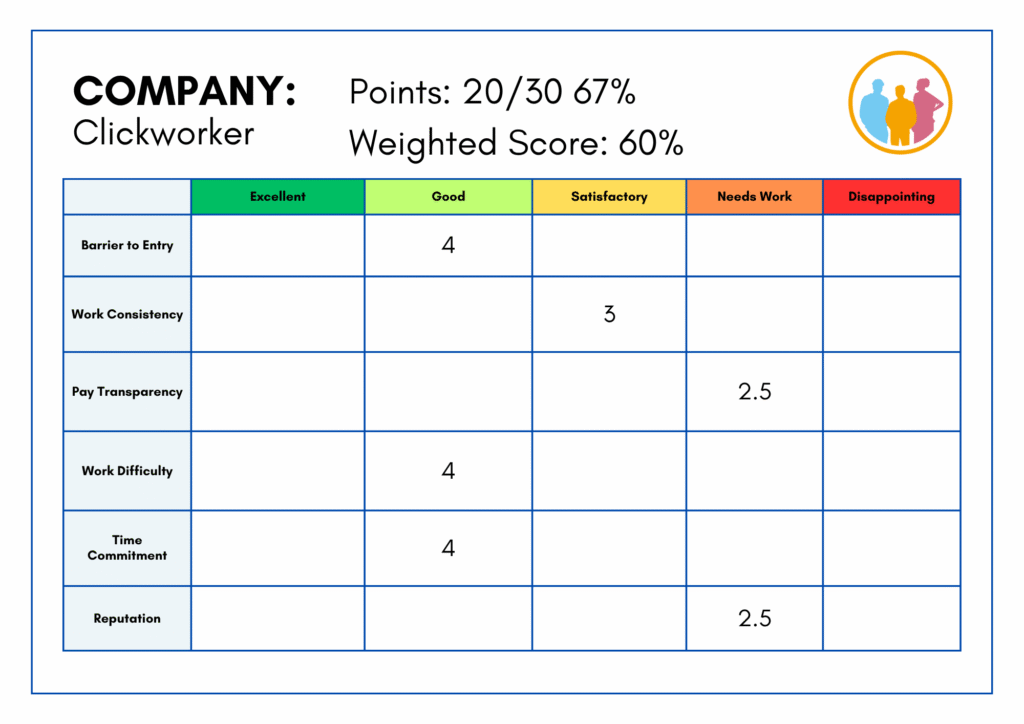
Overall Score Breakdown
Here's how Clickworker performed across each category.
Looking at the numbers as a whole, I think the score accurately reflects my overall experience with the platform.
Clickworker isn't the highest-paying platform I've reviewed, nor does it offer the most consistent work.
What it does offer is flexibility, accessibility, and a broad variety of projects that make it one of the better options for beginners looking to earn supplemental income online.
My Final Verdict
After spending time exploring Clickworker, reviewing the available work, comparing contributor experiences, and evaluating it alongside many other AI training and microtask platforms, I came away with a generally positive impression.
Is Clickworker perfect?
No.
Like almost every platform in this industry, it struggles with inconsistent work availability. There will be times when your dashboard is full of opportunities, and there will be times when very little is available. If you're expecting a dependable 40-hour-a-week job, I think you'll probably be disappointed.
But I also don't think that's what Clickworker is trying to be.
To me, Clickworker works best as a flexible marketplace for online microtasks. Instead of specializing in one type of work, it gives contributors access to a wide range of opportunities, from AI training and data annotation to surveys, app testing, mystery shopping, and market research.
That variety is one of the platform's biggest strengths.
If one type of project isn't available, another may be.
I also like how beginner-friendly the platform is.
Unlike some AI companies that primarily recruit people with advanced degrees or years of professional experience, Clickworker gives almost anyone the opportunity to get started. You won't qualify for every project immediately, but the barrier to entry is significantly lower than many competing platforms.
I also appreciate the flexibility.
You're free to work when you want, skip projects that don't interest you, and decide which assignments are worth your time. That level of control is difficult to find with traditional part-time jobs.
On the other hand, I do think Clickworker could improve in a few important areas.
The dashboard sometimes displays projects that are no longer available, which can make it feel like there's more work than there actually is. I'd also like to see more consistency in project availability and a larger number of higher-paying opportunities.
Overall, though, I think Clickworker remains one of the better entry points into online microtasking.
Would I rely on it to replace a full-time job?
No.
Would I recommend it to someone looking for flexible supplemental income?
Absolutely.
Who I Think Clickworker Is Best For
I think Clickworker is an excellent fit if you:
- Are completely new to online microtask work.
- Want flexible work you can complete whenever you have free time.
- Don't have specialized professional experience.
- Enjoy completing a variety of different task types instead of repetitive work.
- Are looking for supplemental income rather than a full-time replacement.
Who Should Probably Look Elsewhere
I don't think Clickworker is the best option if you:
- Need predictable weekly income.
- Want a traditional remote job with employee benefits.
- Prefer long-term projects instead of short tasks.
- Are looking exclusively for high-paying AI training work.
- Expect to earn a full-time salary from one platform.
Frequently Asked Questions
Is Clickworker legitimate?
Yes.
Based on everything I researched, I believe Clickworker is a legitimate crowdsourcing platform. The company has been operating since 2006, has a long history in the industry, and has paid contributors around the world for many years.
Is Clickworker a scam?
No.
I didn't find evidence suggesting Clickworker is a scam. Most complaints involve inconsistent work availability or lower-paying tasks rather than contributors not being paid.
How much can you make on Clickworker?
There's no simple answer because earnings vary significantly depending on the projects available to you.
Some tasks only pay a small amount and can be completed in a few minutes.
Others, such as mystery shopping assignments, language projects, or specialized AI tasks, may pay considerably more.
Your location, qualifications, and the amount of time you spend on the platform will all affect your earnings.
Can you make a full-time income with Clickworker?
Personally, I wouldn't plan on it.
While some contributors report earning a respectable amount during busy periods, work availability isn't consistent enough for me to recommend relying on Clickworker as your primary source of income.
I think it's much better viewed as supplemental freelance work.
Is Clickworker available worldwide?
One of Clickworker's strengths is that it accepts contributors from many different countries.
However, the projects available to you will depend heavily on where you live, your language skills, and the qualifications you've completed.
Is Clickworker good for beginners?
Yes.
In fact, I think it's one of the more beginner-friendly platforms I've reviewed.
The barrier to entry is relatively low, the work is generally easy to learn, and contributors can choose projects that match their experience level.
Similar Platforms to Consider
If Clickworker doesn't seem like the right fit, there are several other platforms worth exploring.
TELUS Digital
If you're primarily interested in AI evaluation work, TELUS Digital is one of my favorite alternatives.
It offers search evaluation, ads rating, AI response evaluation, and other projects that are generally beginner-friendly while maintaining a strong reputation.
DataAnnotation.tech
For people looking specifically for AI training work, DataAnnotation.tech remains one of the best platforms I've reviewed.
The work tends to be more intellectually challenging than Clickworker, but the platform also offers stronger earning potential for many contributors.
Toloka
Toloka is another flexible microtask platform with a low barrier to entry.
Like Clickworker, it offers a variety of AI-related tasks and allows contributors to work whenever projects are available.
Invisible Technologies
If you're looking for more structured AI operations work rather than traditional microtasks, Invisible Technologies is worth considering.
Many projects involve evaluating AI responses, improving datasets, and supporting enterprise AI systems.
CrowdGen
CrowdGen has been part of the AI data industry for many years and continues to offer a variety of freelance AI training and data collection projects.
Project availability has changed over time, but it's still one of the more recognizable names in the industry.
OneForma
OneForma offers AI training, transcription, translation, search relevance, and many other project types.
While I have some reservations about its reputation compared to higher-ranked competitors, it still provides another opportunity to diversify your freelance work.
Bottom Line
Clickworker isn't the highest-paying platform I've reviewed, and it certainly isn't the most consistent.
What it does offer is something that many competitors struggle to match.
Accessibility.
With a low barrier to entry, flexible scheduling, and a wide variety of project types, it's one of the easiest platforms for beginners to start earning money online.
At the same time, it's important to keep realistic expectations.
Some projects pay very little.
Work availability can fluctuate.
And you'll almost certainly earn more by combining Clickworker with several other freelance platforms rather than relying on it alone.
For me, Clickworker earns a strong recommendation for beginners who want flexible online work without committing to a traditional part-time job.
If you're willing to treat it as supplemental income and take advantage of the different types of projects available, I think it's a platform that's well worth exploring.