
Last Updated on June 19, 2026 by Justin Bryant
Turing has been getting more attention lately as an AI training and remote work platform. A lot of people are looking for flexible AI training jobs, data annotation work, and project-based opportunities they can do from home.
I spent some time digging through the platform, reviewing the available projects, looking at user feedback, and comparing it to many of the other AI training platforms I've covered.
After going through everything, I came away with mixed feelings.
While Turing is a legitimate company with some potentially interesting opportunities, I don't think it stands out as one of the best AI training platforms available right now.
Here's my honest take.
What Turing Actually Does
Turing is a real company founded in 2018 in San Francisco.
The company operates as an AI-powered talent marketplace that connects businesses with remote professionals. While it originally focused heavily on software engineering talent, it has expanded into AI training, data annotation, subject matter expert projects, and various other contract-based opportunities.
One thing that surprised me is that you do not necessarily need to be a software engineer to find work on the platform.
There are still plenty of highly technical projects, but there are also opportunities involving content creation, business expertise, legal review, healthcare knowledge, and other specialized fields.
The platform currently lists hundreds of projects across multiple categories, although the type of work available depends heavily on your background and qualifications.

Barrier to Entry
This is where I started seeing some challenges.
The difficulty of getting accepted depends heavily on the project category.
For example, I found a video content creator project that had relatively simple requirements:
• Comfortable speaking on camera
• Owns a smartphone or recording device
• Reliable internet connection
• Ability to follow instructions
Those requirements are fairly approachable for most people.
On the other hand, many of the projects I reviewed required extensive professional experience.
One software-related role required:
• 8 to 10 years of software development experience
• 5+ years of Atlassian experience
• Multiple technical certifications
• Knowledge of several programming languages
I also found legal projects that essentially required applicants to be practicing attorneys with multiple years of experience.
The pattern became pretty clear. Most opportunities are designed for subject matter experts rather than general freelancers.
Glassdoor interview feedback also suggests that the hiring process can be somewhat challenging. While the platform lists interview difficulty as average, user scores indicate it may actually be harder than many competing AI training platforms.
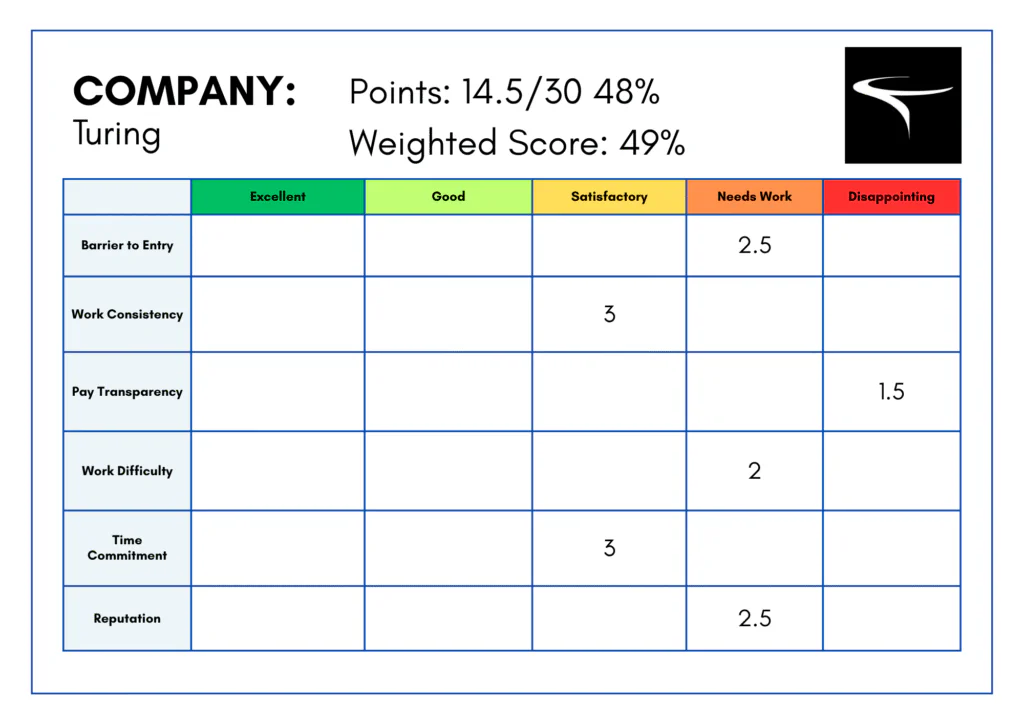
Overall, I would rate the barrier to entry as below average for beginners.
Work Consistency
Work consistency is one area where Turing performed better than I expected.
The platform currently has projects across a wide range of categories, including:
• Software Development
• Data and AI
• Machine Learning
• Science
• Finance
• Business
• Healthcare
• Legal
Some categories contain dozens of active projects.
I also noticed that many projects have longer durations than what I typically see on AI training platforms.
Some contracts run for four weeks, one month, or even longer. Several users reported maintaining long-term relationships with clients after being matched.
That's actually fairly rare compared to many AI training sites where work comes and goes unpredictably.
That said, Turing is far from perfect.
Some users still report:
• Sudden project cancellations
• Ghosting
• Communication issues
• Abrupt offboarding
Those complaints are common across the entire AI training industry, but they still exist here.
Overall, I would describe work consistency as slightly above average compared to similar platforms.
Pay Transparency
This was probably my biggest disappointment.
Many projects do not display compensation at all.
In several listings I reviewed, there was no hourly rate, no estimated range, and no indication of expected earnings.
Oddly enough, some listings were more willing to show referral bonuses than actual project pay.
I find that frustrating because pay transparency has become increasingly important. There are now so many AI training platforms competing for workers that hiding compensation puts Turing at a disadvantage.
Payment methods include:
• Payoneer
• Wise
• Direct deposit in some regions
Those are legitimate options, but they are not particularly impressive compared to competitors that offer more payment flexibility.
Turing also appears to pay monthly, which is slower than many competing platforms.
Overall, I found pay transparency to be one of the weakest aspects of the platform.
Work Difficulty
The actual difficulty of the work depends heavily on the category.
Some projects, such as video creation tasks, are relatively straightforward.
Most of the platform, however, is geared toward experts.
Many projects require specialized knowledge in fields such as:
• Software engineering
• Data science
• Law
• Finance
• Healthcare
• Business operations
In many cases, you are not simply labeling data or reviewing simple outputs.
Instead, you may be:
• Evaluating AI responses
• Applying professional frameworks
• Reviewing technical content
• Assessing industry-specific accuracy
• Providing expert feedback
Compared to many traditional data annotation platforms, I would consider Turing one of the more difficult AI training platforms to qualify for and succeed on.
Time Commitment
The time commitment is fairly average for this type of platform.
Many projects require:
• A minimum of 10 hours per week
• Commitments ranging from 10 to 30 hours weekly
• Ongoing participation over multiple weeks
I did not see many quick one-off projects that could be completed in a few minutes.
Most opportunities appear designed for people willing to commit to longer engagements.
That can be a positive if you're looking for more stable project work, but it may be less attractive if you want small, casual tasks.
Overall, I would rate the time commitment as fairly average compared to other expert focused AI training platforms.
Reputation
Reputation is usually the category I care about most.
This is where things became somewhat mixed.
Glassdoor shows an overall rating in the mid-3 range out of 5.
Indeed scores are stronger, with ratings closer to 4.7 out of 5 and high employee satisfaction scores.
However, I place less weight on Indeed because many of those reviews come from traditional employees rather than AI training contributors.
Trustpilot currently shows a rating that is much lower than the score Turing advertises on some parts of its website.
When I looked through Reddit discussions, the overall sentiment leaned more negative than positive.
Common complaints included:
• Long application processes
• Repetitive assessments
• Poor communication
• Delayed responses
• Inconsistent work availability
• Compensation concerns
There were positive comments as well.
Some contributors reported:
• Well-paying projects
• Long-term opportunities
• Flexible schedules
• Exposure to interesting technologies
The problem is that the positive feedback was often balanced out by complaints about onboarding and communication.
My overall impression is that Turing has a very average reputation.
It's not a scam.
It's not one of the worst platforms I've reviewed.
But it also doesn't seem to have a strong enough reputation to clearly separate itself from competitors.
My Final Verdict
After breaking Turing down category by category, I ended up with a score of roughly 49%.
That's below what I would consider a strong recommendation.
The biggest issues for me were:
• Poor pay transparency
• Higher than average barriers to entry
• Mixed reputation
• Lengthy application processes
The strongest areas were:
• Large project selection
• Some evidence of long-term work
• Legitimate company with real clients
If you already have expertise in a specialized field and don't mind going through a longer onboarding process, Turing may be worth exploring.
If you're looking for beginner-friendly AI training work, however, I think there are easier platforms to start with.
Overall, I came away somewhat disappointed.
At first glance, I thought Turing might rank near the top of the AI training platforms I've reviewed. After digging deeper, it ended up feeling fairly average, with a few notable weaknesses that hold it back.
FAQs
Is Turing legit?
Yes. Turing is a legitimate company founded in 2018 that connects businesses with remote professionals and AI training contributors.
Do you need experience to work on Turing?
In many cases, yes. While some projects are beginner-friendly, most opportunities favor applicants with professional expertise in a specific field.
How much does Turing pay?
Pay varies by project, but many listings do not publicly display compensation. This lack of transparency was one of my biggest concerns.
Is Turing good for beginners?
Not really. Compared to many data annotation platforms, Turing tends to focus more heavily on specialized expertise and professional experience.
Can Turing replace a full-time income?
Possibly for some contributors, but I would not count on it. Work availability varies, and project consistency depends heavily on your qualifications and client demand.
Similar Platforms to Consider
If you're looking at Turing, there are several other AI training platforms worth researching as well.
One of the most popular AI training platforms available today. Many users report simpler onboarding and more transparent pay compared to Turing.
Outlier focuses heavily on subject matter experts and AI evaluation work. Some projects offer competitive pay, although work consistency can vary.
xAI has offered longer-term contracts and more advanced AI training opportunities for qualified contributors. The barrier to entry can be higher, but some workers report stronger project consistency.
Invisible Technologies operates AI training projects through its contributor platform and often offers opportunities for both generalists and specialists.
Each platform comes with its own tradeoffs. In my opinion, Turing sits somewhere in the middle of the pack. It has legitimate opportunities, but it doesn't do enough to clearly stand above many of its competitors.