
Last Updated on June 26, 2026 by Justin Bryant
If you've been looking for AI training jobs or data annotation side hustles lately, there's a good chance you've come across Stellar AI, which operates at joinstellar.ai. It has been getting more attention recently, especially among people looking for flexible remote work that pays weekly.
After reviewing dozens of AI training platforms over the past couple of years, I've learned that first impressions rarely tell the whole story. A platform might advertise high hourly rates, flexible schedules, or easy work, but that doesn't necessarily mean you'll actually get consistent projects or even get accepted.
That's why I always break these companies down the same way. I look at six major categories that I think matter most if you're trying to make money with AI training or data annotation work. I also compare every platform against the others I've already reviewed, so you're not looking at it in a vacuum.
After researching Stellar AI, reading through user feedback, looking over available projects, and comparing it with similar platforms, I came away thinking it's a legitimate platform with some clear strengths. At the same time, there are a few weaknesses that prevent me from putting it near the very top of my list.
Here's my complete breakdown.
What Is Stellar AI?
Stellar AI is an AI training platform that connects contributors with companies developing artificial intelligence systems.
Depending on your qualifications, you may work on projects involving:
- Prompt engineering
- AI evaluation
- Coding challenges
- Documentation
- Machine learning tasks
- General AI training projects
One thing I noticed right away is that Stellar tries to serve both beginners and experienced professionals.
Some AI training companies only recruit software engineers or people with advanced degrees. Others only offer very basic data labeling work.
Stellar sits somewhere in the middle.
They have specialist projects for people with strong technical backgrounds, but they also offer generalist opportunities that don't require extensive AI experience.
I actually like this approach because it gives more people a chance to qualify.

How I Evaluate AI Training Platforms
Whenever I review one of these companies, I use the same six categories.
- Barrier to entry
- Work consistency
- Pay transparency
- Work difficulty
- Time commitment
- Reputation
At the end, I combine those scores into an overall rating.
One thing I always mention is that reputation carries the most weight for me.
I don't care how impressive the pay looks if contributors consistently report payment problems, poor communication, or misleading advertising.
Likewise, I don't automatically dismiss a company because of one bad review. Every platform has unhappy users. The key is looking for patterns instead of isolated experiences.
Barrier to Entry
This is one of Stellar's strongest categories.
On the homepage, they advertise flexible work, weekly pay, and no previous AI experience required.
Now, I always tell people to read those claims carefully.
“No AI experience required” doesn't necessarily mean “no experience required.”
Sometimes companies simply mean they'll teach you their AI systems, but they'll still expect you to have a degree or professional experience in another field.
That's partially true here.
When I looked through the available opportunities, I found a nice balance between generalist and specialist work.
For example, some engineering projects required:
- Bachelor's degree or higher
- Four or more years of experience
- Strong programming skills
- Machine learning knowledge
Those obviously aren't beginner jobs.
However, they also offer generalist positions that don't seem nearly as restrictive.
Those projects focus much more on your ability to think critically, solve problems, and follow instructions than having an advanced technical background.
I also like that Stellar provides training after matching you with projects.
That helps reduce the learning curve compared to some companies that simply throw you into complicated tasks immediately.
Requirements across the platform are fairly reasonable.
Most contributors simply need:
- To be at least 18 years old
- Reliable internet
- English fluency
- A PayPal account
Compared to many AI training companies I've reviewed, I'd consider Stellar more beginner friendly than average.
That's largely because they actually provide opportunities for both specialists and generalists instead of focusing exclusively on one group.
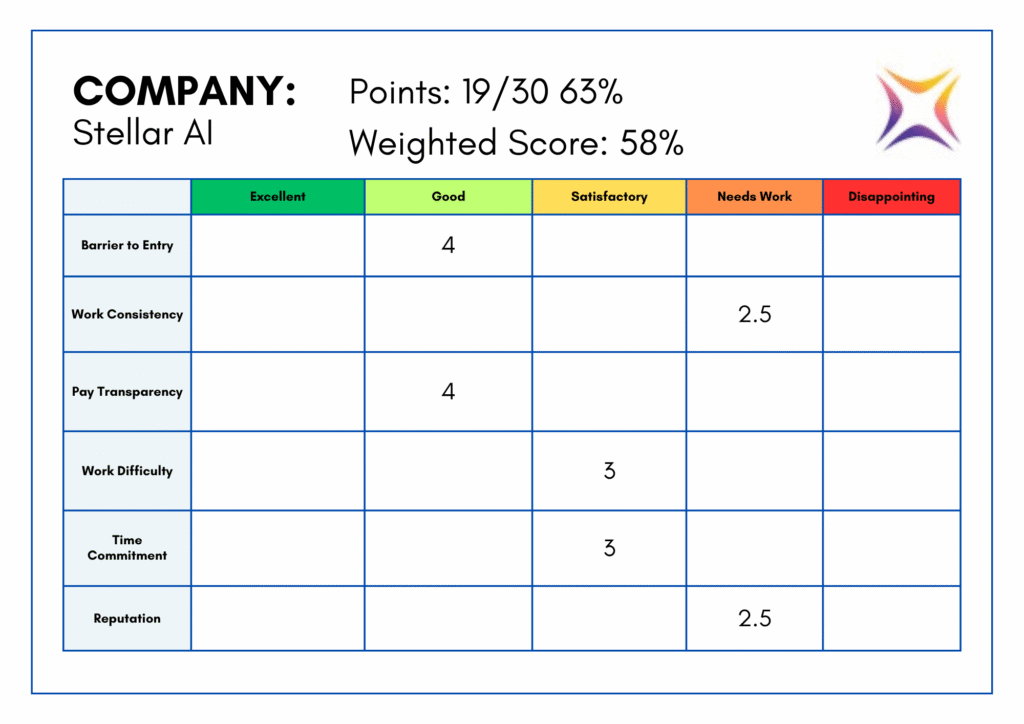
My score: 4 out of 5.
Work Consistency
This is where my opinion becomes more mixed.
If you've watched several of my reviews, you already know this is one category where almost every AI training company struggles.
These platforms depend heavily on client demand.
Projects come and go.
Companies finish contracts.
Budgets change.
That means work consistency is almost never perfect.
Stellar openly tells contributors that project volume fluctuates.
I actually appreciate that honesty because too many platforms make it sound like unlimited work is always available.
One thing I noticed is that specialist projects often list contract lengths.
Several mention six-month engagements.
That's encouraging because longer contracts usually mean more predictable income after you're accepted.
The downside is that Stellar only showed five available opportunities while I was researching the platform.
That's a pretty small number.
Compare that with larger AI training companies that sometimes have dozens or even hundreds of active listings.
A smaller project pool usually means fewer opportunities if your background doesn't match what's currently available.
Reddit discussions also reflect this.
Some contributors report steady work.
Others describe long dry spells between projects.
Honestly, that's exactly what I've come to expect from this industry.
I would never recommend quitting your full time job for an AI training platform.
Treat these as side hustles first.
If they eventually become more consistent, that's great.
If not, you're not putting yourself in a difficult financial position.
Overall, Stellar performs slightly better than average because some projects last several months, but consistency is still nowhere near guaranteed.
My score: 2.5 out of 5.
Pay Transparency
This is probably Stellar's biggest strength.
Too many AI training companies hide compensation until after you've completed assessments or interviews.
I don't like that.
Stellar is refreshingly straightforward.
The homepage clearly advertises hourly earnings.
Most project listings include either a pay range or a minimum hourly rate.
That's something I always appreciate because it helps contributors decide whether a project is worth pursuing before investing time into the application process.
The company also pays weekly.
That immediately puts them ahead of platforms that only process payments monthly.
Weekly payments make budgeting much easier.
PayPal is another positive.
Almost everyone already has a PayPal account.
Some AI companies only support Payoneer or other payment processors that many contributors don't already use.
When I researched Reddit discussions, I also found multiple contributors reporting reliable, on time payments.
That's exactly the kind of confirmation I like seeing.
No company has perfect feedback, but payment complaints appear relatively uncommon compared to many competitors.
Because of that, I think Stellar deserves one of the higher scores I've given in this category.
My score: 4 out of 5.
Work Difficulty
The difficulty really depends on which side of the platform you're working on.
If you're accepted into engineering or machine learning projects, expect considerably more challenging work.
Some examples include:
- Creating tasks for AI coding agents
- Evaluating AI-generated code
- Writing technical documentation
- Testing reasoning abilities
- Analyzing model performance
Those projects naturally require more experience.
On the generalist side, the work appears much more approachable.
The company doesn't provide extensive project details publicly, but it's clear those tasks require significantly less technical expertise.
One thing I always remind people is that difficult doesn't necessarily mean bad.
If you're already an experienced software engineer, those projects probably won't feel very difficult.
That's exactly why they pay more.
I also noticed several discussions mentioning unpaid assessments before onboarding.
Again, I don't love unpaid assessments.
Unfortunately, they're extremely common across AI training companies.
Overall, I think Stellar sits right in the middle.
It's more difficult than simple data labeling platforms but much easier than companies that exclusively recruit experts.
My score: 3 out of 5.
Time Commitment
Time commitment varies depending on the project.
Specialist roles often require around twenty hours per week.
For some people, that's completely manageable.
For others already working full time, it may be difficult.
The generalist side appears much more flexible.
That's another reason I like that Stellar offers multiple types of opportunities.
People wanting extra income without committing twenty hours every week have a realistic option.
If you're hoping for guaranteed part time work every week, specialist projects may actually appeal to you.
If you simply want flexibility, the generalist opportunities are probably a better fit.
Overall, I think Stellar lands somewhere in the middle.
It's neither unusually restrictive nor exceptionally flexible.
My score: 3 out of 5.
Reputation
Reputation is always the category I spend the most time researching.
This is also where Stellar becomes difficult to judge.
Not because I found alarming reviews.
Quite the opposite.
There simply isn't enough feedback yet.
Glassdoor shows a strong rating, but there are only a handful of reviews.
Indeed has only a few reviews as well.
Trustpilot has almost no meaningful sample size.
When you're only looking at a few reviews, it's hard to draw strong conclusions.
One thing I did notice is that Reddit feedback is generally positive.
Contributors mention:
- Reliable payments
- Good communication
- Legitimate projects
- Helpful feedback
There are also complaints.
The biggest ones include:
- Long onboarding
- Inconsistent support
- High-quality expectations
- Fluctuating project availability
Some of those criticisms don't concern me very much.
For example, fluctuating work is simply part of this industry.
I wouldn't penalize Stellar heavily for something that affects almost every AI training platform.
What I do pay attention to are patterns involving communication, payment reliability, and whether contributors feel misled.
Fortunately, I didn't see widespread complaints in those areas.
The biggest limitation here is simply the lack of data.
I wish there were hundreds of reviews across multiple platforms because I'd have much more confidence in the overall score.
Until that happens, I think a cautious middle ground is appropriate.
My score: 2.5 out of 5.
My Final Verdict
After scoring Stellar across every category, I ended up with a total score of 19 out of 30.
That works out to roughly 63% using equal weighting.
Once I give reputation extra weight, which I always do, the overall score drops slightly to about 58%.
That's actually a fairly respectable result.
Stellar isn't one of the very best AI training companies I've reviewed.
It's also nowhere near the worst.
Its biggest strengths are:
- Excellent pay transparency
- Weekly payments
- Beginner-friendly generalist opportunities
- Flexible entry requirements
- Good balance between expert and non-expert work
Its biggest weaknesses are:
- Limited project selection
- Uncertain work consistency
- A small amount of public feedback
- Long onboarding for some contributors
Overall, I think Stellar is worth considering if you're looking for an AI training side hustle.
I wouldn't depend on it as your primary income.
I also wouldn't expect constant work.
But if you qualify for one of the longer contracts, especially on the specialist side, it could become a solid source of supplemental income.
For me, Stellar lands comfortably in the middle of the AI training platforms I've reviewed.
It's a legitimate company with some genuine strengths, but it still has room to grow before I'd consider it one of the top recommendations.
Frequently Asked Questions
Is Stellar AI legitimate?
Based on everything I researched, yes. I found no convincing evidence that Stellar is a scam. Most contributor feedback points to a legitimate company that pays people for completing AI training projects.
Do you need experience?
Not necessarily. Generalist projects appear accessible to beginners, while specialist projects require professional experience or advanced education.
How often does Stellar pay?
The platform advertises weekly payments, and multiple contributors have reported being paid on time.
Is the work difficult?
That depends on the project. Generalist work looks fairly approachable, while engineering and machine learning projects are significantly more technical.
Can Stellar replace a full time income?
I wouldn't count on it. Like most AI training companies, project availability fluctuates. I think it's much better viewed as a side hustle than a dependable primary income source.
Related Platforms Worth Considering
Whenever I review one AI training platform, I think it's important to look at the alternatives too. Every company has different strengths, and depending on your experience level, one may fit you better than another.
DataAnnotation
If you're looking for one of the largest AI training platforms available today, DataAnnotation is still one of my favorite options. It offers a wide variety of writing, reasoning, coding, and AI evaluation projects. It generally has more project diversity than Stellar, although getting accepted can sometimes be more competitive.
Outlier
Outlier is another platform that focuses heavily on AI model evaluation. It has opportunities for both general contributors and subject matter experts. Pay can be excellent, but work consistency varies just like it does with Stellar.
Alignerr
If you already have professional experience in areas like law, medicine, finance, software engineering, or mathematics, Alignerr is worth a look. It focuses on expert contributors and often offers some of the higher-paying AI training projects in the industry.
Turing
Turing leans much more heavily toward experienced software engineers and technical professionals. I generally consider it harder to get into than Stellar, but qualified developers may find larger and longer lasting projects.
Babel Audio
If you'd rather record conversations, read scripts, or complete voice-based AI training instead of evaluating AI responses, Babel Audio is a completely different type of platform that's worth exploring.
Invisible Technologies
Invisible Technologies combines AI training with operational support work. It tends to offer more structured projects than many smaller AI training companies, although requirements vary by role.
TELUS Digital
TELUS Digital has been around much longer than most AI training platforms. It offers search evaluation, AI data collection, and annotation work around the world. If you're looking for an established company with a broad range of project types, it's another solid option to compare against Stellar.
Final Thoughts
After digging into Stellar AI, I think it earns a respectable place among today's AI training platforms. It does a better job than many competitors when it comes to pay transparency, weekly payments, and offering opportunities for both beginners and specialists.
The biggest question mark is simply whether you'll have consistent work after getting accepted. That's something I say about almost every AI training company because it's the nature of this industry.
If you go into Stellar expecting a flexible side hustle instead of a guaranteed paycheck, I think you'll have much more realistic expectations. And if you're comparing several AI training platforms before applying, I'd definitely keep Stellar on the shortlist rather than dismissing it outright.