
Last Updated on September 9, 2026 by Justin Bryant
Micro1 is getting a lot more attention as people search for flexible AI training jobs they can do remotely. The platform lists hundreds of open roles tied to AI evaluation, data labeling, content review, coding, customer support simulation, and other AI training work. At first glance, it looks more accessible than many competing platforms because it offers both specialist and beginner-friendly roles.
After reviewing the platform, user experiences, public company information, and the structure of the work itself, Micro1 sits somewhere in the middle of the AI training space. It has real advantages, but there are also a few things worth understanding before investing time in the onboarding process.
What Micro1 Actually Does
Micro1 is primarily an AI recruiting and talent platform. Part of its business involves helping companies train and improve AI systems using remote workers and contractors.
That work typically involves reviewing AI-generated responses, evaluating quality and accuracy, comparing outputs, labeling or annotating data, testing workflows, and providing structured human feedback that helps AI systems improve over time.
This is similar to platforms like Invisible Technologies, Outlier AI, DataAnnotation, and other AI evaluation marketplaces. One thing that stands out immediately is the volume of roles available. At the time of review, the platform showed more than 450 open opportunities across many different categories, which matters because many competing AI training platforms only maintain a handful of active projects at any given time.

Barrier to Entry
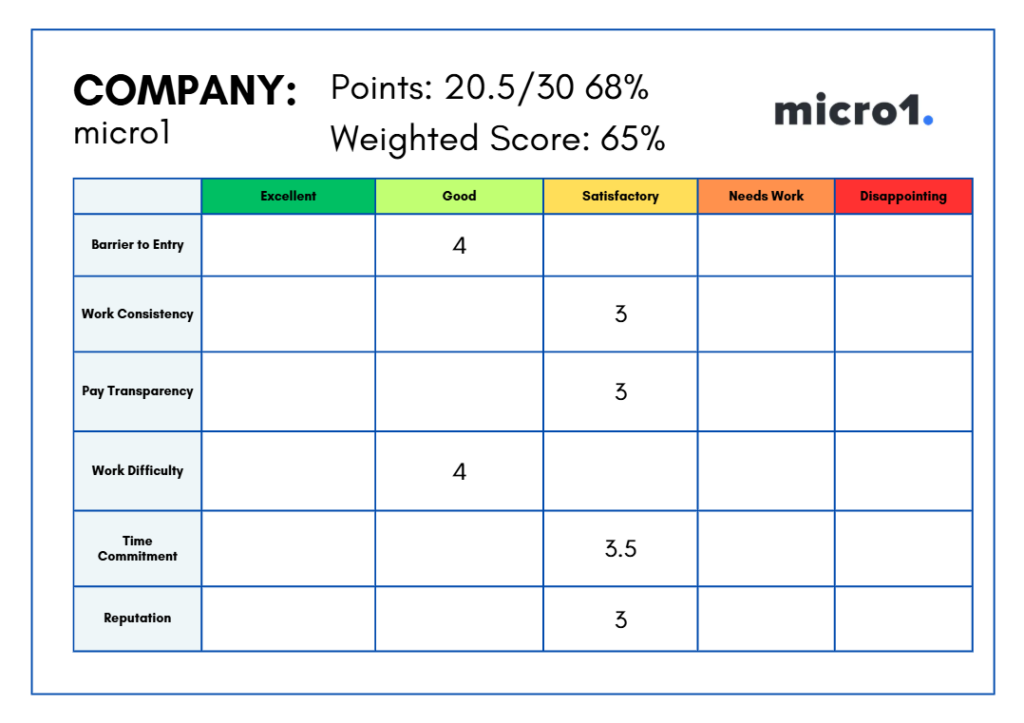
One of the better aspects of Micro1 is that the barrier to entry appears lower than average for this type of work. Many AI training platforms heavily favor people with advanced technical backgrounds, degrees, or niche expertise. Micro1 still has those specialist roles, but it also includes more accessible positions that mainly require native English fluency, reading comprehension, attention to detail, and basic communication skills.
There are also customer support-related AI training projects that do not appear to require formal degrees or prior experience, making the platform more approachable for general applicants compared to some competitors.
The onboarding process is still fairly involved. Applicants typically need to complete profile setup, upload identification details and a photo, go through AI-based interviews, complete assessments or evaluations, and wait for approval and project matching. The AI interview process may feel unusual to some applicants because it is not a traditional human interview experience.
Overall, the entry difficulty is moderate. Easier than many AI training platforms, but not effortless.
Work Availability
This is where things become less predictable.
Micro1 appears to post new projects frequently, which is a positive sign because many competing platforms go quiet quickly. The categories available are broad, covering developer projects, language projects, evaluation work, customer support simulation, subject matter expert tasks, and general AI evaluation roles.
Work consistency still seems mixed, though. Some users report receiving steady projects for months. Others say they waited long stretches between assignments. That inconsistency is common across the entire AI training industry.
Having hundreds of listings does not guarantee steady work for every person. Availability still depends on approval, skill matching, project demand in your specific category, and successful onboarding. For supplemental income, the platform may work well. For dependable full-time income, expectations should stay conservative.
Pay and Compensation
Micro1 is more transparent about pay than many competing platforms. Most listings openly display pay ranges, which commonly fall between $20 and $33 per hour for general roles, $30 to $100 per hour for more involved work, and higher rates for specialized expertise. More technical or niche work pays more. Simpler evaluation or customer support tasks tend to pay less.
Payment structures vary by project and can be hourly, per task, or contract-based. Most reports suggest workers do get paid when projects are completed properly, though some users mention delayed projects, paused contracts, and inconsistent workloads. Those complaints are not unique to Micro1 and appear across almost every AI training platform currently operating.
One useful detail is that the platform supports multiple payout methods through Deel, including bank transfer, PayPal, Payoneer, Revolut, and Coinbase. That flexibility is helpful for international workers.
Work Difficulty
The actual difficulty depends heavily on the project. Specialist projects can require degrees, technical expertise, industry knowledge, and research analysis. General AI evaluation roles are much simpler and mostly involve reviewing outputs and following guidelines.
Most beginner-level work seems manageable for people who are detail-oriented and comfortable working independently. Reviews do not frequently mention excessive stress or unrealistic productivity demands, and the platform does not appear to generate the same level of burnout complaints that some gig platforms attract.
Time Commitment and Flexibility
Flexibility is one of the stronger aspects of the platform. Most reports describe remote work, flexible scheduling, self-managed hours, and project-based workloads. Some projects mention around 15 to 20 hours per week, while others appear more task-driven than hour-driven.
This setup works best for side income, freelancers, students, and supplemental work. It may be harder to rely on for people who need guaranteed full-time schedules.
Company Reputation and Controversy
This is probably the most complicated part of evaluating Micro1.
On major review platforms, the company scores well overall, with strong Glassdoor ratings, positive Trustpilot scores, and mostly favorable contractor experiences. Many workers describe the company as legitimate and professionally managed.
There is also some skepticism online regarding AI interview processes, applicant data collection, rejection experiences, and non-traditional hiring methods. Much of the confusion appears to stem from how unusual AI-based interviewing still feels to many applicants. Some people seem to assume the process is suspicious simply because it is automated and highly scalable.
Questions have also been raised online about the company's address and legitimacy. After further review, the listed Palo Alto address appears to be tied to a legitimate office location and company registrations. That does not guarantee every user will have a positive experience, but there is no strong evidence suggesting the company itself is fraudulent. The bigger risk appears to be uncertainty and inconsistency rather than outright fraud.
Verdict
Micro1 appears to be a legitimate AI training and remote contractor platform with a larger volume of opportunities than most competitors.
The biggest strengths are the large number of open projects, more beginner-friendly roles than average, flexible remote work, decent pay transparency, and a wide variety of project categories.
The biggest downsides are inconsistent work availability, competitive onboarding, variable project quality, uncertain long-term stability, and some confusion around AI hiring processes.
Micro1 makes the most sense as a supplemental income platform rather than as a source of guaranteed earnings. For people who want flexible AI training work and are comfortable with contract-style gig work, it is worth exploring. For people who need a predictable income and long-term stability, expectations should stay cautious.
FAQs
Is Micro1 legit?
Micro1 appears to be a legitimate company with real contractor opportunities, public business information, and a large number of user reviews.
Do you need experience for Micro1?
Not always. Some roles are beginner-friendly and focus more on reading comprehension, communication, and attention to detail. Specialist roles require more expertise.
How much does Micro1 pay?
Pay varies widely depending on the project. Some roles list around $20 to $30 per hour, while specialist projects may pay significantly more.
Is the work remote?
Yes. The platform appears to operate almost entirely remotely.
Can Micro1 replace a full-time job?
Probably not reliably for most people. Work availability appears inconsistent, which is common across AI training platforms.
What kind of work do you do on Micro1?
Most tasks involve reviewing, evaluating, labeling, or improving AI-generated outputs and data.
Similar Platforms to Consider
If you are researching AI training work, a few similar platforms worth comparing include Invisible Technologies, Outlier AI, DataAnnotation, and Alignerr. Each platform carries similar tradeoffs between flexibility and consistency.