
Last Updated on June 16, 2026 by Justin Bryant
AI training jobs are popular because they seem flexible, remote, and tied to one of the biggest tech shifts happening right now.
The catch is that not every AI training platform is easy to qualify for.
Some platforms advertise strong hourly rates, but those roles often require a degree, years of experience, or deep subject knowledge. Others offer more generalist work, but the pay may be lower or the work may be less consistent.
Here is how I would rank 8 popular AI training job platforms from least difficult to most difficult to qualify for.

1. Micro1
Micro1 looks like the easiest platform to consider out of this group.
It still has many expert-level roles, including jobs that require years of experience or technical skills. But it also has more generalist options than most of the others.
Some roles, such as data video generalist work, do not seem to require much experience or a specific degree. That makes Micro1 more realistic for beginners or people who do not have a specialized background.
Best for:
People looking for beginner-friendly AI training work
Not ideal for:
People are expecting every listing to be entry-level
Difficulty rating:
A Tier
2. Invisible Technologies
Invisible Technologies runs freelance AI training work through its Meridial Expert Network.
This one is also more accessible than many of the others. It has specialist projects, but it also has AI generalist roles that state no technical background is required.
Some projects may focus on audio, language, or general AI feedback. These can be better options for people who do not have a degree in a specific field.
The downside is that easier roles may pay less and may not always be available.
Best for:
Generalists, detail-oriented workers, and people new to AI training
Not ideal for:
People who need a steady income right away
Difficulty rating:
B Tier
3. xAI
xAI is more difficult than Micro One or Invisible Technologies, but it may still be worth checking.
The company offers AI tutor roles in areas like language, finance, law, writing, and model behavior. Some language tutor roles may be easier to qualify for than advanced expert roles.
But many listings include long lists of preferred qualifications. Some subject based roles may favor people with advanced degrees, strong academic backgrounds, or competition experience.
Best for:
People with language skills or specialized knowledge
Not ideal for:
Complete beginners with no clear area of expertise
Difficulty rating:
D Tier
4. Outlier
Outlier is one of the most searched AI training platforms, but it is not always beginner-friendly.
Many of its higher-paying roles are built for experts. These may require degrees, advanced skills, or proven experience in a specific subject.
That said, Outlier appears to have added more generalist style opportunities than it used to. Some lower-paying roles focus on writing, problem-solving, attention to detail, and analytical thinking.
That makes it more accessible than some platforms, but still not easy.
Best for:
Writers, editors, problem solvers, and subject experts
Not ideal for:
People looking for a simple signup and instant work
Difficulty rating:
D Tier
5. DataAnnotation
DataAnnotation can be a good platform, but the barrier to entry is higher than many people expect.
Many advertised roles are for experts, such as mathematicians, attorneys, engineers, and researchers. There is a generalist path, but applicants usually need to pass a reasoning assessment.
The platform also appears to value either a bachelor’s degree or strong real world experience. That means it may not be the best fit for someone with no degree and limited work history.
Best for:
People with a degree, strong reasoning skills, or real world experience
Not ideal for:
Beginners without credentials or work experience
Difficulty rating:
E Tier
6. Handshake
Handshake AI has generalist listings, but many still mention a bachelor’s degree.
That makes it less beginner-friendly than platforms where generalist roles do not require a degree. The platform may be a better fit for college students, recent graduates, or people with formal education.
Best for:
College graduates and students with strong academic backgrounds
Not ideal for:
Applicants without a bachelor’s degree
Difficulty rating:
E Tier
7. Mindrift
Mindrift has both entry-level and domain expert sections, but many of its roles focus on specific subjects or professional fields.
Higher paying opportunities can mention rates like $60 or $70 per hour, but those usually come with stronger requirements. Expert roles may require a degree and at least 2 years of professional experience in the field.
For the average person looking for general AI training work, Mindrift may feel limited.
Best for:
Domain experts with education and work experience
Not ideal for:
Generalists or beginners
Difficulty rating:
E Tier
8. Mercor
Mercor looks like one of the hardest platforms to qualify for in this group.
Many roles are expert-focused and higher-paying. Some listings may require serious credentials, such as medical training, board certification, or advanced professional experience.
Even generalist opportunities may prefer a bachelor’s degree from a top-ranked university. That is a high bar compared to other platforms.
Best for:
Highly qualified experts
Not ideal for:
Average applicants, beginners, or people without a degree
Difficulty rating:
E Tier
Final Ranking
Here is the final ranking tier list for all 8 AI training platforms in terms of their barrier to entry:
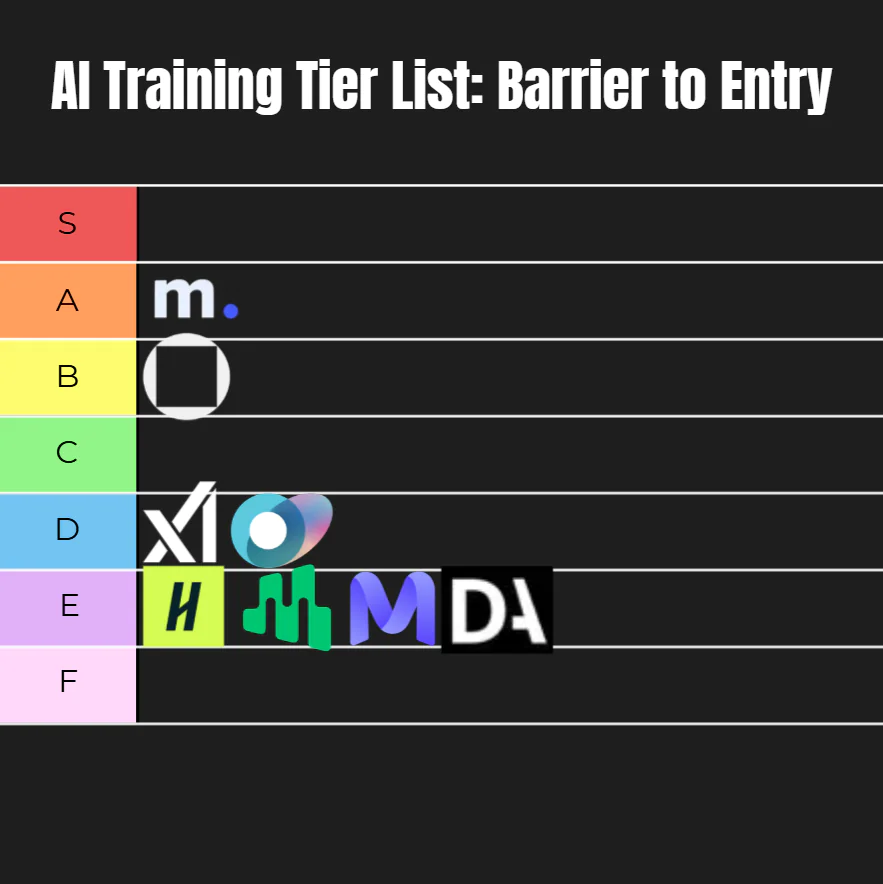
Bottom Line
If you want the easiest AI training job platforms to try first, Micro One and Invisible Technologies look like the best starting points.
If you have a degree, niche expertise, or strong professional experience, platforms like Outlier, DataAnnotation, Mindrift, Handshake AI, and Mercor may be worth considering too.
The main tradeoff is simple. Easier platforms may have lower pay or less consistent work. Harder platforms may pay more, but they usually expect stronger qualifications.