
Last Updated on September 22, 2026 by Justin Bryant
DataForce by TransPerfect offers remote projects where contributors collect, label, record, or evaluate data used to improve artificial intelligence systems. Some assignments can be completed from home with a phone, while others involve writing, annotation, user studies, or longer-term contract work.
I reviewed DataForce's current project listings, payment documentation, company background, and recent contributor feedback. The short version is that DataForce is a real platform with real paid projects, but approval and payment depend heavily on its quality-control process.
That makes DataForce a possible source of occasional side income, not something I would treat as reliable weekly work.
What DataForce by TransPerfect Actually Does
DataForce is the AI-data division of TransPerfect, a large language and technology-services company. Its contributor community completes data sourcing, data annotation, user research, and other tasks that help companies train or evaluate AI systems.
Depending on the project, contributors may be asked to:
- Record short speech samples
- Submit approved photos or videos
- Label images, audio, or text
- Evaluate audio or other AI-generated material
- Write short pieces of content
- Participate in remote or in-person user studies
DataForce says its community includes more than 1.3 million people worldwide. That is a company-provided figure, but the platform also maintains a public project board with current remote and on-site opportunities.
DataForce Review Score
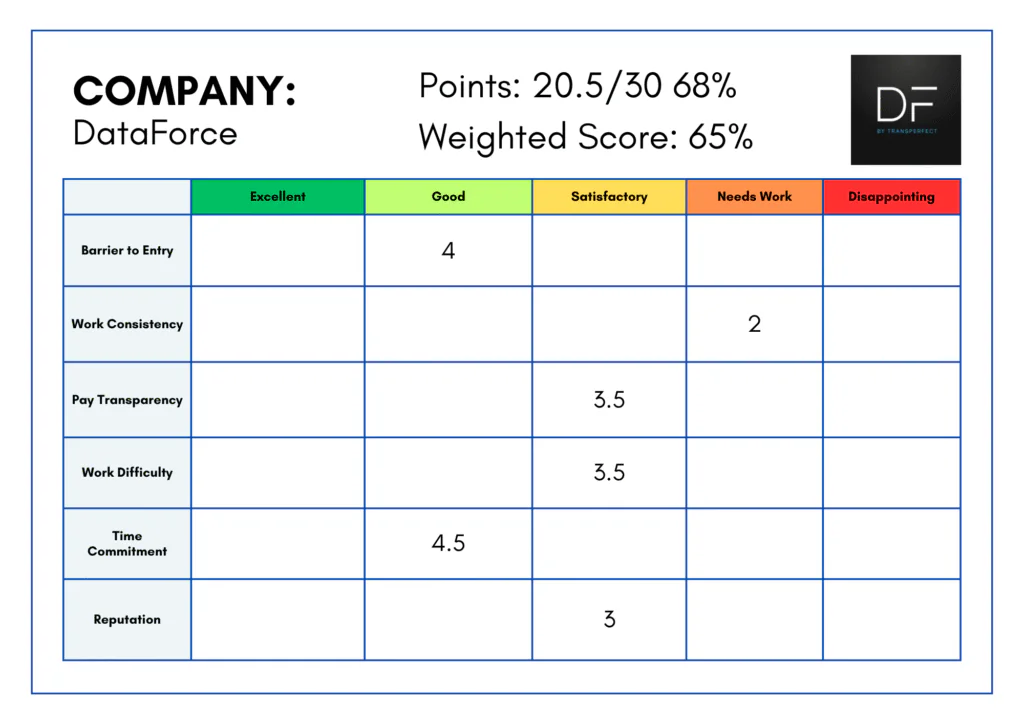
- Barrier to entry — 4/5: Many collection projects have simple requirements, although eligibility varies by country, device, language, and demographic.
- Work consistency — 2/5: Projects are temporary, location-specific, and can close after enough submissions are collected.
- Pay transparency — 3.5/5: Many project pages disclose a rate, but accepted work and quality review determine final compensation.
- Work difficulty — 3.5/5: The basic tasks are often manageable, but detailed instructions and strict quality checks create rejection risk.
- Time commitment and flexibility — 4.5/5: Many projects are remote, short, and self-directed.
- Reputation — 3/5: The company is established, but contributor feedback is sharply divided over quality decisions, communication, and payment.
Total score: 20.5 out of 30, or about 68%.
Weighted SMS score: 65% when reputation receives more weight.
Barrier to Entry
DataForce is more accessible than expert-focused AI training platforms such as Outlier, Handshake, or AfterQuery. Many collection projects do not require an advanced degree or years of professional experience.
The requirements usually depend on the data a client needs. A project may require a particular country, native language, accent, age group, smartphone, camera, or type of document. For example, one current U.S. photo project asks adults to submit RAW images, while another asks for photos or screenshots of old event tickets and membership cards.
That creates an unusual entry barrier. The work itself may be beginner-friendly, but you can be excluded because you do not match the project's exact location, device, language, or demographic requirements.
Registration appears straightforward, but registering does not guarantee access to a project. Some assignments are filled on a first-come, first-served basis, and every submission still has to meet the stated quality rules.
Barrier-to-entry score: 4 out of 5.
Work Availability and Consistency
DataForce had multiple remote projects available when I checked it on September 19, 2026. The listings included speech, photo, video, writing, and audio-evaluation assignments across the United States and several other countries.
That does not mean every registered contributor will see regular work. Most data-collection projects exist because a client needs a specific amount of data from a defined group of people. Once the target is reached, the project can close.
Availability also changes substantially by country. Someone in one market may qualify for several projects while another contributor sees very little. Even a project labeled remote may exclude certain states or require residency in one country.
DataForce also advertises short- and long-term positions, but those are closer to freelance jobs or employment opportunities than open microtasks. I would not combine their possible hours with the one-time collection projects when estimating what the average person can earn.
Work-consistency score: 2 out of 5.
Pay Transparency
DataForce's pay transparency is better on some project pages than others.
When checked in September 2026, one U.S. RAW photo project advertised $1.50 for each accepted photo, with examples showing $75 for 50 accepted photos and $150 for 100. Another remote U.S. project advertised $3.50 for each accepted image, up to $105 for 30 approved submissions.
Other listings require applicants to open the application form before seeing the compensation. DataForce's general payment FAQ says rates may be hourly, per task, or a flat amount and should be disclosed in the relevant announcement.
The most important word is accepted. Submitting a photo, recording, or other asset does not automatically mean it will be paid. The work must pass quality review first.
The payment timeline also starts after approval, not necessarily when you finish the task. DataForce says the quality-review stage can take anywhere from about two to six weeks depending on the project. After acceptance, payment timing varies by method. One current project listed approximately 7 to 10 business days for a gift card, 10 to 15 for PayPal or check, and 14 to 17 for a qualifying wire transfer.
Pay-transparency score: 3.5 out of 5.
Work Difficulty
The tasks often sound simple: record a phrase, upload a picture, evaluate a clip, or follow a short collection process. The challenge is completing that task exactly as instructed.
AI-data projects may have strict rules covering lighting, background noise, image resolution, file type, pronunciation, framing, duplicate content, or the information visible in a submission. A small mistake can cause a submission to be rejected or returned for correction.
Recent worker reviews illustrate both sides. Some contributors say the instructions were clear and the process went smoothly. Others report repeated re-recording requests, rejected submissions, confusing status updates, or disagreements about whether the work met quality standards.
The underlying work is usually easier than expert AI evaluation, but the risk of doing unpaid corrections lowers the score.
Work-difficulty score: 3.5 out of 5.
Time Commitment and Flexibility
Flexibility is one of DataForce's better features. Many projects are fully remote, and one-time collection tasks can often be completed whenever it fits your schedule before the deadline.
Some assignments take only a few minutes, while larger audio, photo, or writing projects can take much longer. You should estimate the total time required, including reading instructions, setting up equipment, redoing rejected items, uploading files, and waiting for quality feedback.
This is important because a per-item rate can look attractive until corrections and rejected submissions reduce your effective hourly earnings.
Time-commitment and flexibility score: 4.5 out of 5.
Reputation
DataForce is legitimate in the narrow sense that it is a real operation owned by TransPerfect and has documented projects and payment procedures. The harder question is whether the contributor experience is dependable.
As of September 19, 2026, DataForce's Trustpilot profile showed approximately 3.6 out of 5 from about 140 reviews. The sample is large enough to show a meaningful pattern, but public reviews are not audited employment records and tend to attract unusually positive or negative experiences.
Positive reviews commonly mention successful payments, flexible projects, clear instructions, and responsive project teams. Negative reviews repeatedly mention rejected work, long quality-review periods, delayed payments, weak communication, or disagreements over whether submissions met the requirements.
DataForce publicly responds to many negative reviews, sometimes saying that missing corrections or quality failures caused the problem and sometimes acknowledging communication or payment delays. That does not prove every complaint, but it confirms that quality approval and follow-up support are central risks.
Reputation score: 3 out of 5.
Verdict: Is DataForce Worth Trying?
DataForce is a legitimate side-hustle platform, and it can be worth checking when a project matches your location, equipment, and background. Its biggest strengths are beginner-accessible tasks, remote flexibility, and project pages that often disclose the pay before you begin.
The main catch is that your earnings depend on accepted work. Projects are temporary, quality standards can be strict, and the combination of review time, corrections, and occasional payment disputes makes the opportunity less predictable than it first appears.
Good for:
- People looking for occasional remote project income
- Beginners who carefully follow detailed instructions
- Contributors comfortable submitting speech, photos, video, or other personal data
- People who can wait through quality review before payment
Not ideal for:
- Anyone who needs predictable weekly work
- People uncomfortable sharing voice, image, video, or document data
- Workers who cannot afford the risk of rejected submissions
- Anyone expecting immediate payment after completing a task
My total score is 20.5 out of 30, with a weighted SMS score of 65%. I would describe DataForce as a situational side hustle: legitimate and potentially useful, but best approached one carefully reviewed project at a time.
Frequently Asked Questions
Is DataForce by TransPerfect legit?
Yes. DataForce is a real AI-data operation within TransPerfect. It has active public projects and documented payment procedures. Legitimate does not mean every submission will be approved or every contributor will receive steady work.
How much does DataForce pay?
Pay varies by project. DataForce may pay per accepted item, per task, by the hour, or at a flat rate. Current examples checked in September 2026 included $1.50 per accepted RAW photo and $3.50 per accepted image on a separate U.S. collection project.
How long does DataForce take to pay?
The work must pass quality review first. DataForce says this review can take approximately two to six weeks depending on the project. Payment processing begins afterward, with the timing determined by the payment method and location.
What types of work does DataForce offer?
Common projects include speech recording, photo and video collection, text or image annotation, audio evaluation, writing, user studies, and occasional longer-term freelance roles.
Can you work for DataForce from anywhere?
No. DataForce operates internationally, but each project has its own country, language, device, or demographic requirements. A remote project may still be restricted to one country or exclude certain states.
Can DataForce replace a full-time job?
Probably not for most contributors. One-time projects are temporary and eligibility changes frequently. It is safer to treat DataForce as occasional supplemental income.
Similar Side-Hustle Platforms to Consider
These platforms share the same basic tradeoff: flexible remote projects can provide extra income, but task availability and approval are rarely guaranteed.