
Last Updated on August 24, 2026 by Justin Bryant
uTest is a platform where independent testers can earn money by testing apps, websites, devices, and other digital experiences.
I reviewed its current projects, qualification process, payment policies, time requirements, company background, and feedback across Trustpilot, Glassdoor, the Better Business Bureau, Reddit, and uTest's own support pages.
The short version is that uTest is legitimate and easier to try than many freelance platforms. It also has one of the better public reputations I have found in this category. The catch is that uTest does not guarantee projects, your earnings can be difficult to predict, and some of the time you spend testing may not result in an approved payment.
That makes uTest a reasonable option for flexible side income—not something I would treat as a dependable remote job.
What Is uTest and How Does It Work?
uTest is the independent testing community operated by Applause App Quality, Inc. According to the uTest About Us page, the community was founded in 2007 and includes more than 1.5 million members across more than 200 countries and territories.
Companies use the platform to find people who can test products under different real-world conditions. Depending on the project, you might:
- Look for bugs in an app or website
- Complete a scripted test case
- Test a device, game, vehicle feature, or streaming experience
- Evaluate audio, video, subtitles, or localized content
- Complete a usability survey
- Document an issue with written steps, screenshots, or video
You can create a free account, build a profile, add your available devices, and complete training through the uTest Academy. Project invitations can depend on your location, languages, devices, experience, tester rating, and the specific customers currently recruiting.
Is uTest Legit?
Yes. uTest is a real crowdtesting platform operated by Applause, and it has been active for years. Its official site documents how testers earn money, how payments are processed, what rights testers have, and why project availability is not guaranteed.
Legitimate does not mean every tester will receive steady work or find every project worthwhile. Your results can depend heavily on your profile, location, devices, rating, timing, and whether your submitted work is approved.
uTest Review Score
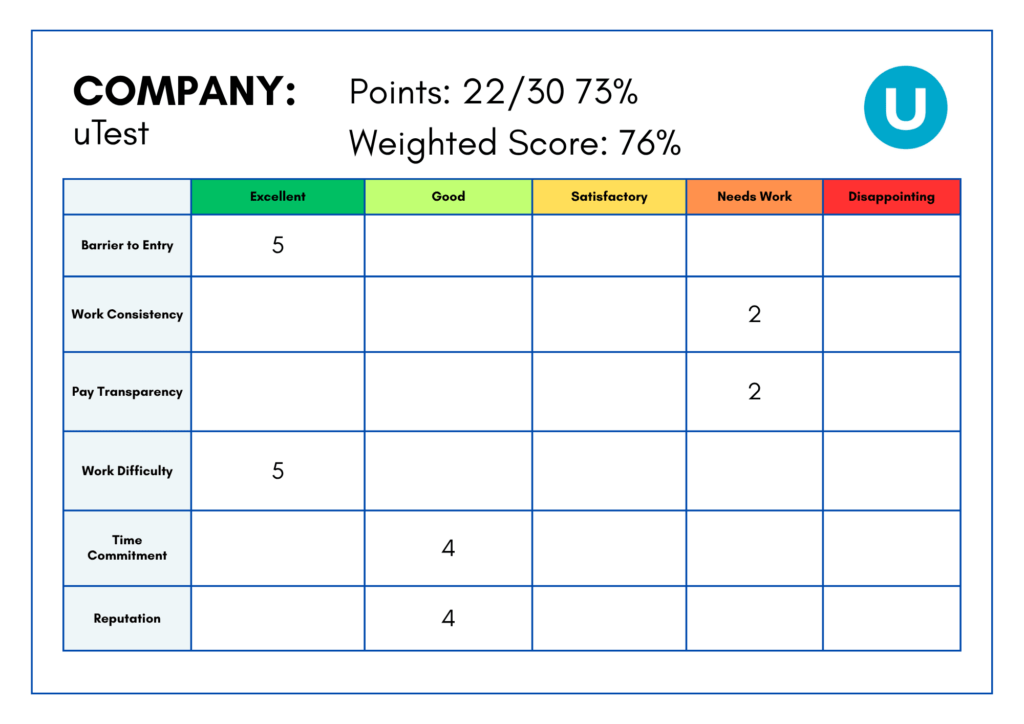
Category total: 23 out of 30, or about 77%.
Weighted score: 76% after giving reputation and work consistency greater influence.
A high score in work difficulty means the work is generally easier—not that it is more difficult.
Barrier to Entry
uTest has one of the lower barriers to entry I have found among project-based side hustles.
You must be at least 18 years old, but you do not necessarily need a degree, portfolio, or professional software-testing background to create an account. Many public projects recruit ordinary consumers who speak a certain language, use a particular device, subscribe to a service, own a certain product, or fit another everyday requirement.
The practical requirements vary by project. Your eligibility may depend on:
- Country or region
- Languages
- Phones, computers, operating systems, or other devices
- Accounts or subscriptions you already use
- Vehicles, payment methods, or connected products you own
- Professional knowledge or specialized testing skills
- Your activity and tester rating on uTest
The uTest Academy provides free training and practice cycles. However, Academy training is unpaid, and completing it does not guarantee that you will receive paid invitations.
Barrier-to-entry score: 5 out of 5.
Work Availability and Consistency
This is one of uTest's biggest weaknesses.
The public Projects Board is updated with recruiting opportunities, but it represents only part of the platform's project inventory. Applying also does not mean you will be selected.
More importantly, the uTest Terms of Use explicitly state that the platform does not guarantee any minimum number of projects, test cycles, or surveys.
Your invitation frequency can depend on current customer demand and how closely your profile matches a project. Your location, devices, languages, tester rating, past activity, and response time can all matter. uTest recommends keeping your profile current, completing Academy work, answering Special Requirement Surveys, and monitoring the Projects Board and email for opportunities.
Those steps may improve your chances, but none creates dependable weekly work. The platform's large worldwide membership also means many accessible projects can attract plenty of competition.
Work-consistency score: 2 out of 5.
Pay Transparency and Payment Methods
uTest is transparent about how payments are processed, but less consistent about showing what an opportunity may pay before a person applies.
When I checked the public Projects Board, some listings disclosed compensation while others did not provide a useful rate or range. There is no single platform-wide hourly rate because earnings can vary by the project, complexity, customer value, tester rating, and type of approved contribution.
According to uTest's earnings guide, paid activity can include approved bugs, completed test cases, bonuses, usability surveys, reviews, referrals, bug-fix verification, and certain specialized tasks. A higher-value approved bug can pay differently from a routine test case.
Testers should be able to see the scope, instructions, and payout for a test cycle before accepting or declining it. That is helpful once an invitation reaches you. However, it does not make your future earnings predictable, and the Terms of Use warn that time spent investigating or testing does not automatically result in payment. Duplicate or rejected bug reports are an important risk.
The official payment guide says available methods can include:
- PayPal
- Payoneer where supported
- Direct to Bank Transfer powered by Wise where available
Payment-method availability varies by country. uTest processes payments twice per month, on the 15th and the final day of the month. If either date falls on a weekend or U.S. holiday, processing moves to the next business day. This schedule applies after earnings become payable; it does not guarantee that every submission will be approved before the next processing date.
Pay-transparency score: 2 out of 5.
Work Difficulty
Many uTest projects are approachable because they include specific instructions and recruit people based on technology or experiences they already have.
A simple project may ask you to watch content, rate the experience, follow a test case, or provide written feedback. Those tasks may require patience and attention to detail, but not necessarily an advanced technical background.
Not every project is equally easy. Exploratory bug hunting, API testing, security testing, automation, localization, and projects involving specialized devices can be considerably more difficult. Even a beginner-friendly cycle may require you to:
- Follow the project scope carefully
- Reproduce a problem consistently
- Write clear steps explaining what happened
- Attach useful screenshots or video evidence
- Avoid submitting an issue another tester already reported
My score reflects the accessibility of the more general projects—not a claim that every uTest assignment is easy.
Work-difficulty score: 5 out of 5.
Time Commitment
uTest gives testers plenty of scheduling flexibility because they can review a cycle and decline it if the scope or timing does not fit.
Some public opportunities involve a short one-time task. Others may require several hours or a limited number of hours per week. The duration and schedule depend on the individual project rather than one platform-wide commitment.
The hidden time cost matters. Your total effort may include:
- Completing unpaid Academy training
- Updating your profile and answering qualification surveys
- Reading cycle instructions and setting up a test
- Investigating and documenting a possible bug
- Discovering that another tester reported the same issue first
- Waiting for your work to be reviewed and approved
The schedule itself is flexible, but flexibility does not guarantee that every hour will be profitable.
Time-commitment score: 5 out of 5.
uTest Reputation
uTest has one of the stronger public reputations I have seen among similar side-hustle platforms, although the sources measure different things and should not be treated as one combined rating.
When checked on August 24, 2026, Glassdoor displayed 4.3 out of 5 from 208 reviews, with 90% saying they would recommend the company to a friend. These are employment and worker reviews—not an audited measure of tester income. Recent visible feedback praised the Academy and available projects while also mentioning seasonal work and the risk of pay being tied to approved bugs.
At the same check, Trustpilot displayed 4.1 out of 5 from 1,401 reviews. The lifetime score is positive, but it is heavily historical: only 12 reviews had been posted during the previous 12 months, and the profile stated that the company had not recently asked for reviews or replied to negative feedback.
The Better Business Bureau profile for Applause displayed an A+ rating, 19 years in business, and no BBB accreditation. Its complaint page displayed four complaints over three years: two marked resolved and two answered. BBB explains that customer reviews do not determine its letter grade, so I treat this as one supporting source rather than final proof of quality.
Recent Reddit discussions were more mixed. Some individual testers described successful payments and legitimate projects. Others complained that setup, troubleshooting, forms, or rejected work took more time than the eventual compensation justified. Those posts are individual experiences rather than representative statistics, but they reinforce the main warning in uTest's own terms: the time you spend does not always become paid work.
Reputation score: 4 out of 5.
Verdict: Is uTest Worth It?
I think uTest is worth considering if you want occasional, flexible testing projects and are comfortable with inconsistent invitations.
Its low barrier to entry, flexible scheduling, documented payment system, and relatively strong reputation make it more appealing than many platforms in this category. It may be especially interesting if you own several devices, speak multiple languages, live in a market with active projects, or enjoy troubleshooting technology.
The main weakness is that you cannot rely on it. uTest guarantees no minimum amount of work, public pay information is inconsistent, and the effective hourly return can fall when training, setup, duplicate reports, rejected work, and approval time are included.
Good for:
- People who enjoy testing apps, websites, devices, or digital services
- Beginners willing to learn through the free Academy
- People with multiple devices, useful language skills, or specialized technology access
- Anyone who wants flexible projects they can accept or decline
- People treating the earnings as occasional extra money
Not ideal for:
- Anyone who needs predictable weekly income
- People expecting a normal hourly remote job
- Anyone unwilling to spend time on unpaid training, setup, or qualification steps
- Testers who would be frustrated by duplicate or rejected bug reports
- People who need a clear public pay range before applying
My category scores add up to 23 out of 30. After applying the scorecard weights, uTest receives a 76% overall score.
My verdict is legitimate and worth trying for flexible side income, but too inconsistent to depend on. Start with the Academy, keep your profile and device list current, review each cycle's scope and payout before accepting it, and judge the opportunity by your actual approved earnings—not the largest payout advertised on one project.
Frequently Asked Questions
Is uTest a scam?
No. uTest is an established crowdtesting platform operated by Applause. It publishes detailed tester policies, maintains active projects, and has documented payment methods. However, legitimate does not mean work or payment is guaranteed for every tester or every hour spent.
What kind of work do you do on uTest?
Projects can include finding and documenting bugs, completing test cases, testing apps or devices, evaluating digital content, completing usability surveys, verifying bug fixes, and performing specialized testing. Each cycle has its own scope and requirements.
How much does uTest pay?
There is no useful universal hourly rate. Pay varies by test cycle, project complexity, customer value, tester rating, location, and the type of work approved. Some public projects disclose compensation, while others do not. Testers should review the payout shown for an invited cycle before accepting it.
How often does uTest pay?
uTest processes payable earnings twice per month, on the 15th and the final day of the month. Weekend and U.S. holiday dates move to the next business day. Approval timing can still affect which payment date applies.
How does uTest pay testers?
Available methods can include PayPal, Payoneer, and Direct to Bank Transfer powered by Wise. Not every method is available in every country, and new U.S.-based testers cannot select Payoneer.
Is the uTest Academy paid?
No. Academy training is unpaid. It can help you learn the platform, improve your rating, and potentially qualify for more invitations, but it does not guarantee paid work.
Does uTest guarantee projects?
No. The uTest Terms of Use explicitly say the company does not guarantee a minimum number of projects, cycles, or surveys.
Do you need experience to join uTest?
You do not necessarily need professional testing experience to create an account or qualify for general projects. Some cycles welcome ordinary users, while others require specialized skills, devices, accounts, languages, professions, or locations.
Is uTest the same as UX research?
Not exactly. Some uTest projects include usability feedback that overlaps with user-experience research, but the platform is better described as crowdtesting or freelance software and product testing. Many projects focus on finding bugs, completing test cases, or checking whether a digital product works correctly.
More Flexible Side Hustles to Compare
If uTest does not fit your devices, location, or preferred type of work, these resources can help you compare other flexible platforms:
- Use the Side Hustle Finder
- AI training platforms ranked from least to most difficult
- Data annotation job platforms ranked worst to best
- Handshake AI training jobs review
Every platform makes a different tradeoff between accessibility, work availability, pay, flexibility, and reputation. uTest stands out for its approachable testing projects and stronger-than-average public reputation, but inconsistent work and unpredictable effective pay prevent it from being a dependable income source.