
Last Updated on June 22, 2026 by Justin Bryant
Most people shop for electricity plans the wrong way.
They look at the high advertised price, pick the lowest number, and assume they're getting the cheapest plan.
That's exactly what many electricity providers want you to do.
The reality is that electricity plans are often built around usage thresholds, bill credits, time-of-use pricing, and other incentives that can make the same plan either incredibly cheap or surprisingly expensive depending on how much electricity you use and when you use it.
While every state's electricity market works a little differently, the process of comparing plans is largely the same. In my case, I used Texas as an example because that's where I live, but these principles can help consumers in any deregulated electricity market.
Step 1: Get Your Last 12 Months of Electricity Usage
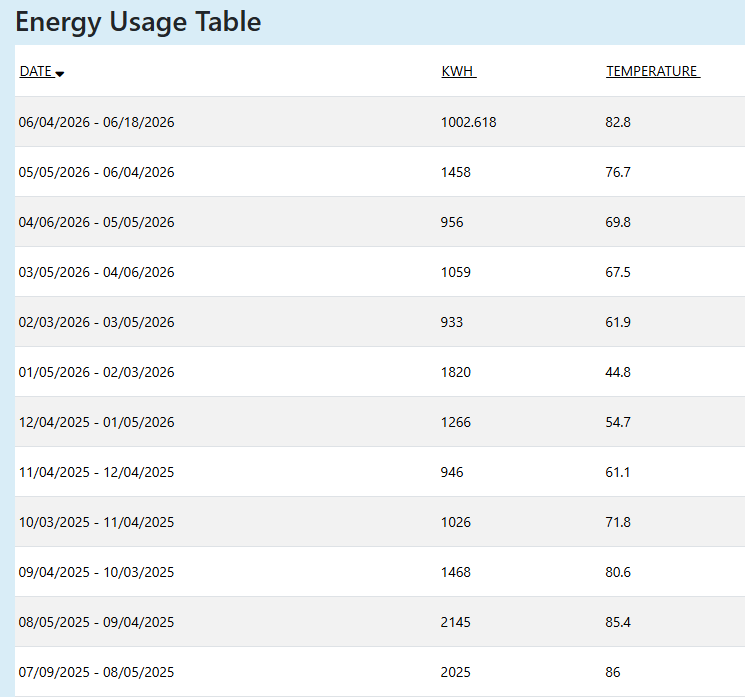
Before looking at a single electricity plan, log into your utility or electricity provider account and download your last 12 months of usage.
Do not just look at your average monthly usage.
Instead, write down every month's electricity consumption.
For example:
- January: 1,820 kWh
- February: 933 kWh
- March: 1,059 kWh
- April: 956 kWh
- May: 1,458 kWh
This is the most important step in the entire process.
Here's an example of one of mine:
Step 2: Don't Just Calculate Your Average
Many consumers make the mistake of calculating an annual average and stopping there.
The problem is that electricity plans often reward or penalize specific usage levels.
Instead of only looking at your average, count how many months you fall above or below common usage thresholds.
Common thresholds include:
- 500 kWh
- 1,000 kWh
- 2,000 kWh
For example:
| Usage Threshold | Months Qualified |
|---|---|
| 500 kWh | 12/12 |
| 1,000 kWh | 8/12 |
| 2,000 kWh | 2/12 |
That information is often more valuable than your average monthly usage.
You don't get charged by your average.
In fact, you get charged by the range you are in for that month.
Your “fixed” price per kWh will depend on the threshold cost and whether you get a usage credit in that range.
Step 3: Understand Usage Credits
Many electricity plans offer bill credits when you reach a certain usage level.
For example:
Receive a $125 bill credit when your monthly usage exceeds 1,000 kWh.
These plans can be fantastic for some households and terrible for others.
Imagine two months:
- 1,059 kWh = qualifies for the credit
- 956 kWh = misses the credit
The actual electricity usage may only differ by a small amount, but the bill could differ by over $100.
This is why understanding your usage pattern matters so much.
I actually got charged more for less usage when I was under 1000 kWh for a month because my rate was higher for the 500-999 range, and the usage credit didn't kick in.
Step 4: Never Compare Only the Advertised Rate
Many comparison websites highlight one eye-catching price.
That price is often based on a specific usage level.
You should always compare pricing at multiple usage levels when available.
For example:
| Usage | Plan A |
|---|---|
| 500 kWh | 20.7¢ |
| 1,000 kWh | 7.8¢ |
| 2,000 kWh | 13.8¢ |
Most shoppers focus on the 7.8¢ number.
That's a mistake.
The pricing at the lower and higher usage levels often reveals whether a plan is actually competitive.
Step 5: Match the Plan to Your Usage Habits
The best plan for one household may be terrible for another.
If You Usually Use Less Than 1,000 kWh
A plan requiring 1,000 kWh to earn a bill credit may not make sense.
If You Usually Use 1,100–1,800 kWh
A bill-credit plan may save you substantial money.
If You Consistently Use 2,000+ kWh
You may benefit from plans designed around higher usage thresholds.
The keyword is “consistently.”
Don't choose a plan based on a usage level you only reach once or twice per year.
Most households will have around 8 months where they are in the same general threshold of usage.
You want to choose the plan that offers the lowest cost and possibly a usage credit for your most common threshold.
Step 6: Evaluate “Free” Electricity Offers Carefully
Many providers advertise:
- Free nights
- Free weekends
- Time-of-use rates
- Bill credits
- Usage bonuses
These aren't automatically bad deals.
In some situations, they can be excellent.
The important question is whether the plan matches your lifestyle.
Free Nights Plans
These can work well if:
- You own an electric vehicle
- You charge batteries overnight
- You run appliances at night
- Most of your energy consumption happens after work
Free Weekend Plans
These may work well if:
- You spend weekdays away from home
- Most household activities happen on weekends
Work-From-Home Households
People who are home throughout the day often use a significant amount of electricity during expensive daytime hours.
In many cases, a traditional fixed-rate plan or a usage-credit plan may provide better value.
Step 7: Read the Plan Details
Always review the provider's official plan documentation.
Look for:
- Energy charges
- Delivery charges
- Monthly fees
- Base charges
- Usage credits
- Minimum usage fees
- Early termination fees
Comparison websites provide a summary.
The official plan documents provide the full story.
Step 8: Watch Out for Minimum Usage Fees
Just as some plans reward high usage, others penalize low usage.
For example:
- Monthly service fees
- Minimum usage charges
- Base fees that apply regardless of consumption
These can dramatically change the true cost of a plan.
Step 9: Understand Contract Lengths
Many plans require commitments, such as:
- 12 months
- 24 months
- 36 months
Longer contracts often come with larger cancellation fees.
Make sure any savings justify the commitment.
Step 10: Time Your Switch Correctly
If you're currently under contract, review your expiration date before enrolling with a new provider.
In many markets, you can schedule a future switch date.
A good rule of thumb is to schedule your new service to begin immediately after your current contract ends.
This helps avoid unnecessary cancellation fees and prevents paying higher month-to-month rates after a contract expires.
Be sure to review your provider's specific terms, as switching rules vary by state and provider.
Step 11: Think About Your Home's Characteristics
Your home's efficiency affects which plans make sense.
Factors include:
- Square footage
- Climate
- Electric vs. gas heating
- Air conditioning usage
- Insulation quality
- Number of occupants
- Work-from-home schedules
A large all-electric home in a hot climate will have very different needs than a small apartment with natural gas heating.
Step 12: Compare Annual Cost, Not Just Monthly Cost
The cheapest plan during one season may not be the cheapest plan for the entire year.
Instead of asking:
Which plan has the lowest advertised rate?
Ask:
Which plan would have been cheapest based on my actual usage over the last 12 months?
That's the question that leads to the best long-term savings.
Final Thoughts
The biggest mistake consumers make is shopping based on one number.
The second biggest mistake is shopping without understanding your own electricity usage.
Before choosing a provider:
- Download your last 12 months of usage.
- Identify how often you exceed common usage thresholds.
- Compare multiple pricing levels, not just the advertised rate.
- Understand bill credits and usage requirements.
- Evaluate whether free nights or free weekends fit your lifestyle.
- Review all fees and contract terms.
- Compare plans based on your actual consumption habits.
The goal isn't to find the lowest advertised rate.
The goal is to find the provider and plan that will cost the least based on how your household actually uses electricity.