
Last Updated on July 31, 2026 by Justin Bryant
For years, Amazon Mechanical Turk was one of the most recognizable names in online microtask work. Long before generative AI became mainstream, people used MTurk to complete surveys, label images, transcribe audio, verify data, and perform thousands of other small tasks for businesses and researchers.
Unfortunately, if you're reading this because you're thinking about signing up, I have some bad news.
As of July 30, 2026, Amazon Mechanical Turk is no longer accepting new workers. Existing workers can continue using the platform for now, but Amazon has stopped accepting new worker applications and has announced that no new features will be added. In other words, MTurk is entering the final stage of its lifecycle rather than continuing to grow.
Even though new registrations have ended, I still think it's worth reviewing the platform.
Understanding what made MTurk successful, why it declined, and where it fell short helps explain why many newer platforms have replaced it. It also makes it much easier to choose a better alternative if you're looking for the same type of work today.

What Was Amazon Mechanical Turk?
Before AI tools like ChatGPT became mainstream, Amazon Mechanical Turk, commonly called MTurk, was one of the most popular platforms for online microtasks.
Launched by Amazon in 2005, MTurk connected businesses and researchers with a global workforce that could complete small digital tasks known as Human Intelligence Tasks, or HITs. These were jobs that computers either couldn't perform accurately at the time or that still required human judgment.
If you've spent any time researching online side hustles, you've probably come across MTurk at some point. For years, it was one of the first platforms people recommended for earning money online because it allowed workers to complete tasks whenever they had spare time. There were no fixed schedules, long-term contracts, or weekly hour requirements.
The work itself was fairly straightforward.
Depending on what requesters needed, you might complete tasks such as:
- Image and video labeling.
- Data annotation.
- Data verification and cleanup.
- Market research surveys.
- Website content writing.
- Search result ratings.
- Audio transcription.
- Information gathering.
- Product categorization.
Looking back, it's interesting to realize how important MTurk was to the early development of artificial intelligence.
Long before today's AI models became publicly available, many companies relied on thousands of MTurk workers to label data, verify information, and complete annotation tasks that helped train machine learning systems. In many cases, products that were marketed as “AI” still depended heavily on real people working behind the scenes through platforms like MTurk.
Ironically, the technology MTurk helped support may have also contributed to its decline.
As large language models became more capable, many repetitive tasks that once required human workers could be automated. According to the transcript, some contributors even began using AI tools themselves to complete MTurk assignments after generative AI became widely available, undermining the original purpose of many of the platform's tasks.
That doesn't mean MTurk was a bad platform.
For many years, it filled an important niche by giving people access to flexible online work that required little experience and almost no long-term commitment.
However, flexibility alone wasn't enough to overcome some of the platform's long-standing problems, many of which became more noticeable as newer competitors entered the market.
Before I get into my full scorecard, it's also important to understand the platform's current status.
As of July 30, 2026, Amazon has stopped accepting new worker applications. Existing workers can continue completing available HITs for now, but Amazon has indicated that no new features will be added, suggesting the platform is being gradually phased out rather than expanded. Because of that, this review is best viewed as both an evaluation of what MTurk offered and an explanation of why I think newer alternatives now make more sense for most people.
Barrier to Entry
My Score: 2 out of 5
One of the biggest reasons Amazon Mechanical Turk lost points in my review was its barrier to entry.
At first glance, MTurk looked like one of the easiest platforms to join. The work itself didn't require a college degree, professional certifications, or years of previous experience. Most of the tasks were simple enough that almost anyone could learn them after a short amount of practice.
Unfortunately, actually getting access to meaningful work wasn't nearly as straightforward.
One of the biggest frustrations contributors reported over the years was the lack of transparency surrounding qualifications.
Unlike many modern freelancing platforms where everyone can view the same opportunities, MTurk divided work into Human Intelligence Tasks, commonly called HITs, and not every worker qualified for every HIT. Some requesters created their own qualification requirements, while others limited access based on approval ratings, location, or previous work history.
That created a confusing experience for new workers.
Two people could create an account on the same day and have completely different opportunities available to them, with very little explanation as to why. If you were new to the platform, it often felt like you had to earn access to the better-paying tasks before you even had a chance to prove yourself.
The recent announcement from Amazon makes this category even more challenging.
As of July 30, 2026, Amazon Mechanical Turk is no longer accepting new worker applications. Existing workers can continue using the platform for now, but if you don't already have an account, you simply can't join anymore. That effectively makes the barrier to entry as high as it can possibly be for new users.
Even before that announcement, I didn't think MTurk was particularly beginner-friendly.
There was too much uncertainty around who could access which HITs, how qualifications worked, and what it took to unlock better opportunities. Compared to newer platforms that have more structured onboarding processes, MTurk often felt unnecessarily opaque.
What I Liked
- Most tasks didn't require specialized experience.
- Simple work once you gained access.
- Good introduction to microtasking and data labeling.
What I Didn't Like
- Qualification system wasn't very transparent.
- Access to HITs varied between workers.
- Better opportunities often required building approval history first.
- No longer accepting new worker applications.
Why I Gave It 2 out of 5
I don't think the work itself was difficult to start.
The problem was getting consistent access to worthwhile work.
Between the confusing qualification system and the fact that new workers can no longer join the platform, MTurk falls well behind many of today's alternatives when it comes to accessibility.
Work Consistency
My Score: 1.5 out of 5
If I had to point to one category that ultimately held Amazon Mechanical Turk back the most, it would be work consistency.
One of the biggest challenges with MTurk was that there was never any guarantee you'd have work waiting for you when you logged in.
Unlike a traditional part-time job where you're scheduled for a certain number of hours each week, MTurk depended entirely on requesters posting Human Intelligence Tasks, or HITs. Some days there might be hundreds of available tasks. Other days there might be very little worth completing, especially if you didn't qualify for many of the higher-paying HITs.
Over time, this became an even bigger problem.
Many long-time contributors have pointed out that the platform had been declining for years before Amazon announced it would stop accepting new workers. Available work became less consistent, competition for better-paying tasks increased, and many contributors felt that the platform simply wasn't as active as it had once been.
Personally, I don't think Amazon's recent announcement came as a complete surprise.
From everything I researched, it seems like the platform had already been slowly losing momentum. The decision to stop accepting new workers feels more like the final stage of a long decline than a sudden change.
Another issue was how quickly desirable HITs disappeared.
Because many tasks paid very little, contributors often competed heavily for the projects that offered better compensation. If you weren't actively monitoring the platform, there was a good chance those opportunities would be gone before you even had a chance to claim them.
That made it extremely difficult to rely on MTurk for predictable income.
Even experienced workers often supplemented their earnings with other platforms because there simply wasn't enough consistency to depend on MTurk alone.
What I Liked
- Flexible work whenever tasks were available.
- Large variety of microtasks.
- No fixed weekly schedule.
What I Didn't Like
- No guaranteed work.
- Task availability fluctuated significantly.
- Better-paying HITs were highly competitive.
- Platform activity appeared to decline over time.
- Difficult to rely on for consistent income.
Why I Gave It 1.5 out of 5
Consistency is one of the most important qualities I look for in any side hustle platform.
Unfortunately, MTurk never performed particularly well in this area, and by the end of its lifecycle, that problem had only become more noticeable.
For me, this was the platform's biggest weakness and one of the primary reasons it finished with a weighted score of just 59%.
Pay Transparency
My Score: 2 out of 5
Pay transparency is another area where Amazon Mechanical Turk consistently fell short.
One of the biggest problems with MTurk wasn't necessarily that some tasks paid very little. It was that there was no consistent standard for how much work should pay.
Unlike many freelance platforms that either advertise an hourly rate or give you a reasonable estimate of what you can expect to earn, MTurk allowed individual requesters to decide how much they wanted to pay for each Human Intelligence Task, or HIT. That meant two tasks requiring roughly the same amount of effort could have completely different payouts.
Over the years, this led to one of the platform's biggest criticisms.
Many workers felt that a large percentage of HITs simply weren't worth the time required to complete them. While there were certainly better-paying opportunities available, they were often more competitive and disappeared quickly. If you weren't constantly monitoring the platform, you were frequently left choosing between low-paying tasks or waiting for something better to appear.
Another issue was the lack of an hourly pay standard.
Because contributors were paid per task rather than by the hour, it was difficult to predict what your actual earnings would be. A task that looked simple could end up taking much longer than expected, dramatically reducing your effective hourly rate.
That uncertainty made it hard to plan your income.
Unlike part-time AI training platforms that advertise hourly compensation or long-term project rates, MTurk earnings depended almost entirely on which HITs happened to be available that day and whether you qualified for them.
One additional concern I have with MTurk is its rejection system.
Like several other crowdsourcing platforms, requesters could reject completed work. If your submission was rejected, you generally wouldn't receive payment for that task. While quality control is understandable, this system placed much of the risk on contributors, especially when working with unfamiliar requesters.
What I Liked
- Some higher-paying HITs did exist.
- Contributors could choose which tasks to accept.
- No long-term contracts or fixed pay structure.
What I Didn't Like
- No consistent hourly pay expectations.
- Many HITs paid very little.
- Earnings depended heavily on the requester.
- Better-paying work was often difficult to access.
- Rejected work could result in no payment.
Why I Gave It 2 out of 5
Personally, I think pay transparency is one of the areas where newer platforms have improved the most.
MTurk's marketplace model gave requesters complete control over pricing, but that often left contributors guessing whether a task would actually be worth their time.
Combined with inconsistent work availability, unpredictable earnings became one of the platform's biggest long-term weaknesses and a major reason I couldn't score this category any higher.
Work Difficulty
My Score: 4 out of 5
If there was one area where Amazon Mechanical Turk consistently performed well, it was the difficulty of the work itself.
One of the reasons MTurk became so popular over the years was because most of its tasks were designed to be completed by everyday people rather than specialists. You didn't need a computer science degree, professional certifications, or years of experience to get started.
In fact, many of the tasks were about as beginner-friendly as online work gets.
Depending on the requester, you might find yourself:
- Labeling images for AI training.
- Categorizing products or websites.
- Verifying business information.
- Cleaning up datasets.
- Rating search results.
- Completing surveys.
- Participating in market research.
- Transcribing short audio clips.
These are the kinds of microtasks that can usually be learned in just a few minutes, which made MTurk an attractive option for people who wanted to earn a little extra money without investing weeks into training.
Another advantage was that contributors could often choose the types of tasks they preferred.
If you enjoyed surveys, you could focus on those.
If you preferred simple data labeling or categorization work, there were usually HITs available in those categories as well.
That flexibility made the platform feel approachable, especially for beginners who wanted to experiment with different kinds of online work.
Of course, not every HIT was equally easy.
Some requesters required qualification tests before allowing workers to complete certain projects, while others expected greater attention to detail or higher accuracy. But compared to many of today's AI training platforms that ask contributors to evaluate large language models or apply specialized professional knowledge, MTurk's work was generally much simpler.
That's one of the reasons I scored this category so highly.
Even though I had concerns about work availability and compensation, I don't think the tasks themselves were particularly difficult for most people.
What I Liked
- Beginner-friendly work.
- No specialized education required for most HITs.
- Wide variety of simple microtasks.
- Easy way to learn basic data labeling and annotation.
What I Didn't Like
- Some higher-paying HITs required additional qualifications.
- Task quality varied depending on the requester.
- Instructions weren't always consistent across projects.
Why I Gave It 4 out of 5
For me, work difficulty was one of MTurk's strongest categories.
The platform succeeded because it made online work accessible to people with little or no previous experience.
If you're simply judging how difficult the work was to perform, Amazon Mechanical Turk compared favorably with many of the platforms that replaced it. Its biggest problems were never the tasks themselves. They were the inconsistent work, low pay, and lack of transparency that surrounded those tasks.
Time Commitment
My Score: 5 out of 5
While Amazon Mechanical Turk had its fair share of problems, one area where I think it genuinely excelled was flexibility.
In fact, I gave it a perfect score for time commitment.
One of the biggest reasons people were drawn to MTurk in the first place was that you could work entirely on your own schedule. There were no managers assigning shifts, no weekly hour requirements, and no long-term contracts tying you to a project.
Instead, you simply logged in whenever you had free time, completed a few HITs, and logged back out.
That made the platform particularly attractive for:
- Students.
- Stay-at-home parents.
- People working full-time jobs.
- Freelancers looking for supplemental income.
- Anyone who wanted to earn a little extra money during their spare time.
Another advantage was the length of the tasks themselves.
Many HITs only took a few minutes to complete. Others might take a little longer, but very few required the kind of ongoing commitment you see with many modern AI training platforms, where contributors are expected to work a minimum number of hours each week or remain on projects for several months.
Personally, I think that's one area where MTurk still compares favorably to many of today's alternatives.
If your schedule was unpredictable, you could simply complete work whenever it was convenient.
Of course, flexibility and consistency aren't the same thing.
Just because you could work whenever you wanted didn't mean there would always be work available. That's why I scored Time Commitment and Work Consistency separately.
MTurk gave contributors complete control over their schedules.
Unfortunately, it couldn't guarantee there would be worthwhile tasks waiting when they logged in.
What I Liked
- Excellent flexibility.
- No fixed schedule.
- No minimum weekly hours.
- Most tasks were short.
- Easy to fit around work, school, or family commitments.
What I Didn't Like
- Flexibility depended on having available HITs.
- Some higher-paying tasks required longer completion times.
- Freedom to work didn't necessarily translate into reliable earnings.
Why I Gave It 5 out of 5
For me, this was MTurk's strongest category.
Very few platforms have ever offered this level of scheduling flexibility.
You could log in for ten minutes or several hours depending entirely on your availability, with no obligation to continue working afterward.
Even though the platform struggled in other areas, I think it deserves full credit for making online work as flexible as possible for contributors.
Reputation
My Score: 3 out of 5
The final category I evaluate is reputation.
I've mentioned this in several of my reviews, but over time I've started giving reputation more weight than any other category.
The reason is simple.
A platform can advertise flexible work, easy tasks, or competitive pay. But if thousands of workers consistently report poor experiences, payment issues, or declining work quality, I think that should carry more weight than the marketing on the company's website.
When I looked at Amazon Mechanical Turk, I came away with mixed feelings.
On one hand, the platform had something that many of its competitors didn't.
It was backed by Amazon.
That alone gave MTurk a level of legitimacy that many smaller crowdsourcing platforms have struggled to establish. Workers generally didn't question whether the platform itself was real. The bigger concern was whether the available work was actually worth doing.
When I looked across review sites, the picture became a little more complicated.
Its Trustpilot rating sat around 2.7 out of 5, suggesting plenty of contributors were unhappy with their experience. On the other hand, worker reviews on Glassdoor were much stronger at around 4.2 out of 5, while reviews specific to Mechanical Turk on Indeed were closer to 3.3 out of 5.
Those numbers tell me there wasn't a universal opinion about the platform.
Instead, experiences seemed to depend heavily on when someone used MTurk, the types of HITs they qualified for, and what they expected going into it.
I also spent time looking through community discussions.
One trend kept appearing over and over again.
Many long-time contributors said the same thing.
Years ago, they thought MTurk was one of the better microtask platforms available.
More recently, however, many felt the platform had steadily declined as better opportunities became harder to find and lower-paying HITs became more common. That lines up closely with Amazon's recent decision to stop accepting new workers. Rather than coming as a surprise, it feels like the conclusion of a gradual decline that contributors had already been talking about for years.
For that reason, I landed right in the middle with a 3 out of 5.
I don't think MTurk deserves a poor reputation score because it played an important role in creating the online microtask industry and remained a legitimate platform throughout its lifetime.
At the same time, I don't think I could justify scoring it higher given the volume of complaints about declining work quality, inconsistent earnings, and the platform's overall trajectory during its final years.
What I Liked
- Backed by Amazon.
- One of the original microtask platforms.
- Long history in AI data collection and crowdsourcing.
- Legitimate platform with millions of completed tasks.
What I Didn't Like
- Mixed reviews across multiple review websites.
- Reputation declined over time.
- Frequent complaints about low-paying HITs.
- Many long-term workers felt the platform had been fading for years.
Why I Gave It 3 out of 5
Overall, I think Amazon Mechanical Turk deserves credit for helping shape the crowdsourcing industry and introducing millions of people to online microtask work.
However, by the end of its lifecycle, the platform was no longer viewed as the industry leader it once was.
Combined with declining contributor sentiment and Amazon's decision to stop accepting new workers, I think an average reputation score best reflects where MTurk ultimately ended up.
Overall Score
After reviewing Amazon Mechanical Turk across all six categories, I gave it a total score of 17.5 out of 30, resulting in a weighted score of 59%.
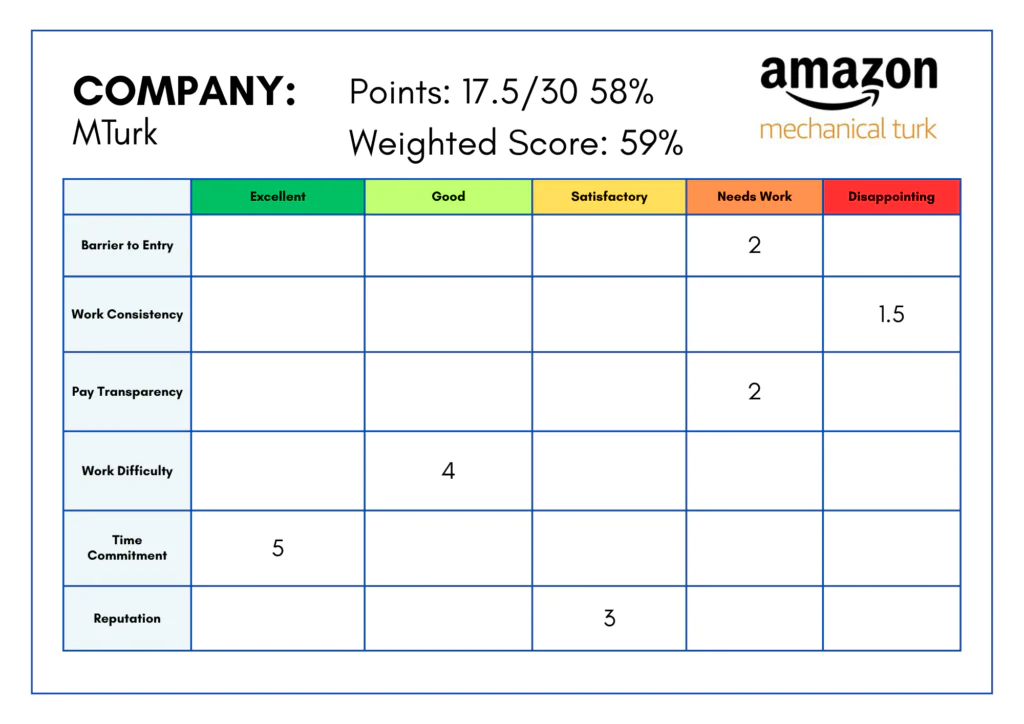
Looking at the scorecard as a whole, I think it tells the story of Amazon Mechanical Turk surprisingly well.
The platform wasn't difficult to use, and it offered one of the most flexible ways to earn money online. You could log in whenever you had spare time, complete a few tasks, and log right back out without worrying about schedules or long-term commitments.
Unfortunately, flexibility wasn't enough to overcome its biggest weaknesses.
Work became increasingly inconsistent over the years, pay was often too low to justify the time invested, and contributors had little control over which tasks they qualified for or how much those tasks paid. While MTurk helped pioneer online microtasking, many of the platforms that followed have done a better job addressing those shortcomings.
My Final Verdict
For a long time, Amazon Mechanical Turk was one of the most recognizable names in online side hustles.
It introduced millions of people to microtask work years before AI training, data annotation, and remote freelancing became mainstream. In many ways, it helped create the industry that dozens of newer platforms now compete in.
That alone makes it an important platform in the history of online work.
However, if I'm evaluating it based on today's standards rather than its historical significance, I think it falls squarely into the middle of the pack.
My biggest concerns have always been the same.
The work wasn't consistent enough to depend on, the pay often wasn't competitive, and the qualification system made it difficult for many contributors to access the better opportunities. Those issues existed long before Amazon announced it would stop accepting new workers, and I think they ultimately contributed to the platform's decline.
That brings us to the biggest update readers need to know.
As of July 30, 2026, Amazon Mechanical Turk is no longer accepting new worker applications. Existing workers can continue completing available HITs for now, but Amazon has indicated that the platform will only receive security and availability updates going forward, with no new features planned. If you don't already have an MTurk account, you won't be able to create one today.
For that reason, I can't recommend Amazon Mechanical Turk to new job seekers.
Not because I think it was a terrible platform, but because it simply isn't an option anymore.
Fortunately, there are several alternatives that offer many of the same types of work.
If you're interested in:
- Data labeling
- Data annotation
- AI training
- Market research studies
- Surveys
- Microtasks
- Search evaluation
there are newer platforms that are still actively accepting contributors and, in many cases, provide a better overall experience.
I'll cover those in a separate guide dedicated to the best Amazon Mechanical Turk alternatives.
Who Amazon Mechanical Turk Was Best For
Before Amazon stopped accepting new workers, I think MTurk was best suited for:
- People looking for occasional side income.
- Students with flexible schedules.
- Beginners interested in data labeling.
- Freelancers wanting short, task-based work.
- Anyone who valued flexibility over predictable earnings.
Who Should Look Elsewhere
Today, I think everyone looking for this type of work should focus on active alternatives instead.
Since new registrations have ended, platforms like Clickworker, Prolific, TELUS Digital, Toloka, and several other AI training companies simply make more sense for anyone entering this space today.
Frequently Asked Questions
Is Amazon Mechanical Turk still accepting new workers?
No. As of July 30, 2026, Amazon Mechanical Turk is no longer accepting new worker applications. Existing workers can continue using the platform for now, but new accounts are no longer being approved.
Can existing MTurk workers still complete tasks?
Yes. According to Amazon's announcement, existing workers can continue completing available HITs. However, the platform is only expected to receive security and availability updates going forward, with no new features planned.
Was Amazon Mechanical Turk legitimate?
Yes. Amazon Mechanical Turk was a legitimate crowdsourcing platform operated by Amazon. For many years, it connected businesses and researchers with workers who completed microtasks such as data labeling, surveys, transcription, and information verification.
Why did Amazon Mechanical Turk decline?
Based on my research and the contributor feedback I reviewed, several factors likely played a role. Many workers reported declining task availability, low pay, inconsistent work, and increasing competition for better-paying HITs. At the same time, advances in AI automation reduced the need for some of the manual tasks that originally made MTurk popular.
Final Thoughts
Amazon Mechanical Turk helped define an entire category of online work.
Long before AI training became one of the fastest-growing remote side hustles, MTurk gave people a way to earn money by completing small digital tasks from home. It introduced countless workers to data annotation, surveys, transcription, and other forms of crowdsourced work that are still common today.
Even though the platform is now winding down, its influence is hard to overstate.
Many of the AI training and data labeling companies we use today built on ideas that MTurk helped popularize.
So while I don't recommend it for new workers in 2026, I do think it's an important platform to understand. It laid the foundation for much of the remote microtask industry that exists today.
If you're disappointed that you can no longer sign up, don't worry too much.
In many ways, this transition is an opportunity rather than a setback. Many of the newer platforms have learned from MTurk's shortcomings and now offer better work consistency, clearer pay structures, and more specialized opportunities.
That's exactly what I'll cover in the companion article, where I'll rank the best Amazon Mechanical Turk alternatives and help you decide which platform is the right replacement based on the type of work you're looking for.