
Last Updated on June 17, 2026 by Justin Bryant
Welocalize has been getting a lot of attention lately for its AI training, data annotation, and search evaluation opportunities. If you've been looking for flexible work-from-home projects that involve training AI systems, reviewing search results, or labeling data, there's a good chance you've come across them.
I've covered Welocalize several times over the years, and after taking another close look at their current opportunities, I wanted to see how they compare to other AI training platforms. The company has actually been around since 1990, which gives it a much longer track record than many of the newer AI training companies that have appeared over the past few years.
After reviewing their available projects, pay transparency, reputation, work consistency, and entry requirements, here's my take on whether their AI training and data annotation jobs are worth considering.
What Is Welocalize?
Welocalize is a language services and AI data company that works with businesses on localization, translation, search quality evaluation, and AI training projects.
Many people know them from their search engine evaluator and search quality rating programs, which have existed for years. More recently, they have expanded heavily into AI-related work.
Today, they offer projects involving:
• AI training
• Data annotation
• Data labeling
• Search result evaluation
• Content review
• Fact-checking
• Prompt creation and testing
• Language evaluation
• Maps and location relevance projects
One thing I immediately noticed is how many countries and languages they support. Unlike some competing platforms that focus primarily on the United States, Welocalize regularly posts opportunities across multiple regions around the world.

Barrier to Entry
To evaluate the barrier to entry, I looked at several different listings because there is a huge variety of projects available.
One example was a Quality Control Specialist position for Project Lyra. In this role, workers review AI-generated text for linguistic accuracy, grammar, and cultural appropriateness. The catch is that this project requires a strong academic or professional background in linguistics.
On the other hand, some projects have much lower requirements.
For example, their Maps Personalization Relevance Rater project mainly requires:
• Residence in the required country
• An active Gmail account
• Familiarity with Google Maps
The actual work involves reviewing search results and evaluating whether suggested locations are relevant and useful.
I also looked at one of their larger AI training listings where workers help train AI systems through annotation, labeling, search evaluation, and chatbot response review. The requirements for these projects are often minimal.
Overall, I think the barrier to entry is quite good.
There is a wide range of projects available. Some require specialized knowledge and pay more. Others are much more beginner-friendly and don't require significant experience.
The fact that they support so many countries and languages also helps make the platform accessible to more people.
Work Consistency
Work consistency is always one of the biggest concerns with AI training platforms.
The good news is that Welocalize often provides details about expected hours and project duration before you apply.
Some examples I found included:
• 20 hours per week with flexible scheduling
• 8 to 10 hours per week
• Projects lasting several weeks
• Shorter projects lasting only a few days
I like that they are fairly transparent about what to expect.
Based on feedback I found across Reddit and other communities, workload can still be inconsistent. Many workers report periods with very little work followed by bursts of activity.
That said, this is fairly common across the entire AI training industry.
The reason I score Welocalize slightly higher than many competitors is the sheer volume of projects they offer. Because they have so many different project types, there may be more opportunities to move between projects instead of relying on a single assignment.
Some workers even report staying on projects for months or years.
I still would not treat this as a guaranteed full-time income, but compared to many competitors, the consistency appears better than average.
Pay
One area where Welocalize has improved significantly is pay transparency.
In the past, many listings required applicants to start the application process before learning what the pay would be. Today, many listings display exact hourly rates upfront.
For example, several of the projects I reviewed included clearly stated hourly rates directly in the job description.
Not every listing includes compensation details. I found some AI training projects where pay information was missing entirely.
However, compared to many competing platforms, I think Welocalize does a better job than average when it comes to showing compensation before you apply.
One thing to keep in mind is that rates can vary significantly by country. Just because a project pays a certain amount in the United States does not mean workers in other countries will receive the same rate.
Still, overall, I found their pay transparency to be better than many similar companies.
How Difficult Is the Work?
The actual work itself generally does not appear very difficult.
Many projects involve tasks like:
• Reviewing AI responses
• Correcting grammar and language issues
• Evaluating search results
• Rating locations and recommendations
• Labeling data
• Creating prompts
• Testing AI systems
Even some of the higher-paying projects are primarily focused on reviewing and improving AI-generated content.
For example, one project involves identifying language issues, rewriting responses, and improving prompt quality.
If you already have expertise in the required subject area, the work itself should be fairly straightforward.
The biggest challenge is usually getting accepted, not performing the work once you are on a project.
Of course, quality standards can still be strict. That is fairly normal across the AI training industry.
Overall, I would consider most of their AI-related projects relatively easy compared to many traditional jobs.
Time Commitment
Time commitment varies significantly depending on the project.
Some projects ask for approximately 20 hours per week, which could be difficult for people balancing a full-time job, school, or other responsibilities.
Others require only 8 to 10 hours weekly.
Some projects are even more flexible and can be completed whenever you have available time.
One of the biggest advantages is that most projects are fully remote and allow you to work on your own schedule.
As long as you meet project requirements and complete assigned tasks, you can typically work whenever it is convenient for you.
Because of the wide variety of projects available, I would rate the time commitment requirements as average overall.
Company Reputation
Reputation is probably the most important category when evaluating any freelance platform.
Welocalize has several things working in its favor.
First, the company has been around since 1990. That alone gives it far more credibility than many newer AI training platforms.
On Glassdoor, the company holds approximately a 3.4 out of 5 rating, with around 58% of reviewers recommending the company to a friend.
Indeed shows similar results, with ratings hovering around the average range.
The Better Business Bureau gives the company an A+ rating, which is a positive sign. They also have very few complaints, considering the size of the company.
Trustpilot is less favorable, showing a much lower rating. However, many large companies receive poor Trustpilot scores, so I do not put as much weight on that metric alone.
Reddit feedback is mixed, which is fairly standard for this industry.
Common positives include:
• Reliable side income
• Consistent payments
• Flexible schedules
• Opportunities for linguists and language specialists
Common complaints include:
• Inconsistent workloads
• Frustrating hiring processes
• Occasional payment issues
• Unclear project expectations
The good news is that most payment complaints I found seemed to involve delays rather than nonpayment.
Most workers agree that Welocalize is a legitimate company that pays for completed work.
Final Verdict
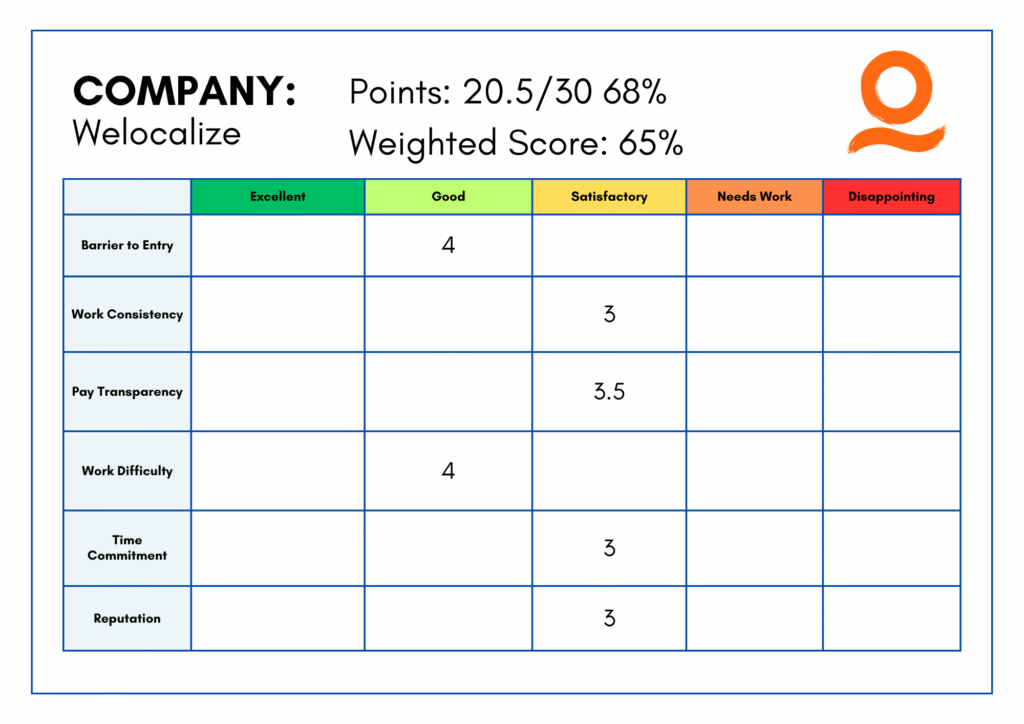
After reviewing everything, I gave Welocalize 20.5 points out of a possible 30 on my scorecard.
That translates to roughly 65% overall.
For an AI training and data annotation platform, that is actually one of the higher scores I have given.
There are no major red flags that stood out to me. The company has been around for decades, offers a huge variety of projects, provides relatively good pay transparency, and appears to pay workers consistently.
That does not mean it is perfect.
Work availability can still be inconsistent. The hiring process can be frustrating for some applicants. And like most AI training platforms, this should probably be viewed as supplemental income rather than a dependable full time career.
Still, compared to many competitors in the AI training and data annotation space, I think Welocalize is one of the stronger options available right now.
Who I Think It's Best For
Good for:
• Side income
• Flexible remote work
• AI training projects
• Data annotation work
• Linguists and language specialists
• People outside the United States
Not ideal for:
• Full-time income replacement
• Guaranteed work availability
• People who want immediate acceptance
Similar Platforms to Consider
If you're exploring AI training and data annotation work, there are a few other platforms worth looking at alongside Welocalize.
DataAnnotation is one of the most popular alternatives in this space right now. The work is very similar, with projects focused on evaluating AI responses, writing prompts, labeling data, and improving AI systems.
One advantage is that many workers report having access to a steady stream of projects once they're accepted. The downside is that getting approved can be difficult, and the platform doesn't always explain why applicants are rejected.
If you're able to get in, it can be one of the better options for AI training work.
Outlier offers many of the same types of projects as Welocalize, including AI evaluation, prompt engineering, and subject matter expert work.
The platform often advertises higher pay rates for specialized projects, particularly for people with backgrounds in fields like math, science, programming, finance, or writing.
Like most AI training companies, workload can fluctuate depending on demand, but it's one of the larger players in the industry and regularly adds new projects.
TELUS Digital is another long-established company that offers search evaluation, AI training, data annotation, and internet assessor positions.
In many ways, it feels similar to Welocalize. The company has been around for years, operates globally, and offers opportunities in numerous countries and languages.
The work can be inconsistent at times, but TELUS remains one of the most recognizable names in the search evaluation and AI training space.
Invisible Technologies focuses heavily on AI training and human feedback projects. Workers are often tasked with reviewing AI outputs, identifying mistakes, and helping improve model performance.
The platform tends to attract people looking for flexible remote work, although project availability can vary significantly depending on your background and area of expertise.
Many workers view it as a supplemental income source rather than a full-time replacement.
Bottom Line
If you're looking for AI training or data annotation work, I think Welocalize is worth considering.
It's not perfect, and I would still expect some inconsistency in project availability. However, the company's long history, project variety, transparent listings, and generally solid reputation put it ahead of many competing platforms.
You can certainly do worse in this industry, and based on everything I've seen, Welocalize remains one of the better AI training platforms available today.