
Last Updated on August 29, 2026 by Justin Bryant
Trymata is a usability-testing platform that pays people to record themselves testing websites, apps, and other digital experiences. It was previously called TryMyUI, and its testing system is now being integrated into QuestionPro UX.
I created a tester account, completed a practice test, reviewed the current testing process, and compared the platform across six categories: barrier to entry, work consistency, pay transparency, work difficulty, time commitment, and reputation.
The short version is that Trymata is legitimate, and the basic work is relatively easy. The main catch is that tests can be scarce, many standard tests pay only $5, and public feedback includes recurring complaints about technical problems, support, rejected tests, and payments.
That makes Trymata better suited to occasional extra money than dependable side-hustle income.
What Is Trymata, TryMyUI, and QuestionPro UX?
Trymata is the company formerly known as TryMyUI. Businesses use its platform to watch real people navigate websites, apps, and prototypes while explaining what they see, think, like, and find confusing.
In February 2026, Trymata announced that it would merge with QuestionPro and become part of the company's QuestionPro UX solution. Trymata said its unmoderated tests, moderated tests, user interviews, and focus groups would continue through the combined platform.
The transition explains why you may encounter several names:
- TryMyUI was the platform's original name.
- Trymata was the name adopted during its earlier rebrand.
- QuestionPro UX is the current system used for tester signup and login.
The Trymata website currently says existing accounts and tests have moved to the new system, while the old TryMyUI system remains available in view-only mode.

How Does Trymata Testing Work?
After creating a tester account, you provide demographic information and complete a practice test. Passing that qualification test determines whether you can receive paid opportunities.
A typical unmoderated test asks you to:
- Read a scenario and its instructions out loud
- Navigate a website, app, or prototype
- Complete tasks in the order shown
- Keep talking through what you see, think, and expect
- Explain anything confusing or difficult to use
- Answer a short survey after the recording
The customer is paying for your thought process, not just whether you can finish the task. Quietly clicking through the test will not provide the kind of feedback the platform expects.
You generally need a compatible computer or mobile device, a reliable internet connection, a microphone, and sometimes a webcam or other camera. You also need to be comfortable recording your screen and speaking continuously.
Is Trymata Legit?
Yes. Trymata is a real usability-testing company, and I was able to create an account and complete its test process. The company has operated under the TryMyUI and Trymata names for years, and its merger with QuestionPro is documented by QuestionPro's official announcement.
That does not automatically make it a strong opportunity. A platform can be legitimate while still offering inconsistent work, modest pay, technical frustration, or poor support. Those practical issues are what the scorecard is designed to measure.
Trymata Review Score
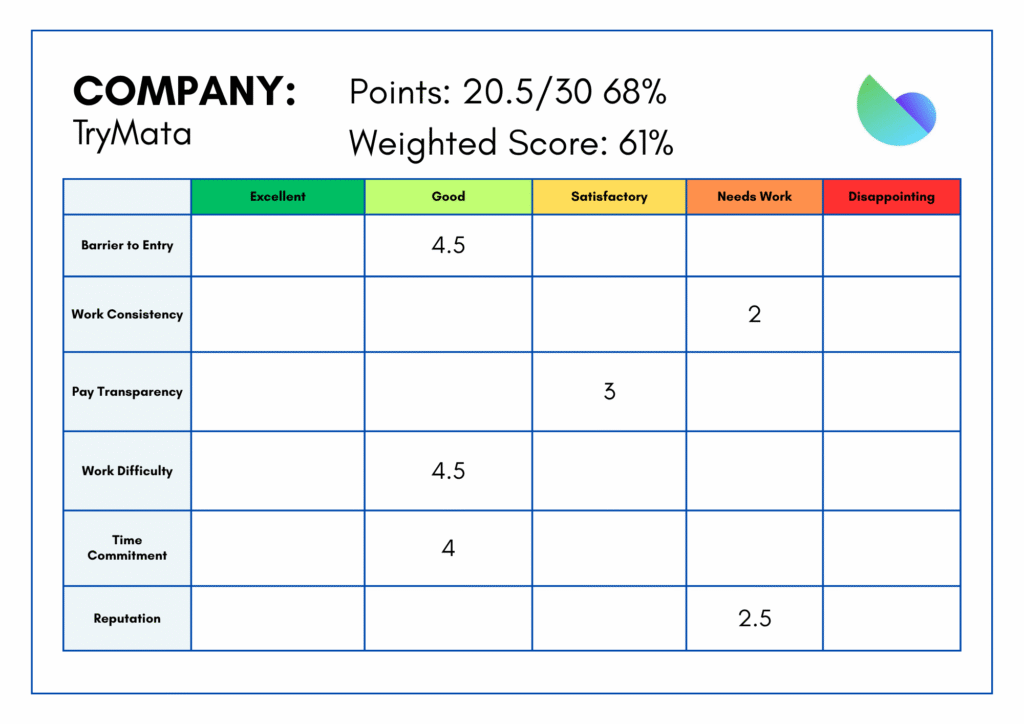
Category total: 20.5 out of 30, or about 68% without weighting.
Weighted score: 61% after giving reputation 50% of the overall score and each of the other five categories 10%.
A high score in work difficulty means the work is generally easier, not harder.
Barrier to Entry
Trymata has a relatively low barrier to entry because you do not need a degree, portfolio, or previous usability-testing job.
You do have to complete a practice test before receiving paid tests. The platform is evaluating whether you can stay on task and clearly explain everything you see, read, think, and do. Trymata's own site says panelists must pass a qualification test demonstrating their ability to vocalize and explain their thoughts.
This will be easier for some people than others. You may not enjoy the work if you dislike hearing your own recorded voice, appearing on camera, or continuously verbalizing thoughts that you would normally keep to yourself.
The equipment requirement also creates a small barrier. Depending on the test, you may need:
- A desktop computer, laptop, phone, or tablet
- A stable internet connection
- A working microphone
- A webcam or mobile-device camera
- A PayPal account or the payment setup requested in your tester account
Most people with ordinary technology and clear communication skills should at least have a chance to qualify.
Barrier-to-entry score: 4.5 out of 5.
Work Availability and Consistency
This is one of Trymata's biggest weaknesses.
Once accepted, matching tests can appear in your dashboard. The problem is that there may not be many of them. Availability varies by current research demand, your location, devices, demographic profile, and how closely you match each customer's requirements.
I would not expect most testers to receive guaranteed work every week. Even when a test appears, other eligible testers may claim it quickly.
This is very different from a remote job or a contract project that gives you a predictable block of paid hours. Trymata may produce a few isolated payments, but it does not create a reliable income schedule.
Work-consistency score: 2 out of 5.
Trymata Pay and Payment Transparency
Trymata has advertised payments of approximately $5 to $30 per test, depending on the format and length.
The most common unmoderated tests may pay only $5 to $10, with many at the $5 level. Higher-paying opportunities are more likely to involve a moderated session, live interview, or call with a UX researcher.
The platform previously paid more for some standard tests. Tester discussions documented a reduction from $10 to $5 for many 20- and 30-minute tests in 2023. That history matters because the largest advertised payout is not representative of what most available tests will necessarily pay.
One positive is that you can see a test's payout before completing it. In the account flow I reviewed, PayPal was the payment method, there was no large balance threshold to reach first, and payments were processed frequently after tests were reviewed and approved.
A $5 test completed in 20 minutes is mathematically equivalent to $15 per hour for that one recording. It is not the same as earning $15 per hour consistently. Qualification, waiting for invitations, setup, the post-test survey, uploads, rejected work, and long gaps with no tests can reduce your real return.
Pay-transparency score: 3 out of 5.
Work Difficulty
The basic work is straightforward.
During a test, the product being evaluated appears alongside the scenario, tasks, and instructions. You work through each task, talk about what you are trying to accomplish, and explain anything that attracts your attention or causes confusion.
Good feedback requires more than saying that a page looks nice or bad. You need to explain why you expected something to happen, what you were looking for, whether you found it, and what could improve the experience.
You should:
- Read every instruction carefully
- Complete tasks in the correct order
- Stay in the role or scenario provided
- Keep speaking instead of leaving long periods of silence
- Point out specific confusion, friction, or missing information
- Complete the short post-test questions
I consider this one of the easier types of online side-hustle work. The tradeoff is that easy, short tests usually do not pay very much.
Work-difficulty score: 4.5 out of 5.
Time Commitment
Trymata scores well for flexibility because you do not have to commit to a fixed weekly schedule.
The test I completed had a 20-minute target. My recording took 16 minutes and 12 seconds, followed by a four-question survey that took roughly another five minutes.
A normal unmoderated test may require approximately 15 to 25 minutes at one time. A live interview or moderated session can take longer and may require you to be available at a scheduled time.
This is not as quick as a five-minute survey or microtask, but it is still easier to fit around another job than a side hustle requiring set shifts or large uninterrupted blocks of time.
Time-commitment score: 4 out of 5.
Trymata and QuestionPro UX Reputation
Trymata's reputation is mixed, and the multiple company names make the evidence more difficult to interpret.
When checked on August 29, 2026, the TryMyUI Glassdoor page displayed 3.3 out of 5 from five ratings, with 65% saying they would recommend the company to a friend. Five ratings are too few to support a strong conclusion, and Glassdoor feedback is not a controlled measure of the average tester's earnings.
The Better Business Bureau profile for Trymata lists the business as starting in 2015 and identifies TryMyUI, Inc. and Trymata, Inc. as alternate names. The profile supports that this is an established legal business, but a BBB profile alone does not prove that the tester experience is good.
At the same check, Trymata's unclaimed Trustpilot profile displayed 2.5 out of 5 from 50 reviews. Fifty-eight percent of the ratings were one star. Recent complaints mentioned failed uploads, weak support, low pay, account issues, and tests that reviewers said were not paid.
QuestionPro's broader Trustpilot profile displayed 2.1 out of 5 from 13 reviews. I would not treat that as a clean rating for QuestionPro UX testers because the profile covers the larger QuestionPro business and its survey products. It is still a caution signal, but not a precise measure of this specific side hustle.
Reddit feedback is also mixed. Some testers report completing tests and receiving payments without major trouble. Others describe low test volume, technical problems, poor support, rejected recordings, or payments that they had to chase. Reddit posts are individual experiences, not representative statistics, so I would not label the platform a scam based only on those complaints.
My own experience was more functional than some of the worst reports. I completed the test process and did not find the recorder especially difficult to use. I did find the login flow confusing because testers must use the correct portal instead of accidentally entering the researcher side of the platform.
The name changes are now explainable: TryMyUI rebranded to Trymata, and Trymata later merged into QuestionPro UX. Even so, the fragmented review history, small samples on some sites, pay reduction, and recurring technical and payment complaints justify caution.
Reputation score: 2.5 out of 5.
Verdict: Is Trymata Worth It?
Trymata is legitimate, but I would only use it as an occasional extra-income option.
The work is approachable, individual tests are short, the schedule is flexible, and the platform tells you what a test pays before you complete it. Those are real advantages.
The weaknesses are more important if you need meaningful income. Test availability is inconsistent, many ordinary tests pay only $5, and public feedback raises concerns about failed uploads, rejected work, support, and payments. Even a smooth $5 test does not help much if you receive very few invitations.
Good for:
- People who enjoy evaluating websites and apps
- Clear communicators who are comfortable thinking out loud
- Anyone who wants short, flexible tasks with no fixed schedule
- People treating the platform as occasional pocket money
- Testers willing to judge the platform by their own approved earnings
Not ideal for:
- Anyone who needs dependable weekly income
- People who dislike recording their screen, voice, or camera
- Anyone who expects steady access to tests
- People who would be frustrated by technical or support problems
- Anyone counting on the advertised $30 maximum for most tests
My category scores add up to 20.5 out of 30. After giving reputation more weight, Trymata receives a 61% overall score.
My verdict is legitimate and easy enough to try, but too inconsistent and too mixed in reputation to rely on. If you sign up, complete only tests whose payout looks worthwhile, follow every instruction closely, and treat any earnings as a small bonus rather than part of your monthly budget.
Frequently Asked Questions
Is Trymata a scam?
I do not consider Trymata a scam. It is an established usability-testing platform that now operates through QuestionPro UX, and I was able to create an account and complete its testing process. However, some public reviewers report rejected tests, missing payments, technical failures, and weak support. Legitimate does not mean risk-free or dependable.
Is Trymata now QuestionPro?
Trymata announced a merger with QuestionPro in February 2026. Its customer tools are becoming part of QuestionPro UX, and the current tester signup and login use the QuestionPro UX domain. The Trymata website remains online as the public home of the tester community.
Is Trymata the same as TryMyUI?
Yes. TryMyUI rebranded to Trymata. The later QuestionPro merger created another branding transition, which is why old reviews and account pages may use different names.
How much does Trymata pay?
Trymata has advertised approximately $5 to $30 per test. Many ordinary unmoderated tests may pay only $5 to $10, while higher payments are more likely to involve live, moderated, or interview-style research. The amount and frequency of available work are not guaranteed.
How does Trymata pay testers?
The tester flow I reviewed used PayPal. Payment details can change during the QuestionPro UX transition, so confirm the method shown in your account before completing work.
How long does a Trymata test take?
A typical unmoderated test may take about 15 to 25 minutes, followed by a short survey. My own recording took 16 minutes and 12 seconds, plus roughly five minutes for four post-test questions. Moderated sessions and interviews can take longer.
Do you need experience to become a Trymata tester?
You do not necessarily need professional testing or UX experience. You must complete a practice test and show that you can follow instructions, stay on task, and clearly explain your thoughts while navigating a digital product.
Can Trymata replace a job?
No. Test availability is too inconsistent for most people to treat Trymata as a reliable job. It is better viewed as a source of occasional extra money.
How much can you realistically make with Trymata?
Your results will depend on your profile and the number of tests available. I would not build a monthly income plan around the platform. Reaching roughly $100 in a strong month may be possible for some testers, but it should not be presented as a normal or guaranteed result.
More User-Testing and Side-Hustle Options
If Trymata does not provide enough work, compare it with other platforms instead of waiting for one dashboard to become consistent:
Each platform makes a different tradeoff between ease of entry, available work, pay, flexibility, and reputation. Trymata performs well for simplicity and time commitment, but its low work consistency and mixed public feedback keep it from being one of the stronger options to depend on.