
Last Updated on August 13, 2026 by Justin Bryant
A lot of AI certifications teach you the concepts and then give you a multiple-choice exam to prove you understood them.
AWS Agentic AI Demonstrated takes a very different approach.
Instead of answering questions about how you would build or troubleshoot an AI solution, AWS puts you into a provisioned environment and asks you to actually work with the technology.
That immediately made this one of the more interesting AI credentials for me to review.
There is one important distinction, though.
AWS Agentic AI Demonstrated is a microcredential. It is not one of the traditional AWS Certification exams.
The current version focuses on working with Amazon Bedrock AgentCore, including Runtime, Gateway, and Memory. AWS substantially updated the microcredential in May 2026, so if you have seen older information about it, make sure you're looking at the current version.
The other big change came in April 2026, when AWS made its microcredentials free. AWS says you no longer need an AWS Skill Builder subscription to access them.
So the question I wanted to answer was simple.
Is AWS Agentic AI Demonstrated actually worth earning?
I evaluated it using six criteria. Employer signal accounts for 25% of my score. Career upside and skill proof are each worth 20%. Real-world skill value is worth 15%. Cost value and time efficiency are each worth 10%.
After adding everything together, AWS Agentic AI Demonstrated earned 82 out of 100.
That's one of the stronger scores I've given an AI credential.
Its biggest advantage is skill proof. You're actually being asked to configure, integrate, and troubleshoot AWS services instead of simply memorizing information for an exam.
But there are some important limitations.
It's technical, specialized, and heavily focused on the AWS ecosystem. I also found much stronger evidence that employers want the underlying skills than evidence that they're specifically asking candidates to have this exact microcredential.
Here's how I scored it.
Employer Signal
My Score: 3 out of 5
Employer signal is the most heavily weighted category in my certification reviews because I want to know whether employers actually care about the credential you're spending time earning.
AWS obviously has an advantage here.
Amazon Web Services is one of the biggest names in cloud computing, and AWS already has an established professional certification ecosystem.
But there's an important distinction between AWS certifications and AWS Agentic AI Demonstrated.
This is a newer microcredential.
AWS positions it as a way to demonstrate practical skills and as a complement to credentials such as its Generative AI Developer Professional certification. It isn't meant to replace one of those broader role-based certifications.
When I looked at current job demand, I found evidence that the skills behind the microcredential are relevant.
Employers are looking for experience with areas such as Amazon Bedrock, Bedrock AgentCore, AI agent deployment, tool integration, observability, and production AI systems.
What I didn't find was meaningful evidence that employers are regularly asking applicants to have the exact AWS Agentic AI Demonstrated microcredential.
That's an important difference.
Learning how to work with Bedrock AgentCore could absolutely be valuable. But I wouldn't assume a hiring manager is going to recognize this particular credential in the same way they might recognize one of the established AWS certifications.
Part of that may simply come down to timing.
AWS launched the microcredential relatively recently and substantially updated it in May 2026. Employer awareness may grow as more people earn it.
For now, though, I think its strongest employer value is probably for people who are already working around AWS.
That could include cloud developers, solutions architects, AI engineers, consultants, DevOps professionals, and other technical workers who want another way to demonstrate practical AWS skills.
That's why I gave employer signal 3 out of 5.
The AWS name carries weight, and the underlying skills have real employer demand. I just didn't find enough evidence that employers are specifically requesting this exact microcredential to score it any higher.
Career Upside
My Score: 4 out of 5
Career upside is where AWS Agentic AI Demonstrated starts to separate itself from some of the more basic AI credentials I've reviewed.
The skills being assessed are directly connected to building and operating AI agents on AWS.
The current version focuses on practical work with Amazon Bedrock AgentCore, including Runtime, Gateway, and Memory. You're dealing with areas such as implementing AI agents, integrating services, deploying them, and troubleshooting problems.
Those are much more technical skills than simply understanding what generative AI or large language models are.
I also found current AWS job listings that connect Bedrock and AgentCore experience with software engineering, solutions architecture, AI and machine learning, consulting, and production deployment work.
So while employers may not specifically ask for the AWS Agentic AI Demonstrated microcredential, the underlying skills do have career value.
I think that's an important distinction.
I wouldn't earn this because I expect the credential name alone to get me hired. I'd earn it because it gives me a structured way to develop and demonstrate skills that are being used in actual AWS AI environments.
AWS also positions Agentic AI Demonstrated as a complement to its Generative AI Developer Professional certification.
I think that's probably the best way to look at it.
If you already have experience with cloud computing, software development, DevOps, data, or AI, this could be a useful addition to your existing skill set. It gives you a way to demonstrate more specialized experience with agentic AI without having to earn another broad certification.
The limitation is that it is still very narrow.
Passing this microcredential doesn't prove that you have broad software engineering, cloud architecture, or machine learning skills. It specifically demonstrates your ability to work with a particular group of AWS agentic AI technologies.
I also wouldn't recommend looking at it as an easy way for someone with no technical background to break into AI.
The career upside is much stronger for someone who already understands AWS fundamentals and has technical skills they can build on.
That's why I gave career upside 4 out of 5.
The underlying skills have meaningful value for several technical career paths, and I can see this being particularly useful for existing AWS professionals who want to move further into generative and agentic AI.
I just wouldn't expect the microcredential by itself to create an entirely new career path without supporting experience, projects, or broader technical skills.
Skill Proof
My Score: 5 out of 5
Skill proof is where AWS Agentic AI Demonstrated really stands out.
A lot of certifications and microcredentials rely on multiple-choice exams. You study the material, memorize the concepts, and then answer questions about what you learned.
That's not how this assessment works.
AWS says its microcredentials use simulated business scenarios inside a provisioned AWS environment. There are no multiple-choice questions.
Instead, you're expected to actually perform tasks.
Depending on the scenario, that can mean configuring services, troubleshooting problems, integrating components, repairing an existing solution, or improving how something works.
For AWS Agentic AI Demonstrated specifically, the current version validates practical work with AI agents using Amazon Bedrock and Bedrock AgentCore.
That's a major difference for me.
If you pass a traditional multiple-choice certification exam, I know you've demonstrated some level of knowledge about the subject. But that doesn't necessarily tell me whether you can sit down in an AWS environment and actually perform the work.
This microcredential provides much stronger evidence of that.
AWS is essentially giving you a scenario and asking you to demonstrate that you know what you're doing rather than asking you to choose the correct answer from a list.
That's about as close as you can get to the type of assessment I want to see when evaluating skill proof.
It also makes the credential more interesting for someone who already has traditional certifications.
If you've already proven that you understand AWS concepts through a certification exam, a hands-on microcredential gives you another way to demonstrate that you can apply some of that knowledge in a practical environment.
Of course, this doesn't mean AWS Agentic AI Demonstrated proves every skill you would need for an AI or cloud position.
The assessment is still focused specifically on agentic AI and AWS technologies.
But within that scope, the assessment itself is strong.
That's why I gave SkillProof a perfect 5 out of 5.
You're not getting the credential simply for finishing a course or passing a basic quiz. You're being placed into a provisioned environment and asked to configure, integrate, and troubleshoot actual AWS solutions.
For me, that's much stronger evidence of practical ability than a standard multiple-choice assessment.
Real World Skill Value
My Score: 5 out of 5
Real-world skill value is another category where AWS Agentic AI Demonstrated scores extremely well.
This category is a little different from skill proof.
Skill proof looks at whether the assessment actually tests your abilities. Real-world skill value looks at whether the things you're being tested on are useful for actual work.
In this case, I think they are.
The assessment is built around the types of tasks you could realistically encounter when working with agentic AI on AWS.
That includes configuring services, connecting different components, troubleshooting failures, and improving an existing solution.
The current version also focuses on Amazon Bedrock AgentCore features including Runtime, Gateway, and Memory.
These aren't just abstract AI concepts.
They're technologies used to build and operate agentic AI systems on AWS.
I also found that the underlying skills connect to current AWS work involving agent runtimes, gateways, memory, tool integration, deployment, and operational troubleshooting.
That's why I think there's a meaningful difference between this microcredential and a beginner AI course.
A foundational course might teach you what an AI agent is or explain how generative AI works.
AWS Agentic AI Demonstrated is asking you to work with the infrastructure and services behind those systems.
That makes the skills much easier to connect to real projects.
If you're a developer, solutions architect, consultant, or cloud professional, I can see these skills being useful when building or supporting agentic AI applications in an AWS environment.
There is one obvious limitation.
The skills are heavily AWS-specific.
Learning Amazon Bedrock AgentCore doesn't necessarily mean you'll know how to build the same solution using another cloud provider or a completely different agent development stack.
But I don't think that takes away from the practical value of what you're learning.
It just narrows where those skills are most useful.
That's why I gave real-world skill value 5 out of 5.
The tasks map closely to actual cloud AI work, and you're practicing skills that can be applied to AWS projects, consulting work, development, and adjacent architecture roles.
If you already work with AWS or expect to use AWS for AI projects, I think this is one of the strongest parts of the microcredential.
Cost Value
My Score: 5 out of 5
Cost value is another major strength of AWS Agentic AI Demonstrated.
As of April 23, 2026, AWS says its microcredentials are free.
You also don't need a paid AWS Skill Builder subscription to access them.
That means you're getting access to a hands-on assessment in a provisioned AWS environment and, if you successfully complete it, an AWS-issued microcredential without paying an exam fee.
That's unusually good value.
I've reviewed plenty of credentials where the training itself is free, but you eventually hit a paywall when it's time to take the assessment or receive the actual credential.
That doesn't appear to be the case here.
The fact that the assessment is hands-on makes the free price even more impressive to me.
AWS isn't simply giving you a few videos and a basic quiz. It's providing an environment where you're expected to demonstrate practical skills with its technology.
If this microcredential still had a significant exam fee, I'd have to think much more carefully about whether the narrow focus and limited employer recognition justified the cost.
At $0, that calculation changes quite a bit.
If you already have the AWS knowledge needed to attempt it, there's very little financial downside to seeing whether you can earn the credential.
There is one thing I would confirm before starting.
Because AWS only recently made its microcredentials free, I recommend going through the current enrollment process with a free AWS Skill Builder account and making sure there isn't a payment or subscription requirement anywhere between enrollment and receiving the credential.
Based on AWS's current information, though, the microcredential itself is free and doesn't require a Skill Builder subscription.
That's why I gave cost value a perfect 5 out of 5.
For $0, you're getting the opportunity to complete a practical AWS assessment and potentially earn a vendor-issued credential that demonstrates hands-on agentic AI skills.
Time Efficiency
My Score: 5 out of 5
With the current AWS Skill Builder information, time efficiency is another area where AWS Agentic AI Demonstrated scores extremely well.
The current course page lists a duration of 2 hours and 10 minutes.
Once you start the assessment, you have 130 minutes to complete all of the challenges inside the live exam lab.
For me, that's a very reasonable time commitment considering the type of skill proof you're getting.
This isn't two hours of watching videos followed by a basic quiz. You're working inside a provisioned AWS environment and completing practical challenges involving agentic AI services.
There are also a couple of important rules to understand before you start.
The assessment cannot be paused or restarted once it's underway. You'll want to make sure you have the full 130 minutes available and can complete it without interruptions.
You should also take the assessment seriously before using an attempt.
If you fail, AWS requires you to wait 25 days before trying again.
The biggest caveat is preparation time.
I don't think a complete beginner should look at the 2-hour and 10-minute duration and assume that's all the time they'll need to earn this microcredential.
AWS recommends preparing through resources such as its Agentic AI Learning Plan and Generative AI SimuLearn paths.
If you already understand AWS, Amazon Bedrock, and agent development, you may be able to move into the assessment relatively quickly.
If you're new to those technologies, your actual time commitment could be substantially longer because you'll need to develop those skills first.
I'm still giving time efficiency 5 out of 5 because I'm evaluating the credential for the type of learner it's designed for.
For someone who already has the recommended AWS background, a focused 130-minute practical assessment is an extremely efficient way to demonstrate meaningful hands-on skills.
Just don't confuse the assessment duration with the amount of preparation a beginner may need.
That's why I give AWS Agentic AI Demonstrated 5 out of 5 for time efficiency.
Overall Score
After scoring AWS Agentic AI Demonstrated across all six categories, I gave it a final score of 86 out of 100.
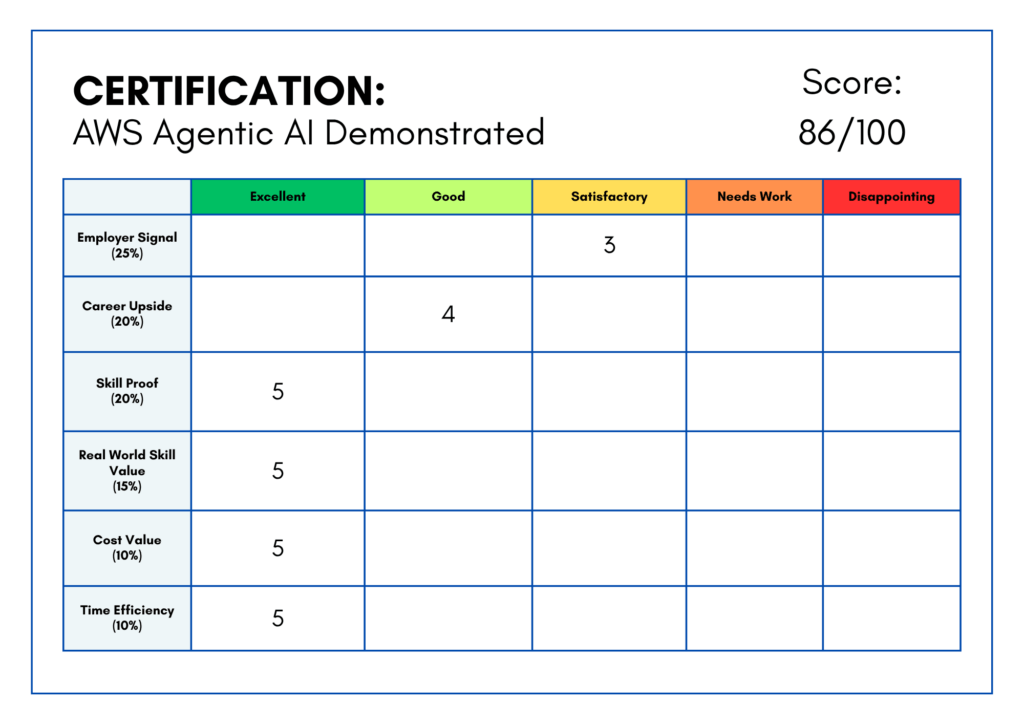
For me, that 86 reflects what makes this credential different from a lot of the AI programs I've looked at.
Its biggest strength is that you're actually demonstrating practical skills.
You're not earning the credential simply by watching training videos or passing a multiple-choice exam. AWS puts you into a provisioned environment where you have to work with agentic AI services and solve practical problems.
That resulted in perfect scores for both skill proof and real-world skill value.
The fact that AWS now offers its microcredentials for free also gave it a perfect score for cost value.
Where it loses points is employer recognition and time efficiency.
I found evidence that employers are looking for the underlying AWS, Amazon Bedrock, and agentic AI skills. What I didn't find was much evidence that employers are specifically requesting the AWS Agentic AI Demonstrated microcredential by name.
The time commitment is also difficult to predict because AWS doesn't provide enough public information about how long the current assessment and preparation should take. If you already understand AWS and Bedrock, it could be fairly efficient. If you're starting from scratch, you'll probably need considerably more preparation.
My Final Verdict
I think AWS Agentic AI Demonstrated is an excellent practical credential for technical AWS learners, but it's probably not the best place for a complete beginner to start.
If you're already a developer, solutions architect, DevOps engineer, consultant, or another technical professional working with AWS, I think this is worth considering.
You're getting an opportunity to demonstrate practical agentic AI skills without paying for the assessment.
I especially like it as a complement to a broader AWS certification.
A traditional AWS certification can demonstrate that you understand a wider range of concepts. AWS Agentic AI Demonstrated gives you a different type of proof by showing that you can actually perform tasks inside an AWS environment.
That's a strong combination.
What I wouldn't do is assume that earning this microcredential by itself is going to qualify you for an AI engineering position.
It's too specialized for that.
The assessment focuses specifically on agentic AI within the AWS ecosystem, including Amazon Bedrock AgentCore. It doesn't demonstrate broad competence across software engineering, machine learning, cloud architecture, or every other skill an employer may expect.
So I would treat this as an addition to an existing technical skill set rather than a replacement for one.
Who I Think Should Get This Microcredential
I think AWS Agentic AI Demonstrated makes the most sense if you already have some technical experience and want to demonstrate practical AI skills within AWS.
That includes developers, cloud professionals, solutions architects, DevOps engineers, consultants, and technical learners who already understand AWS fundamentals.
It could also make sense if you're already working with Amazon Bedrock and want something you can use to document that experience.
The fact that it's free makes the decision easier.
If you already have the background knowledge needed to attempt the assessment, there isn't much financial downside to earning another AWS-issued credential that demonstrates practical skills.
Who Should Skip It
I wouldn't make AWS Agentic AI Demonstrated my first AI credential if I were a complete beginner.
There are easier ways to learn basic concepts such as generative AI, large language models, and AI agents before jumping into a hands-on AWS environment.
This also isn't the credential I'd choose if my main goal were simply adding the most recognizable AWS certification possible to my resume.
AWS itself positions Agentic AI Demonstrated as a complementary credential rather than a replacement for its broader certification exams.
If you're starting from scratch, I'd build the foundational knowledge first.
Then this microcredential becomes much more interesting because you can use it to prove that you're capable of applying some of that knowledge.
One Important Distinction
One thing I want to emphasize is that AWS Agentic AI Demonstrated is not an AWS Certification.
It's an AWS microcredential.
That doesn't make it less legitimate, but I wouldn't list it on a resume or LinkedIn profile in a way that implies you passed one of AWS's traditional certification exams.
The value here comes from the practical assessment.
AWS gives you a simulated business scenario in a provisioned environment and asks you to demonstrate that you can work with the technology.
That's exactly why I scored its skill proof so highly.
Final Thoughts
AWS Agentic AI Demonstrated earns 86 out of 100.
For me, its biggest advantage is simple.
You actually have to demonstrate that you can do the work.
The credential is free, the assessment is hands-on, and the skills connect to real work involving Amazon Bedrock, Bedrock AgentCore, agent deployment, integration, and troubleshooting.
The tradeoff is specialization.
I found much stronger evidence that employers want these underlying skills than evidence that they're specifically asking for this exact microcredential.
That's why I wouldn't earn it just for the name.
I'd earn it if I were already building my AWS skills and wanted a practical way to demonstrate that I can work with agentic AI.
For the right person, especially someone who already has technical AWS experience, I think that's enough to make AWS Agentic AI Demonstrated worth doing.