
Last Updated on August 14, 2026 by Justin Bryant
Kaggle Intro to Machine Learning is a free, hands-on course that teaches learners how to explore data, build models, validate results, and improve model performance.
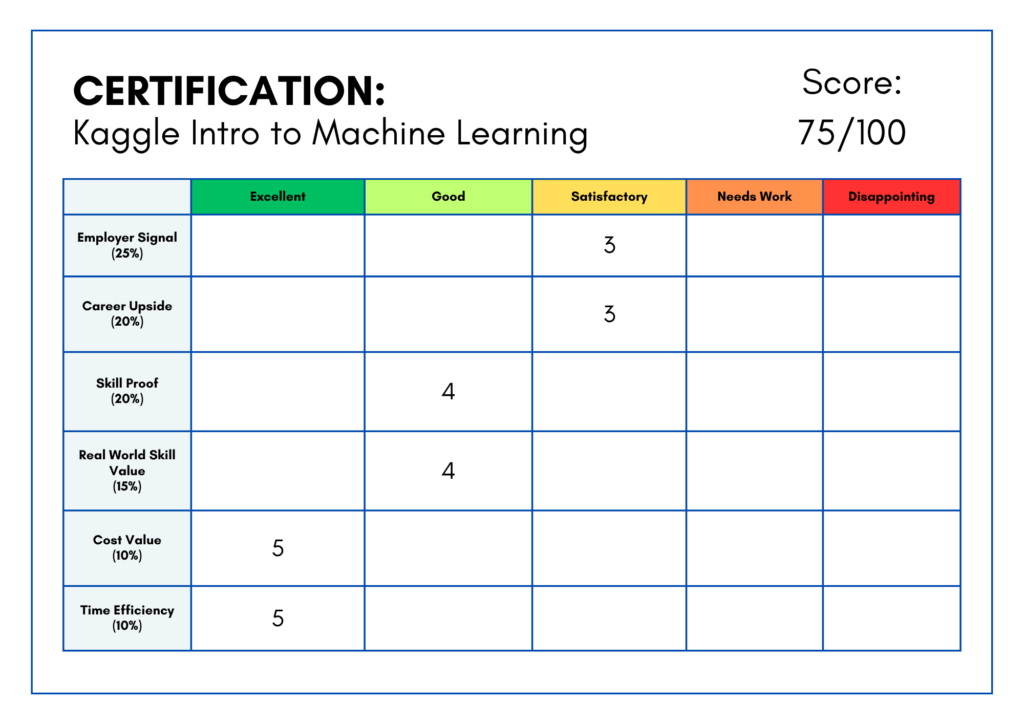
Kaggle publishes a completion time of approximately three hours and awards a course certificate. The combination of short duration and real coding exercises helped it earn 75 out of 100 in my free AI credential scorecard.
The course is an excellent fast introduction for someone who already knows basic Python. It is not enough to prepare a person for a professional machine-learning role by itself.
Kaggle Intro to Machine Learning Review Summary
Best for: Learners with basic Python who want a fast, practical introduction to machine learning.
Not ideal for: Noncoders or anyone expecting one short certificate to establish professional ML competence.
What Is Kaggle Intro to Machine Learning?
Kaggle is an online data-science and machine-learning community owned by Google. Its Learn platform offers short, no-cost courses with interactive coding exercises.
Intro to Machine Learning contains seven lessons:
- How models work
- Basic data exploration
- Building your first machine-learning model
- Model validation
- Underfitting and overfitting
- Random forests
- Machine-learning competitions
Each lesson combines a tutorial with an exercise. Learners work in Kaggle's notebook environment rather than only reading about the concepts.
Is the Kaggle Course Free?
Yes. Kaggle labels Intro to Machine Learning as no cost, like the other Kaggle Learn courses.
You will need a Kaggle account to save your work and receive the course certificate. There is no separate exam or certificate fee listed.
How Long Does It Take?
Kaggle publishes three hours to earn the certificate.
That estimate makes it one of the fastest credentials in the comparison. The time applies to the machine-learning course itself, not the Python preparation a new coder may need first.
If you are unfamiliar with Python, pandas, or notebook environments, start with Kaggle's Python course or another programming introduction before expecting to finish in three hours.
What Do the Exercises Prove?
The course requires learners to write and run code while working through a basic model-development process.
Exercises cover:
- Loading and inspecting data
- Selecting prediction targets and features
- Building a model
- Measuring model error
- Comparing model complexity
- Using random forests
- Preparing for Kaggle competitions
This is stronger than a completion-only certificate because learners interact with real data and code. The exercises remain guided, introductory, and unproctored, so the certificate does not prove independent professional-level ability.
Employer Signal: 3/5
Kaggle is well known in data-science and machine-learning communities. A developed Kaggle profile, competition results, notebooks, and projects can provide useful evidence to employers.
I did not find strong evidence that employers frequently require the exact Intro to Machine Learning certificate. The short certificate is a supporting signal, while a learner's broader Kaggle work and portfolio will matter more.
Career Upside: 3/5
The course can help someone begin a data-science or machine-learning path and decide whether they enjoy model-building work.
It also provides the foundation needed for Kaggle's intermediate machine-learning, feature engineering, data visualization, and other courses.
Three hours of introductory training will not qualify someone for a machine-learning job. Career value comes from continuing into larger projects, mathematics, statistics, data preparation, and software skills.
Skill Proof: 4/5
Kaggle earns a strong score because every major topic includes a coding exercise.
The learner does more than watch videos or answer multiple-choice questions. They build models and validate results inside a working notebook environment.
The course stops at 4 because the exercises are guided, the credential is unproctored, and the scope is too small to demonstrate independent ML competence.
Real-World Skill Value: 4/5
The basic workflow—inspect data, choose features, train a model, measure error, and improve performance—is directly relevant to practical machine-learning work.
These are genuine transferable skills. The course does not cover the broader data cleaning, deployment, monitoring, experimentation, and engineering requirements found in professional projects.
Pros and Cons
Pros
- Completely free
- Approximately three hours
- Interactive coding exercises
- Recognizable Kaggle platform
- Teaches a real model-development workflow
- Natural path into more advanced Kaggle courses and competitions
Cons
- Requires Python preparation
- Introductory and guided
- Certificate is not commonly requested by employers
- Does not cover the full machine-learning lifecycle
- Too short to establish job readiness
Who Should Take It?
Kaggle Intro to Machine Learning is a good fit for:
- Python beginners ready to try machine learning
- Data analysts exploring predictive modeling
- Students who prefer hands-on exercises
- Job seekers beginning a technical portfolio
- Learners considering Kaggle competitions
Nontechnical learners may be better served by a broader AI-literacy course before attempting the code.
How to Enroll
- Open Kaggle Intro to Machine Learning.
- Create or sign in to a free Kaggle account.
- Confirm that you have enough Python preparation.
- Complete each tutorial and coding exercise.
- Finish the course to receive the certificate on your Kaggle profile.
- Continue into an intermediate course or create a larger independent notebook.
Final Verdict: Is Kaggle Intro to Machine Learning Worth It?
Kaggle Intro to Machine Learning is worth it for someone who understands basic Python and wants a fast, practical first experience with model building.
It earned 75 out of 100 because it provides real coding exercises, transferable introductory skills, a recognizable platform, and a free certificate in about three published hours.
The certificate alone will not get someone hired. Its best use is as the first small step toward deeper Kaggle courses, competitions, and independent projects.
Last verified: August 14, 2026.
Frequently Asked Questions
Is Kaggle Intro to Machine Learning free?
Yes. Kaggle lists it as a no-cost course and includes a certificate.
How long does it take?
Kaggle publishes approximately three hours.
Do I need Python?
Yes. The course builds on Python. New coders should complete Python preparation first.
Does it include coding exercises?
Yes. Each major lesson includes practical work in Kaggle's notebook environment.
Is the certificate enough for a machine-learning job?
No. It is an introductory credential that should lead into deeper courses and projects.