
Last Updated on July 21, 2026 by Justin Bryant
When people search for remote jobs, We Work Remotely is usually one of the first websites they come across.
Considering it's one of the oldest remote-only job boards on the internet, that isn't surprising.
Unlike general job boards that mix office jobs, hybrid positions, and remote opportunities together, We Work Remotely focuses almost entirely on remote work. That immediately makes it appealing for anyone who doesn't want to waste time filtering through thousands of traditional job listings.
On the surface, the platform looks impressive.
It advertises tens of thousands of remote jobs, features positions from recognizable companies, and has built a strong reputation over the years within the remote work community.
But after spending time using the platform, exploring its filters, reviewing the available listings, and comparing it with several other remote job boards, I think the experience is more mixed than many people expect.
Some aspects are excellent.
Others haven't kept pace with newer job boards.
In this review, I'm going to evaluate We Work Remotely using the same scorecard I use for every job board I review.
Rather than simply giving my opinion, I'll score it across six categories that I think matter most to job seekers:
- Number of Jobs & Coverage
- Listing Quality & Freshness
- Safety & Verification
- Filtering
- Transparency & Cost
- User Experience & Control
At the end, I'll explain how those scores produced an overall rating of 15.5 out of 30 (52%), whether I think We Work Remotely is worth using today, and why it isn't currently my first recommendation for people looking for entry-level remote jobs.

What Is We Work Remotely?
We Work Remotely is one of the largest job boards dedicated exclusively to remote work.
Unlike websites such as Indeed or LinkedIn that list every type of job imaginable, We Work Remotely focuses almost entirely on positions that can be performed remotely.
Employers pay to post openings across categories such as:
- Customer Support
- Programming
- Design
- Marketing
- Sales
- Product Management
- Finance
- AI-related work
- Writing
- Operations
That narrower focus is one of the platform's biggest strengths.
If your only goal is finding remote work, you don't have to spend time filtering out thousands of office jobs first.
However, I also think this specialization creates higher expectations.
Because the website focuses on one thing exceptionally well, I expect it to outperform general job boards in the areas that matter most.
As I continued reviewing the platform, I found that wasn't always the case.
My Review Methodology
Before jumping into the scores, I think it's important to explain how I evaluate job boards.
A website can advertise thousands of jobs, but that doesn't necessarily make it useful.
Likewise, a smaller job board with better filtering and higher-quality listings may save you far more time during your job search.
For that reason, I don't simply judge platforms based on how many listings they display.
Instead, I score each one across six categories.
Number of Jobs & Coverage
How many legitimate opportunities are available?
Do they cover different industries, experience levels, and countries?
Listing Quality & Freshness
Are the listings recent?
Are they duplicates?
Do they clearly describe the position?
Safety & Verification
How much effort does the platform make to reduce scams and misleading listings?
Filtering
Can I actually narrow my search efficiently?
Can I filter by experience level, salary, location, employment type, and other meaningful criteria?
Transparency & Cost
Does the platform clearly explain what employers are paying?
Is pricing transparent?
Are important details missing?
User Experience & Control
Finally, I evaluate how enjoyable the website actually is to use.
Can I quickly find relevant jobs?
Can I customize my searches?
Does the platform help me save time, or does it create more work?
These categories form the basis for every job board review I publish.
Number of Jobs & Coverage
Score: 2 out of 5
This was actually the category that surprised me the most.
At first glance, We Work Remotely appears enormous.
The website proudly references more than 40,000 remote jobs over its lifetime, which certainly sounds impressive.
But that's also where I think the marketing becomes a little misleading.
When I actually searched the platform, there were only around 235 active job listings available.
That's a very different number.
Now, to be fair, there isn't anything inherently wrong with highlighting how many jobs have been posted over the years.
The problem is that many people naturally assume they're looking at tens of thousands of current opportunities when that's simply not the case.
For me, active listings matter far more than historical totals.
After all, I can't apply for a job that was posted three years ago.
The current selection also felt surprisingly narrow in several categories.
If you're an experienced software engineer or someone working in technology, you'll probably have more opportunities than someone looking for customer service, administrative work, or true entry-level positions.
That was one of the biggest weaknesses I noticed.
The platform clearly favors certain industries.
Another issue is geographic coverage.
Although many jobs are remote, a significant number still require applicants to live in specific countries or time zones.
So while the website specializes in remote work, not every listing is location independent.
Overall, I don't think We Work Remotely performs poorly here.
I just think the platform's marketing creates expectations that the current inventory doesn't fully meet.
That's why I ended up giving Number of Jobs & Coverage a 2 out of 5.
Listing Quality & Freshness
Score: 3 out of 5
Once I moved beyond the number of available jobs, the next thing I wanted to evaluate was the quality of the listings themselves.
After all, I'd much rather browse 200 high-quality opportunities than 2,000 outdated or duplicate listings.
Overall, I came away with mixed feelings.
The positive news is that most listings on We Work Remotely are well written.
Employers generally provide detailed job descriptions, explain the responsibilities, outline the qualifications they're looking for, and include information about the company. Compared to some general job boards that scrape listings from dozens of different websites, the overall presentation feels much more professional.
I also noticed that many of the companies posting on the platform are recognizable businesses or established startups rather than unknown employers with little online presence.
That immediately increases my confidence.
However, I don't think the platform deserves top marks here.
One of the first things I noticed while browsing was that many positions weren't particularly recent. Although new jobs are added regularly, I found plenty of listings that had already been available for several weeks.
Now, that doesn't necessarily mean the jobs are no longer accepting applications. Some companies intentionally leave positions open while they're hiring. Still, as a job seeker, I generally prefer platforms where it's immediately obvious what's new and what's getting older.
Freshness matters.
When you're competing for remote jobs, being one of the first applicants can make a significant difference.
Another issue is the relatively small number of new postings each day.
Because the overall inventory isn't especially large, it's easy to reach a point where you've already seen most of the available opportunities.
That makes We Work Remotely a platform I would check periodically rather than multiple times throughout the day.
I also think the platform could do a better job highlighting recently added listings, trending employers, or jobs that have been updated since your last visit.
Features like those help frequent users avoid reviewing the same listings over and over again.
What I Like
- Detailed job descriptions.
- Professional presentation.
- Generally legitimate employers.
- Less clutter than many general job boards.
What I Don't Like
- Limited number of new listings.
- Some jobs remain posted for long periods.
- Few tools to surface newly added opportunities.
- Easy to run out of fresh listings.
My Score: 3 out of 5
The listings themselves are generally good.
I just wish there were more of them and that the platform made it easier to identify the newest opportunities.
Safety & Verification
Score: 2 out of 5
Safety has become one of the most important factors I evaluate when reviewing job boards.
Unfortunately, remote work has become one of the biggest targets for online scams.
Every year, more fake employers appear offering unrealistic salaries, fake interviews, commission-only jobs disguised as salaries, or phishing attempts designed to collect personal information.
Because of that, I expect remote-only job boards to take verification seriously.
This is one area where I think We Work Remotely leaves room for improvement.
To be clear, I'm not saying the platform is full of scams.
Far from it.
Most of the listings I reviewed appeared to come from legitimate companies.
The concern is that the platform doesn't seem to provide many visible signals showing how employers are vetted before their listings go live.
As a job seeker, I like seeing clear verification badges, company history, hiring information, or other trust indicators that help me quickly evaluate whether an employer appears credible.
We Work Remotely doesn't provide much of that.
Instead, much of the responsibility falls on you.
That means before applying, I still recommend researching every company independently.
Whenever I find a position that interests me, I usually check:
- The company's official website.
- Its LinkedIn page.
- Employee reviews.
- Whether it has an active careers page.
- How long it's been operating.
- Whether the job appears elsewhere online.
Those extra steps only take a few minutes, but they can save you from wasting time on questionable opportunities.
I also think it would be helpful if We Work Remotely were more transparent about its employer review process.
If every company is manually reviewed before posting, I'd love to see that explained more clearly.
If verification is limited, I'd rather know that too.
Transparency builds trust.
What I Like
- Most listings appear legitimate.
- Fewer obvious scam listings than many free job boards.
- Professional employers overall.
What I Don't Like
- Limited visible employer verification.
- Few trust indicators.
- Job seekers still need to perform their own research.
- Verification process isn't clearly explained.
My Score: 2 out of 5
I don't think We Work Remotely is unsafe.
I simply think it asks users to do more verification work than I would prefer from a premium remote-only job board.
Filtering
Score: 3.5 out of 5
Filtering is one of those features people don't think about until they spend an hour looking at jobs that don't fit what they're actually searching for.
Personally, I think great filters save more time than almost anything else a job board can offer.
This is an area where We Work Remotely performs reasonably well, but I also think it's one of its biggest missed opportunities.
The platform allows you to browse jobs by category, making it easy to jump directly into areas like programming, design, customer support, marketing, sales, or product management.
That works well if you already know what type of role you're looking for.
There's also a search function that lets you look for specific keywords, which is useful when targeting particular job titles.
However, compared to larger job boards like LinkedIn or Indeed, the filtering options feel fairly limited.
For example, I would have liked to see more robust filters for:
- Experience level.
- Salary ranges.
- Employment type.
- Country eligibility.
- Time zone requirements.
- Entry-level opportunities.
- Visa sponsorship.
- Recently posted jobs.
These may sound like small details, but they have a big impact on how quickly you can find relevant jobs.
Take entry-level filtering as an example.
If you're a recent graduate, you probably don't want to scroll through dozens of senior engineering positions before finding one job you actually qualify for.
Likewise, if you only want jobs available worldwide, stronger location filters could eliminate a lot of unnecessary searching.
I don't think the current filters are bad.
They're simply not as advanced as I would expect from one of the largest remote-only job boards.
What I Like
- Clean category navigation.
- Simple keyword search.
- Easy interface.
- Fast to browse.
What I Don't Like
- Limited advanced filters.
- No dedicated experience-level filtering.
- Limited salary filtering.
- Could better support entry-level job seekers.
My Score: 3.5 out of 5
The filtering system is perfectly usable.
I just think it has plenty of room to grow, especially for people searching for very specific types of remote work.
Transparency & Cost
Score: 2 out of 5
Transparency is one of those categories that often gets overlooked when people review job boards.
Most discussions focus on how many jobs a platform has or whether it's easy to use. Those things certainly matter, but I also want to know whether the platform gives job seekers enough information to decide if a position is worth pursuing before they invest time applying.
This is an area where I think We Work Remotely could improve.
One of the biggest issues I noticed while browsing the listings was how inconsistent salary information is.
Some employers include a clear salary range.
Others don't mention compensation at all.
That means you often have to spend time reading through an entire job description only to discover there's no indication of what the position actually pays.
Personally, I think salary transparency has become much more important over the last few years.
Applying for remote jobs can be a time-consuming process. You may spend an hour tailoring your résumé, writing a cover letter, and completing an application.
If the salary isn't remotely close to what you need, that's time you can't get back.
I understand that some employers prefer not to publish compensation publicly, and there are legitimate reasons for that in certain industries.
Still, from the perspective of a job seeker, I strongly prefer platforms that encourage or require employers to include salary ranges whenever possible.
I also would have liked to see more consistency in the information included across job listings.
Some employers provided excellent descriptions covering responsibilities, qualifications, benefits, company information, and hiring expectations.
Others were noticeably shorter and left out details that many applicants would probably want to know before applying.
The result is a somewhat inconsistent experience.
Some listings answer nearly every question you might have.
Others require you to visit the company's website or begin the application process just to gather basic information.
What I Like
- Many listings provide detailed job descriptions.
- Application links are generally easy to find.
- The overall layout is clean and easy to read.
What I Don't Like
- Salary information is inconsistent.
- Some listings lack important details.
- Transparency varies significantly between employers.
- Job seekers often need to conduct additional research before applying.
My Score: 2 out of 5
I don't think We Work Remotely performs poorly because of bad design.
Rather, I think it relies too heavily on employers to decide how much information they want to share.
More standardized job listings would create a much better experience for applicants.
User Experience & Control
Score: 3 out of 5
If you've made it this far, you probably won't be surprised to hear that I have fairly mixed feelings about the overall user experience.
On one hand, We Work Remotely is easy to navigate.
The website loads quickly, the layout is clean, and browsing categories feels straightforward.
I've certainly used job boards that were much more cluttered and confusing.
From a design perspective, I think We Work Remotely does a nice job keeping the interface simple.
The problem isn't using the website.
The problem is controlling the results you're shown.
As I continued searching, I found myself wanting more ways to customize my experience.
For example, I'd like to hide jobs I've already viewed.
I'd like better alerts for newly posted opportunities.
I'd like stronger filters that let me focus only on entry-level positions.
I'd also appreciate more control over country restrictions, salary ranges, and experience requirements without having to manually review each listing.
These may seem like relatively small features, but together they make a significant difference for anyone searching regularly.
Remote job hunting is already competitive.
Anything that helps reduce unnecessary scrolling and repetitive searching makes the process much more efficient.
Another thing I noticed is that because the overall inventory isn't especially large, frequent visitors will probably recognize many of the same listings every time they return.
That isn't necessarily the platform's fault.
It's simply a consequence of having a smaller number of active jobs.
Still, I think additional personalization features could make repeat visits much more valuable.
What I Like
- Clean, modern interface.
- Fast-loading pages.
- Easy category navigation.
- Simple application process.
What I Don't Like
- Limited personalization.
- More control over search results would be helpful.
- Frequent visitors may see many of the same listings.
- Several quality-of-life improvements could make the platform much more efficient.
My Score: 3 out of 5
Overall, I think the website is pleasant to use.
I just don't think it gives job seekers enough tools to customize their search experience.
Overall Score Breakdown
After evaluating every category, here's how We Work Remotely performed.
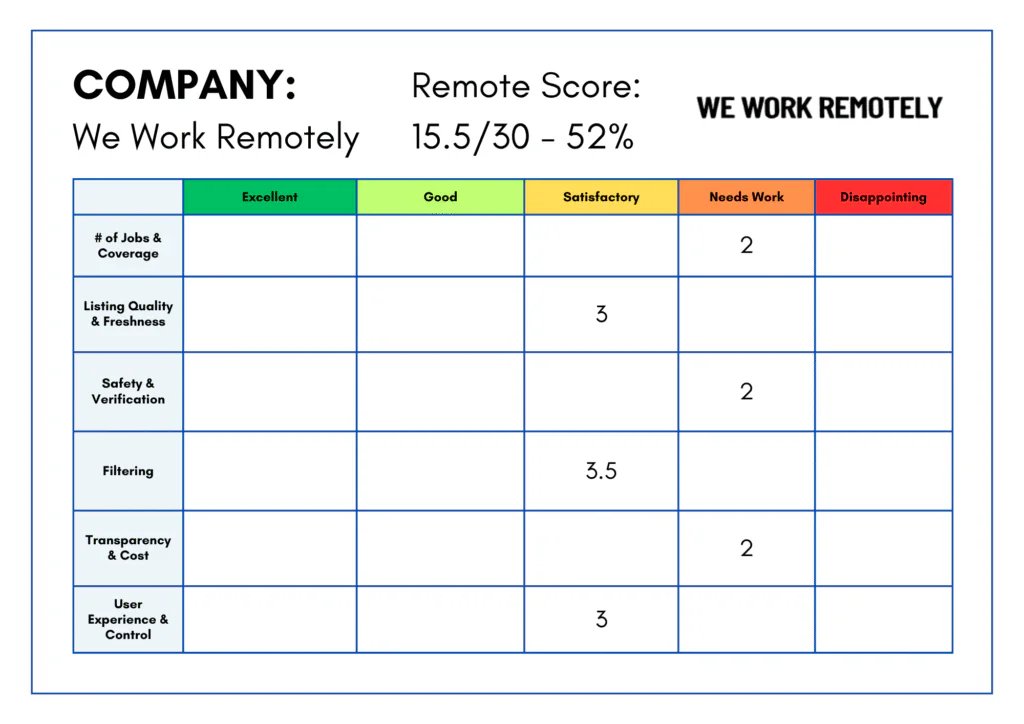
When I look at the score as a whole, I think it accurately reflects my experience.
We Work Remotely isn't a bad job board.
In fact, I think it's one of the better niche platforms dedicated entirely to remote work.
The issue is that my expectations were much higher because of its reputation.
As one of the largest remote-only job boards on the internet, I expected more active listings, stronger filtering tools, greater salary transparency, and more visible employer verification.
Instead, I found a platform that's good in several areas but still leaves quite a bit of work for the job seeker.
My Final Verdict
After spending time exploring We Work Remotely, I understand why it has remained popular for so many years.
The website is clean, easy to use, and focused entirely on remote work.
That alone makes it a useful resource.
At the same time, I don't think it's comprehensive enough to become your only job board.
The relatively small number of active listings, limited filtering options, inconsistent salary information, and lack of stronger verification features prevent me from recommending it as a one-stop solution.
Instead, I think We Work Remotely works best as one tool in a broader job search strategy.
I'd absolutely check it regularly.
I just wouldn't rely on it exclusively.
Who I Think Should Use We Work Remotely
I think We Work Remotely is a good fit if you:
- Already have professional experience.
- Are searching specifically for remote work.
- Don't mind checking multiple job boards.
- Prefer a clean, distraction-free interface.
- Want access to jobs from established remote-first companies.
Who May Want a Different Option
I think you may become frustrated if you:
- Are looking specifically for entry-level remote jobs.
- Need advanced search filters.
- Want salary transparency on every listing.
- Prefer verified employers with stronger trust signals.
- Want a larger inventory of active opportunities.
An Alternative I Created for Remote Job Seekers
While reviewing job boards as We Work Remotely, I kept noticing the same problems.
I'd spend a significant amount of time filtering out senior-level positions, checking whether jobs were truly remote, researching employers, and sorting through listings that simply weren't a good fit for someone just starting their career.
Eventually, I realized I was spending almost as much time filtering jobs as I was applying for them.
That's one of the main reasons I built my own remote job board.
Rather than trying to compete with massive platforms that list every remote job imaginable, I wanted to focus on a much more specific audience.
The goal is simple.
Help people with little to no professional experience find legitimate remote opportunities more efficiently.
Instead of browsing thousands of jobs across every experience level, you'll find listings that generally require between zero and two years of experience, along with tools that make it easier to narrow your search based on your needs.
I don't think there's a single perfect job board.
That's why I still encourage people to use platforms like We Work Remotely, LinkedIn, Indeed, and others.
My hope is that my own job board simply saves you time by reducing many of the frustrations I kept running into during my own research.
Bottom Line
We Work Remotely remains one of the better-known names in remote hiring, and I think it's worth keeping in your job search rotation.
It offers a clean interface, generally high-quality listings, and a remote-first focus that many larger job boards still struggle to match.
However, it also has limitations.
The number of active jobs is smaller than many people expect, salary transparency is inconsistent, employer verification could be stronger, and the filtering tools leave room for improvement.
For those reasons, I gave We Work Remotely an overall score of 15.5 out of 30, or 52%.
I'd recommend using it as part of a broader strategy rather than relying on it as your only source of remote job opportunities.
If you combine it with other trusted job boards and stay consistent with your applications, you'll give yourself a much better chance of finding legitimate remote work.