
Overview
GitLab is an open-core software company best known for its AI-powered DevSecOps platform — a single application covering version control, CI/CD, security scanning, and deployment. Used by more than 100,000 organizations, including NASA, Comcast, and Goldman Sachs, it competes directly with GitHub (Microsoft) in the developer tooling space.
But GitLab is arguably more famous for how it operates than what it sells. Since its founding in 2011, it has run as an entirely remote company — no headquarters, no hub offices, no hybrid-as-an-afterthought. Its publicly available 2,000+ page employee handbook has become a blueprint other companies cite when building remote cultures of their own.
Who this is best for: Self-directed professionals who thrive without structure handed to them. Engineers, product managers, and technical salespeople who want maximum schedule flexibility and the credibility of working on a well-respected open-source product. Not well-suited for people who need frequent in-person contact, rapid onboarding, or a highly directive management style.

What It’s Like to Work at GitLab
The Async-First Reality
GitLab doesn’t do remote the way most companies do remote. There’s no Zoom-heavy calendar that replicates an in-office schedule from home. The company operates on a documented, async-first philosophy: the assumption is that the right answer is written down somewhere in the handbook, and that collaboration happens through issues, merge requests, and recorded calls — not live meetings.
For people who click with this, it’s liberating. Reviews repeatedly describe the flexibility as “unparalleled.” Engineers talk about getting meaningful deep-work hours back. The model treats adults like adults: show results, not seat time.
“GitLab is light years ahead of most companies when it comes to creating the most efficient remote work environment.”
For people who don’t click with it, the experience can feel isolating and disorganized. Repeatedly surfacing in reviews: colleagues going on vacation without notifying anyone, slow ramp-up periods without structured onboarding, and the psychological weight of being entirely self-directed from day one.
Culture: What’s Real vs. What’s PR
The values (Collaboration, Results, Efficiency, Diversity/Inclusion, Iteration, Transparency — “CREDIT”) are unusually operational. They’re woven into how decisions get made, how performance is assessed, and how the hiring process runs. Multiple reviewers — including former employees — credit this as genuine rather than decorative.
However, there’s a pattern worth flagging: the experience is heavily team-dependent. Some managers are described as exceptional; others as absent or, increasingly, micromanaging. This variance across teams is one of the most consistent signals in the review data — not an outlier complaint.
Pattern to watch: Middle management quality appears to be the primary variable in employee experience at GitLab. The cultural foundation is strong; execution at the team level is inconsistent. If you’re interviewing, spend time probing your direct manager’s style and tenure.
Work-Life Balance
Rated 3.9/5 on Glassdoor for work-life balance — solid but not exceptional. The unlimited PTO policy is real, but carries the same risk as everywhere: without cultural norms enforcing actual usage, some employees end up taking less time off, not more. On the flip side, GitLab does have documented guidance on preventing burnout, and the lack of a physical office means no one’s guilt-tripped into staying late visibly.
For sales roles specifically, reviews consistently flag long hours and a difficult, shifting sales motion — particularly as GitLab pushes into enterprise accounts against heavily funded GitHub. Non-sales roles generally report a healthier balance.
Pay & Benefits
Transparency Level
This is where GitLab genuinely stands apart. Its compensation framework is publicly documented in the handbook — you can read the methodology, the geographic multipliers, and the role levels before you even apply. Candidates who pass a screening call get access to the compensation calculator to see their own expected range. This eliminates most of the negotiation theater that burns candidates at other companies.
Competitiveness
The picture is nuanced. The median total compensation at GitLab is around $206K (per Levels.fyi, US-weighted). For senior engineering and technical roles, pay is competitive with industry benchmarks. For sales and non-technical roles, some reviews suggest comp lags behind comparable Bay Area firms — though GitLab’s geographic pay model means US/Western Europe employees generally fare well.
The important caveat: GitLab applies geographic pay bands, meaning the same role pays differently in Amsterdam vs. Austin vs. Ahmedabad. This is increasingly standard in remote-first companies but can still frustrate candidates in mid-tier markets who feel the adjustment is steeper than justified.
One repeated negative: the RSU (stock) component has eroded in value since GitLab’s IPO highs. For employees hired at peak valuations, this has been a significant real-compensation decline.
Notable Perks
Standout Benefits
- Home office setup stipend
- Coworking space reimbursement
- Continuing education / learning budget
- Generous parental leave + return program
- Mental health benefits
- Unlimited PTO (with encouragement to use it)
- Employee stock purchase plan (ESPP)
- Company equity (RSUs)
Where It Falls Short
- Rising employee health insurance premiums
- Below-average 401k match vs. big tech
- Stock value has underperformed post-IPO
- Geographic pay bands penalize some markets
- No physical office perks (by design, but still)
Interview Process
Structure
GitLab’s interview process is well-documented in its public handbook — candidates can literally read what to expect before applying. In practice, it typically runs 4–5 stages:
Stage 1 — Recruiter/TA screen (~30 min). Values alignment, logistics, compensation preview.
Stage 2 — Hiring manager call. Role-specific questions, async work assessment begins.
Stage 3 — Technical or functional panel (often includes a take-home or async exercise).
Stage 4 — Team/peer interviews; for senior roles, an extended “deep dive” exercise (2–3 days, 1–2 hrs/day).
Stage 5 — Skip-level or executive interview for senior positions. References checked.
Difficulty
Comparably rates GitLab interview questions as difficult, with an 84/100 candidate experience score — a useful combination. The process is rigorous but the experience of going through it is generally positive. Candidates consistently mention feeling informed, respected, and clear on timelines.
“I can’t emphasize enough how transparent the whole process was. I was informed at every stage what was ahead of me… everyone was so nice.”
Red Flags & Positives
Positives: Transparent timeline, candidates know what’s coming, compensation disclosed early, no endless reschedules, interview experience reflects the actual company culture well.
Red flags: Processes for senior roles can stretch to 2+ months. During the 2023 hiring freeze, candidates were left mid-process with minimal communication. References were contacted before offers were confirmed in at least one documented case — not ideal.
Glassdoor Ratings Snapshot
Based on 700+ anonymous employee reviews (Glassdoor, 2025–2026)
| Overall | 3.7/5 |
| Work-Life Balance | 3.9/5 |
| Career Opportunities | 3.4/5 |
| Comp & Benefits | 3.9/5 |
| Culture & Values | 3.6/5 |
| % Would Recommend | 70% |
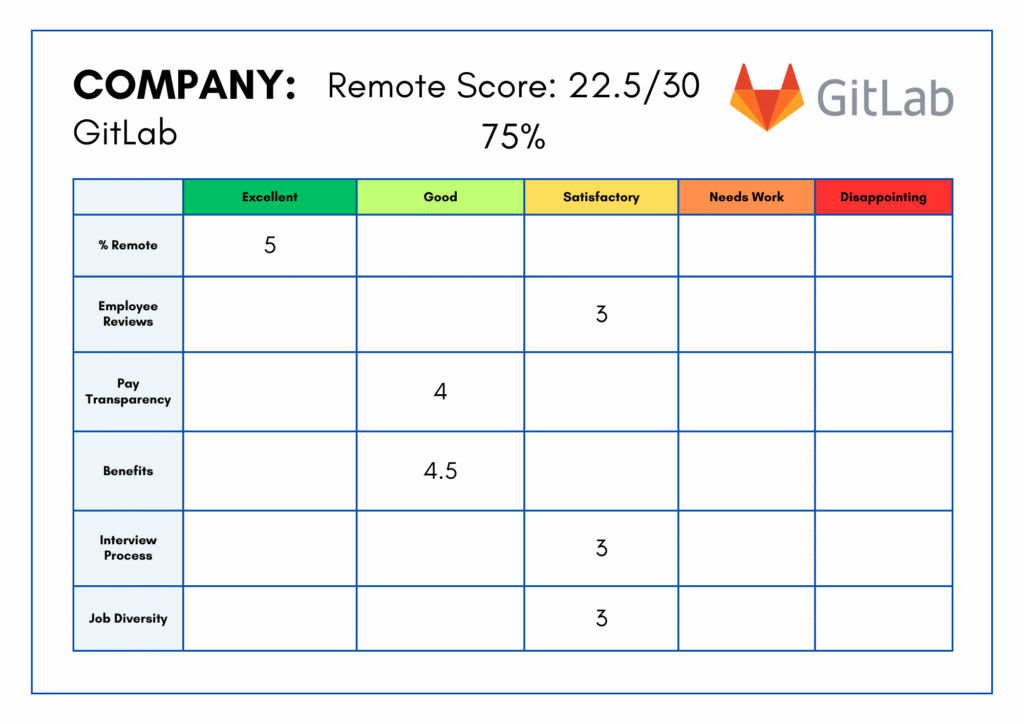
Remote Score: 23 / 30
23/30
Strong Remote Employer
GitLab sets the benchmark for remote-first infrastructure and culture. Minor deductions reflect a compensation model that disadvantages some geos, a rating dip amid layoffs and sales turbulence, and job diversity that skews heavily technical.
Final Verdict
✓ Who Should Apply
Senior engineers, DevOps/DevSecOps professionals, technical PMs, and sales engineers who are genuinely self-directed. People who’ve struggled with remote work at companies that weren’t built for it. Professionals outside the US or Western Europe looking for globally competitive compensation. Anyone who wants full schedule sovereignty without a RTO threat hanging over them.
✗ Who Should Avoid
New grads or early-career professionals who need structured mentoring. People who are energized by in-person collaboration. Anyone in sales who isn’t comfortable with a volatile quota environment and an evolving enterprise motion. Those who want career advancement to feel managed and paced — GitLab rewards people who create their own momentum.
↑ Biggest Strengths
The async infrastructure is the real deal — not theater. Pay transparency is class-leading. Benefits package is thoughtfully designed for remote life (stipends, coworking, mental health). The product has genuine market credibility. And the culture of transparency extends to how the company communicates internally, including publicly posting difficult decisions.
↓ Biggest Risks
Team experience is lottery-dependent on manager quality. The stock component has been a disappointment post-IPO. Career growth is lateral-heavy and requires self-advocacy that not everyone is comfortable with. If you’re in sales, recent reviews paint a turbulent picture. The rating trend is declining — this is a company in a transitional moment, not on a smooth upswing.
Bottom line: GitLab remains one of the most credible all-remote employers on the planet — especially for technical professionals. Its foundations are genuinely strong. But the 2023 layoffs, stock slide, and management inconsistencies have created a real gap between the GitLab of the handbook and the GitLab some employees are experiencing today. Go in with eyes open, do your due diligence on your specific team, and it’s still one of the better bets in remote tech. Sources: Glassdoor (700+ reviews), Indeed, Levels.fyi, Comparably, GitLab Public Handbook, LinkedIn · Data as of May 2025 · Remote Company Scorecard · Score: 23/30