
Last Updated on September 14, 2026 by Justin Bryant
If you are over 50 and looking for remote work, the best option may not be the job with the lowest entry barrier. It may be the one that turns the experience you already have into an advantage.
I compared 12 remote-friendly job paths using six equally weighted categories: demand, pay and stability, barrier to entry, remote friendliness, growth and risk, and how well experience transfers for someone over 50. Training or learning specialist ranked first with 25 out of 30 points. Customer onboarding specialist, project coordinator, online tutor, and insurance sales agent tied for second with 23 points.
The current openings linked below were checked on September 14, 2026. Job postings can close or change at any time, so treat each one as proof that the role exists—not a promise that the exact opening will still be available when you apply.

How I ranked these jobs
Each job received a score from 1 to 5 in six categories. Every category has the same weight, and the six scores add up to a maximum of 30 points.
- Demand: How consistently employers need this kind of work.
- Pay/stability: The earning potential and how dependable the income is likely to be.
- Barrier to entry: How realistic the transition is. A 5 means a lower barrier; a 1 means a higher barrier.
- Remote-friendly: How often the work is genuinely remote and how much location flexibility it offers.
- Growth/risk: The outlook, advancement options, and exposure to automation, contracting, or industry volatility.
- Transferable exp for 50+: How much the role rewards communication, judgment, industry knowledge, reliability, and other experience built over time.
Jobs with equal totals remain tied. I did not use a hidden tiebreaker to force them into separate positions.
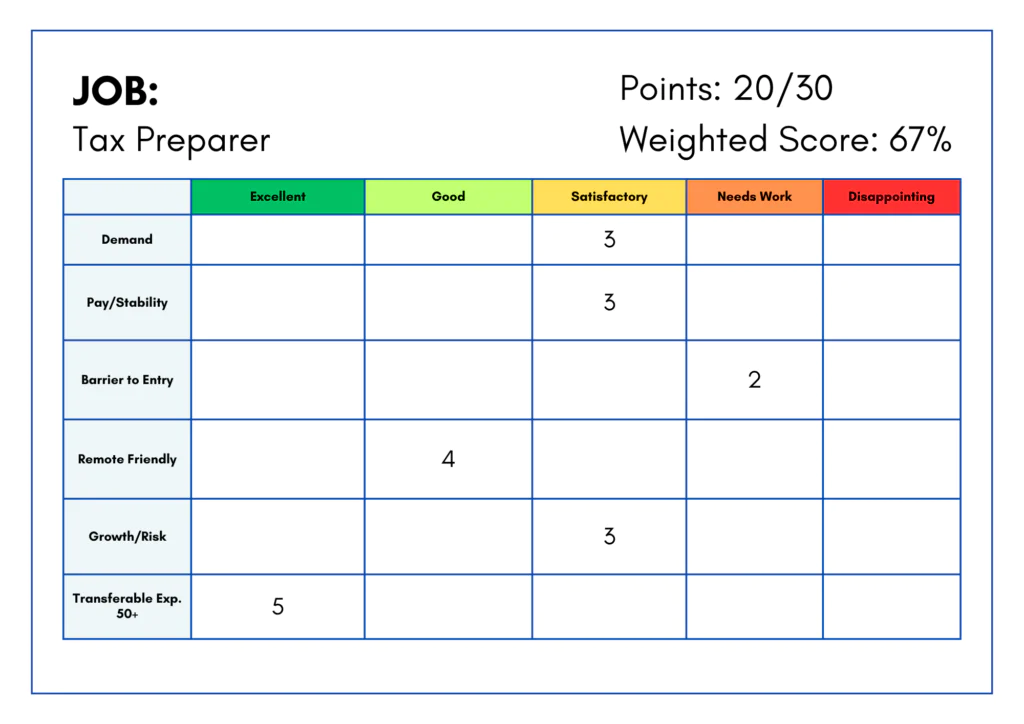
No. 12: Tax preparer — 20/30
Tax preparers organize financial records, prepare or review tax returns, identify eligible deductions, use tax software, and contact clients when information is missing. This can be a practical remote income path, but seasonal is the key word.
- Demand — 3/5: Tax filing creates recurring demand every year, but hiring is concentrated around filing season.
- Pay/stability — 3/5: Glassdoor estimates average pay at about $59,611, but an annual figure can hide seasonal hours and temporary employment.
- Barrier to entry — 2/5: A four-year degree is not always required, but employers may want tax-preparation experience, a PTIN, or prefer an enrolled agent or CPA.
- Remote-friendly — 4/5: Documents and tax software are digital, although schedules can become rigid near filing deadlines.
- Growth/risk — 3/5: Tax work will continue, but software and automation put pressure on simple returns. Credentials can open the door to more advanced, year-round work.
- Transferable exp for 50+ — 5/5: Accuracy, discretion, client trust, and experience with finances or business administration transfer very well.
Why it ranks here: Tax preparation has a strong experience fit and real remote availability, but seasonality and qualification preferences make it the weakest full career-reset option in this ranking.
Current example: Kruse & Crawford CPAs lists a remote seasonal tax preparer role and says CPA or EA credentials are preferred.
Salary evidence: Glassdoor's tax preparer salary page estimates average annual pay around $59,611, with a typical range of roughly $46,308 to $77,687.
Tied No. 9: AI evaluator or domain expert — 21/30
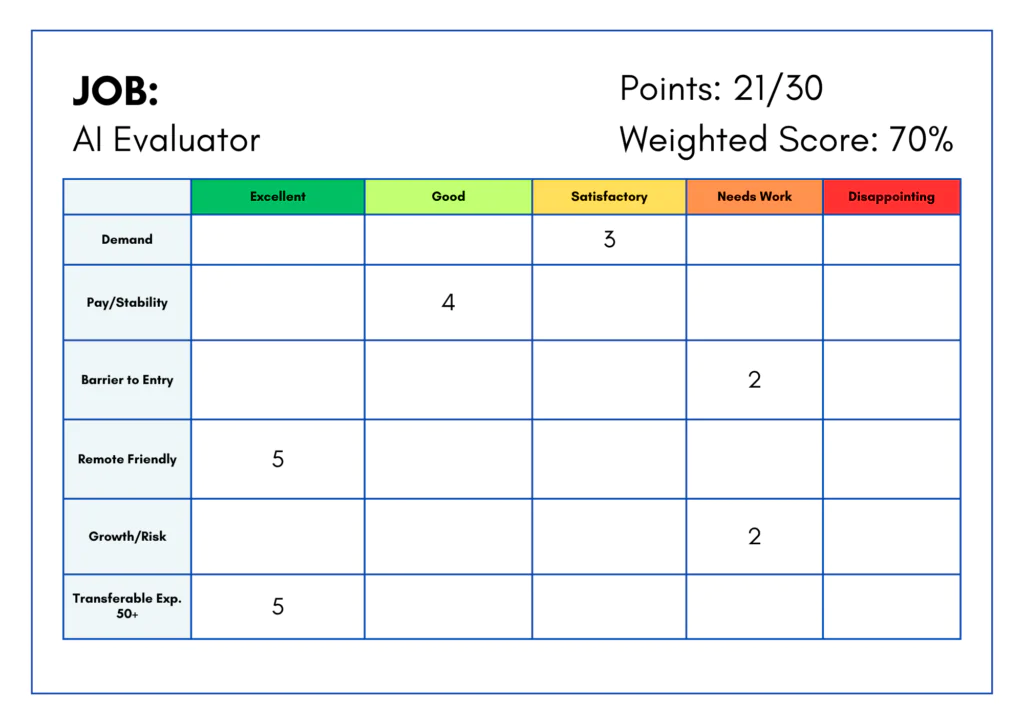
AI evaluators review model-generated answers, compare responses, check facts, write better examples, and identify errors. Specialized projects may need people with professional knowledge in software, finance, healthcare, law, education, or another field. This is one of the few AI job categories where deep experience outside technology can matter more than knowing how to code.
- Demand — 3/5: Multiple platforms recruit evaluators and experts, but project availability changes quickly and acceptance does not guarantee assignments.
- Pay/stability — 4/5: Specialized projects can advertise high hourly rates, but screening, project gaps, and inconsistent hours make the income less dependable than a salary.
- Barrier to entry — 2/5: Applicants may face assessments and identity verification, while better-paying projects usually require genuine domain expertise.
- Remote friendly — 5/5: The work is designed for remote delivery and is often asynchronous.
- Growth/risk — 2/5: Contracts can end suddenly, standards change, and the work does not always create a clear promotion path.
- Transferable exp for 50+ — 5/5: Subject knowledge, sound judgment, clear writing, and the ability to notice subtle errors are central to the work.
Why it ranks here: AI evaluation makes unusually good use of accumulated expertise and is extremely remote-friendly. Its high entry barrier and unstable project structure make it risky as a sole source of income.
Current example: Mercor's software, AI, IT, and data evaluator project advertises remote contract work at $80 to $120 per hour for applicants with at least five years of relevant experience. The contract can end early, so the hourly rate should not be treated like a salary.
Salary evidence: Glassdoor's AI evaluator salary page shows a modeled estimate around $134,000, but it is based on a small, mixed sample and is not a safe estimate of typical project earnings.
Tied No. 9: Bookkeeping or payroll specialist — 21/30
Bookkeeping and payroll specialists maintain financial records, process transactions, reconcile accounts, handle deductions, correct discrepancies, and answer employee or client questions. It can be one of the more attainable office-to-remote transitions if you have handled invoices, timesheets, payroll, or sensitive records.
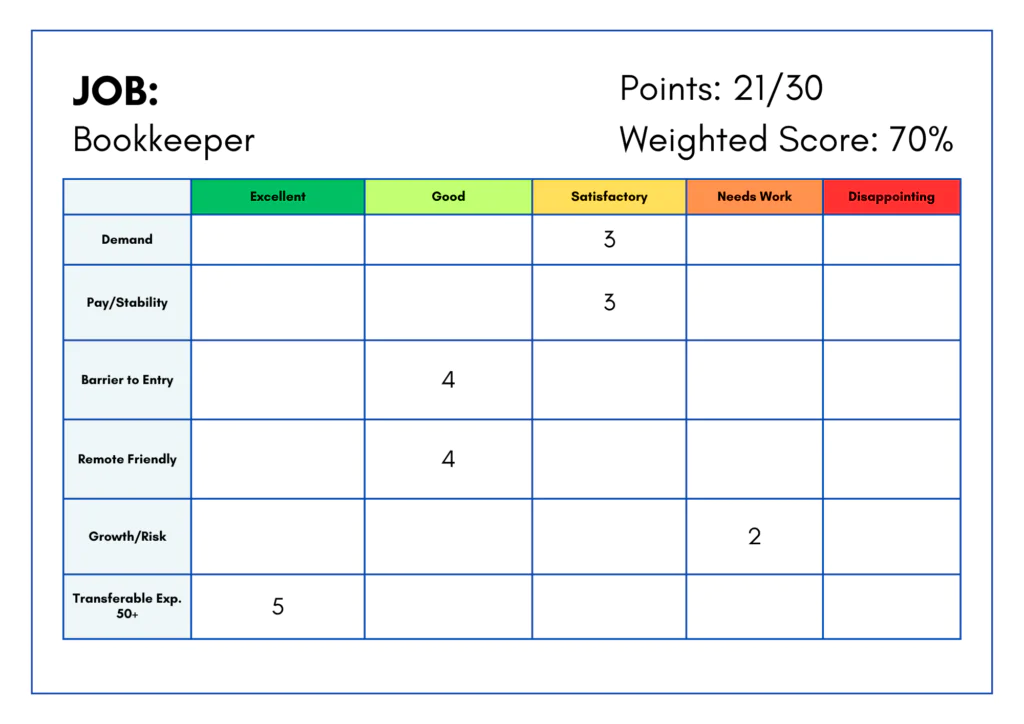
- Demand — 3/5: Employers continually need accurate payroll and financial records, but routine bookkeeping demand is shrinking.
- Pay/stability — 3/5: Payroll specialists can earn dependable middle-income pay, while entry-level bookkeeping often pays less.
- Barrier to entry — 4/5: A four-year degree is not universal. Related office experience, payroll software knowledge, or a focused certification can create a realistic route in.
- Remote friendly — 4/5: Cloud accounting and payroll systems support remote work, although payroll cycles and deadlines limit schedule freedom.
- Growth/risk — 2/5: Automation is absorbing routine data entry and reconciliation. Payroll compliance, analysis, and advisory work are safer directions.
- Transferable exp for 50+ — 5/5: Reliability, confidentiality, organization, and experience handling money or records are major advantages.
Why it ranks here: This path is more accessible than grant writing or AI evaluation, but automation risk keeps it in the 21-point group. It is strongest as a bridge into specialized payroll, compliance, or accounting work.
Current example: Intuit's remote payroll tax operations and services specialist role advertises year-round, 20-to-40-hour SelectTime work and location-dependent pay of $25 to $49 per hour. It asks for hands-on payroll tax experience and an FPC credential.
Salary evidence: Glassdoor's payroll specialist salary page estimates average pay around $66,383, with a typical range of about $54,606 to $81,779.
Tied No. 9: Grant writer — 21/30
Grant writers research funding opportunities, interpret requirements, gather program and budget information, write proposals, manage deadlines, and sometimes report outcomes to funders. The work can pay well, but employers frequently want proof that your writing has already helped secure funding.
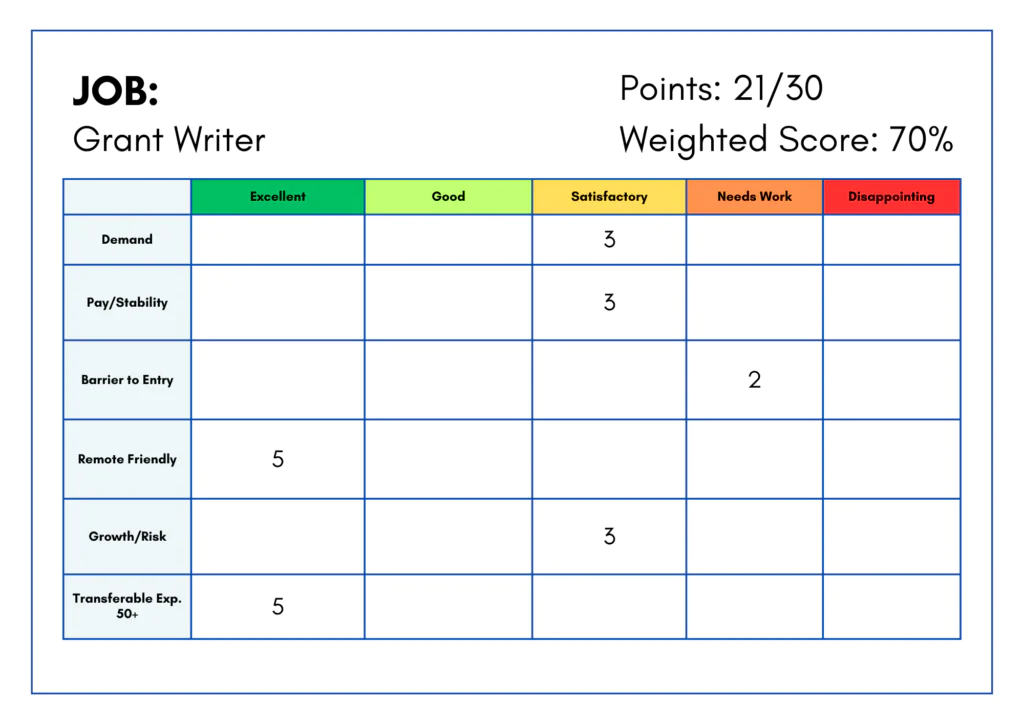
- Demand — 3/5: Nonprofits, schools, healthcare organizations, governments, and climate organizations need grant support, but this market is narrower than general administrative work.
- Pay/stability — 3/5: Specialized contracts can pay much more than the national median, but funding cycles and contract work reduce stability.
- Barrier to entry — 2/5: Employers commonly ask for a portfolio, successful funded proposals, domain knowledge, and several years of experience.
- Remote friendly — 5/5: Research, writing, collaboration, and submission can all be handled digitally.
- Growth/risk — 3/5: Organizations will continue competing for funding, while AI will assist with routine drafting. Strategy, compliance, and subject expertise remain valuable.
- Transferable exp for 50+ — 5/5: Professional writing, persuasion, project management, budgeting, and industry knowledge transfer extremely well.
Why it ranks here: Grant writing scores very well for remote friendliness and transferable experience, but the proof-of-results barrier makes it better for someone redirecting established skills than starting from zero.
Current example: Climate Finance Solutions' remote contract grant writer role advertises $70 to $100 per hour, but it also asks for substantial proposal leadership and climate-domain experience.
Salary evidence: Glassdoor's grant writer salary page shows median total pay around $60,000 and a typical range of roughly $49,000 to $75,000.
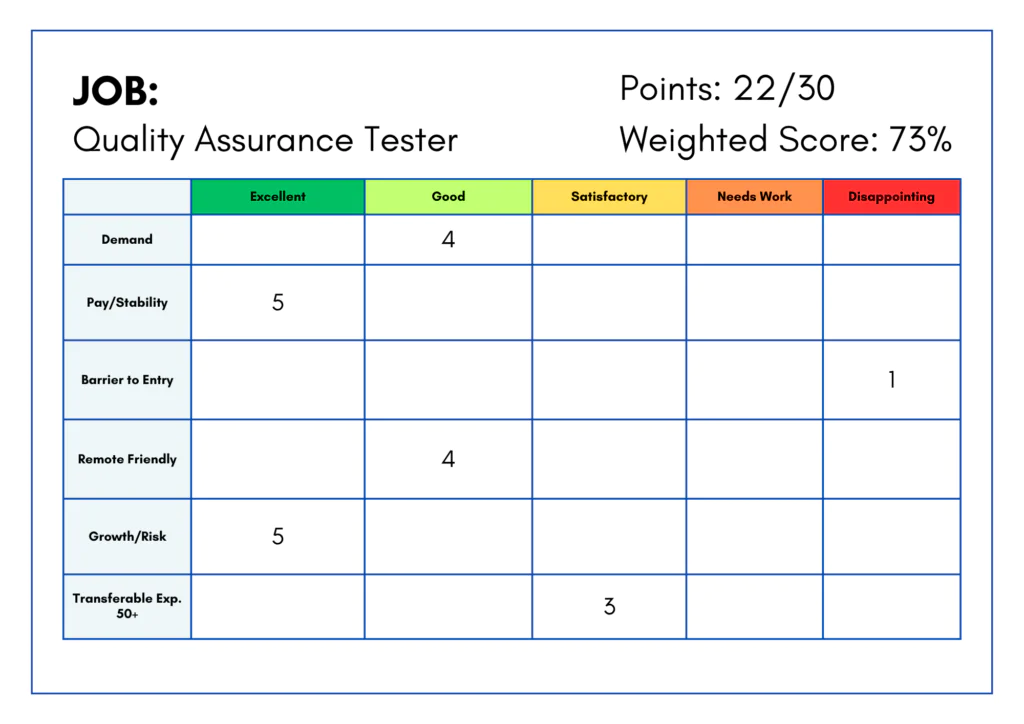
Tied No. 6: Quality assurance tester — 22/30
Quality assurance testers review product requirements, create test cases, test software, reproduce bugs, document defects, and verify fixes. QA is often marketed as an easy route into technology, but credible openings usually tell a more demanding story.
- Demand — 4/5: Software companies continue to hire QA professionals, and federal projections support ongoing growth.
- Pay/stability — 5/5: Broad tester pay is solid, while experienced technical QA positions can reach six figures.
- Barrier to entry — 1/5: Current openings often ask for a degree, several years of QA experience, development-lifecycle knowledge, and testing tools.
- Remote friendly — 4/5: Fully remote jobs are common in software teams, but location restrictions and fixed collaboration hours still apply.
- Growth/risk — 5/5: QA can lead to automation, quality engineering, product operations, security, or management. AI changes the tools but does not remove the need for quality judgment.
- Transferable exp for 50+ — 3/5: Attention to detail and process discipline help, but recent technical experience matters more than general seniority.
Why it ranks here: QA earns perfect scores for pay/stability and growth/risk, but the highest entry barrier on the list pulls it down to 22 points. It is compelling for someone with technical experience, not the average beginner.
Current example: Filevine's remote Quality Assurance Analyst II opening advertises $120,000 to $140,000, while also requiring five or more years of QA experience.
Salary evidence: Glassdoor's quality assurance tester salary page estimates average pay around $67,097, with a typical range of approximately $51,921 to $87,292.
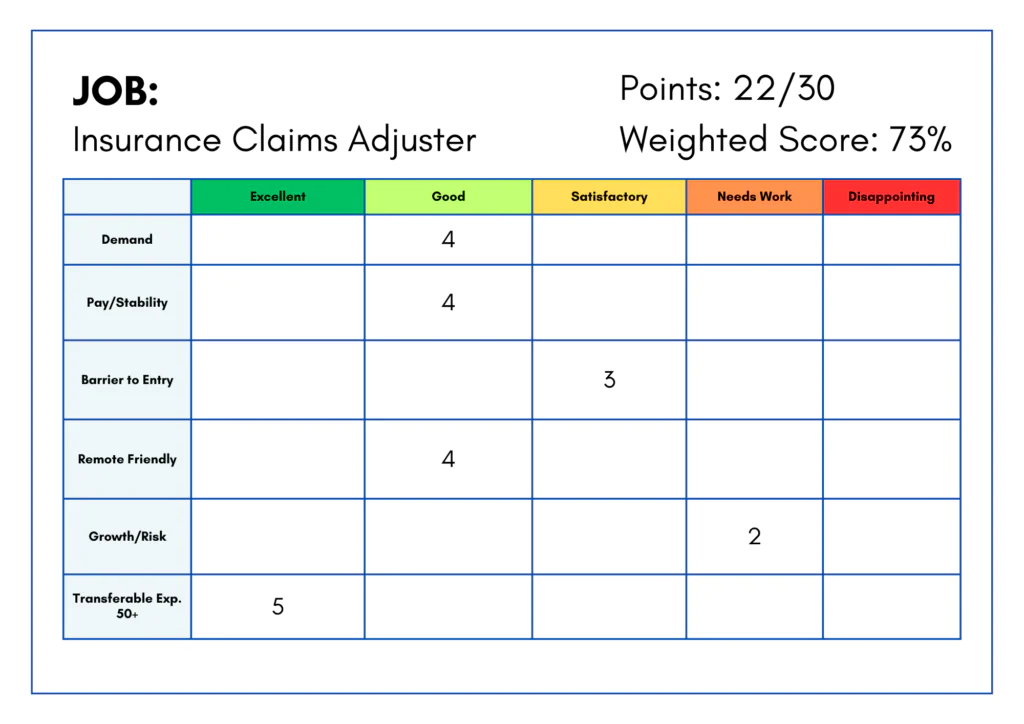
Tied No. 6: Insurance claims adjuster or examiner — 22/30
Claims professionals collect records and statements, determine coverage, estimate losses, document decisions, negotiate settlements, and communicate with customers, providers, repair shops, or attorneys. The work is not glamorous, but it can provide a real salary, benefits, and employer training.
- Demand — 4/5: The occupation is projected to decline, but insurers still need replacement workers and repeatedly post openings.
- Pay/stability — 4/5: Salaried carrier roles can provide dependable income and benefits, with median total pay around the upper-$60,000 range.
- Barrier to entry — 3/5: Some employers accept a high school diploma and provide training, but others want claims experience, industry knowledge, or a state license.
- Remote-friendly — 4/5: Fully remote roles exist, although licensing, geographic restrictions, fixed schedules, and occasional fieldwork can apply.
- Growth/risk — 2/5: Automation is improving routine claims processing. Complex claims, investigation, negotiation, and specialized knowledge are safer areas.
- Transferable exp for 50+ — 5/5: Judgment, documentation, empathy, conflict management, and calm communication under pressure transfer well.
Why it ranks here: Claims work combines dependable pay, remote availability, and a strong experience fit, but a weak long-term outlook keeps it at 22 points.
Current example: APCO Holdings' remote mechanical claims adjuster application demonstrates current hiring while also showing the value of adjuster licensing and hands-on automotive experience.
Salary and outlook evidence: Glassdoor shows median total pay near $68,000, while the Bureau of Labor Statistics explains the entry paths, licensing requirements, and projected decline.
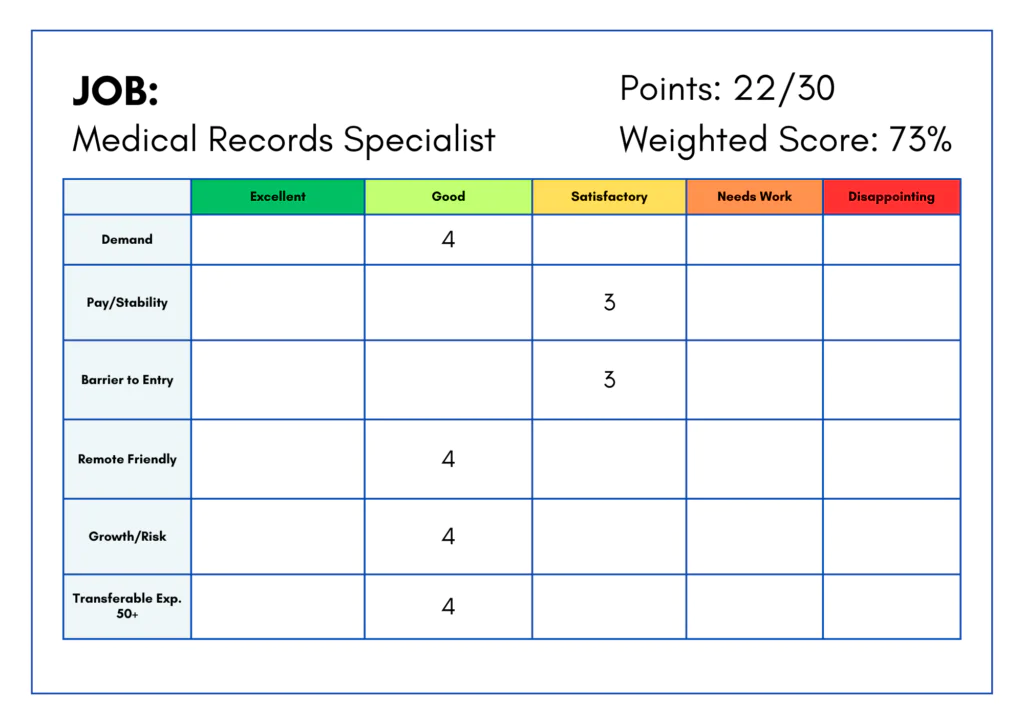
Tied No. 6: Medical records specialist — 22/30
Medical records specialists retrieve and organize health records, enter or abstract clinical data, protect patient privacy, and support coding, quality reporting, or insurance processes. Healthcare needs accurate records, and much of this work can now be completed remotely.
- Demand — 4/5: Federal projections show 7% growth and about 14,200 openings per year.
- Pay/stability — 3/5: Federal median pay is around $50,250, making this a stable middle-income path rather than an elite-paying one.
- Barrier to entry — 3/5: Adjacent healthcare or administrative experience may qualify, but some jobs require medical terminology, coding knowledge, an HIM credential, or abstraction experience.
- Remote friendly — 4/5: Electronic records support genuine remote work, although security rules, location limits, and fixed hours are common.
- Growth/risk — 4/5: The role can lead to coding, compliance, data quality, and health-information management, although AI-assisted coding introduces some risk.
- Transferable exp for 50+ — 4/5: Accuracy, confidentiality, healthcare familiarity, and process discipline help, but role-specific knowledge still matters.
Why it ranks here: Medical records specialist has no score below 3 and offers a clear occupational path. It also does not dominate any category, producing a balanced 22-point total.
Current example: Layer Health's remote clinical quality data abstraction specialist role advertises $28 to $35 per hour for about 15 hours per week and requires specialized registry-abstraction experience.
Salary and outlook evidence: Glassdoor shows median total pay around $54,000. The Bureau of Labor Statistics reports $50,250 median pay, 7% projected growth, and about 14,200 openings per year.
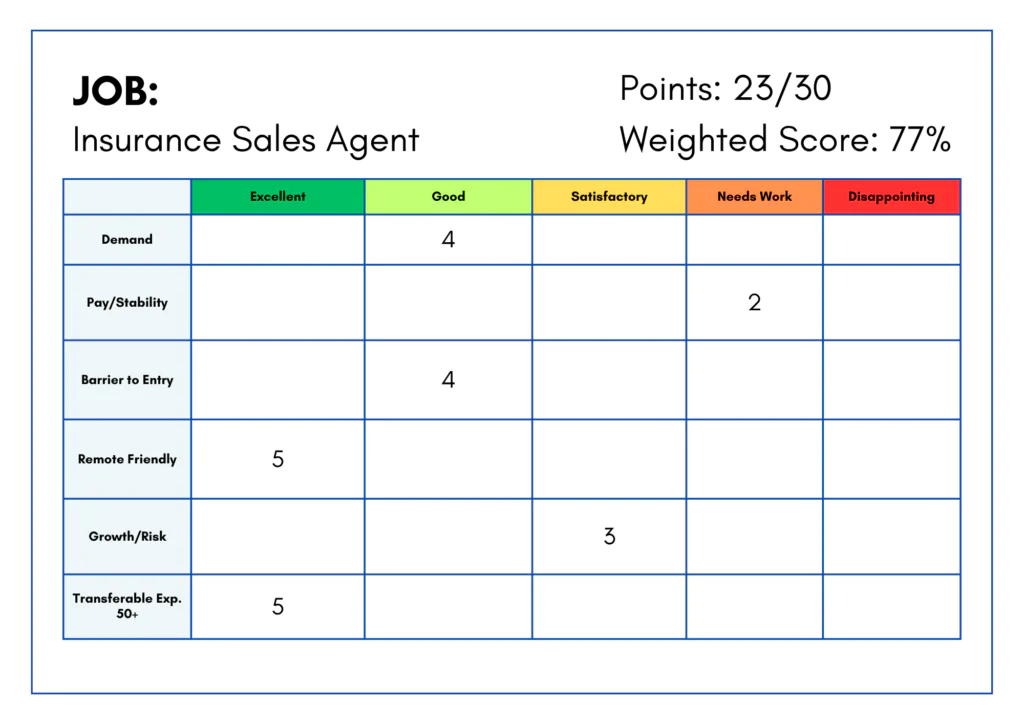
Tied No. 2: Insurance sales agent — 23/30
Insurance agents assess customer needs, explain products, provide quotes, complete applications, follow up with prospects, maintain licenses, and service existing policyholders. It is one of the more accessible remote career paths here, but the quality of the opportunity depends heavily on the compensation plan.
- Demand — 4/5: Insurance companies repeatedly hire agents, with modest growth and continued replacement demand.
- Pay/stability — 2/5: Earnings may combine base pay, bonuses, and commissions, making results less predictable than a fixed salary.
- Barrier to entry — 4/5: High-school-level entry and employer training are possible, but agents must obtain and maintain the applicable state license.
- Remote-friendly — 4/5: Many jobs are remote, although phone schedules, quotas, call monitoring, and state eligibility rules limit flexibility.
- Growth/risk — 4/5: Insurance remains necessary, licenses are portable, and successful agents can advance into account management, underwriting support, or leadership.
- Transferable exp for 50+ — 5/5: Trust, listening, patience, relationship-building, and explaining complicated choices are major advantages.
Why it ranks here: Insurance sales combines a relatively manageable entry barrier with excellent use of mature communication skills. Commission-driven income prevents it from overtaking the other second-place jobs.
Current example: Globe Life's remote sales operations opening focuses on calls with existing customers. It requires a high-school education and either an insurance license or the ability to obtain one.
Salary evidence: Glassdoor's insurance sales agent page shows a high, commission-heavy modeled total that should not be treated as guaranteed pay. The Bureau of Labor Statistics provides a more conservative occupational benchmark and explains the licensing requirement.
Tied No. 2: Online tutor or instructional support — 23/30
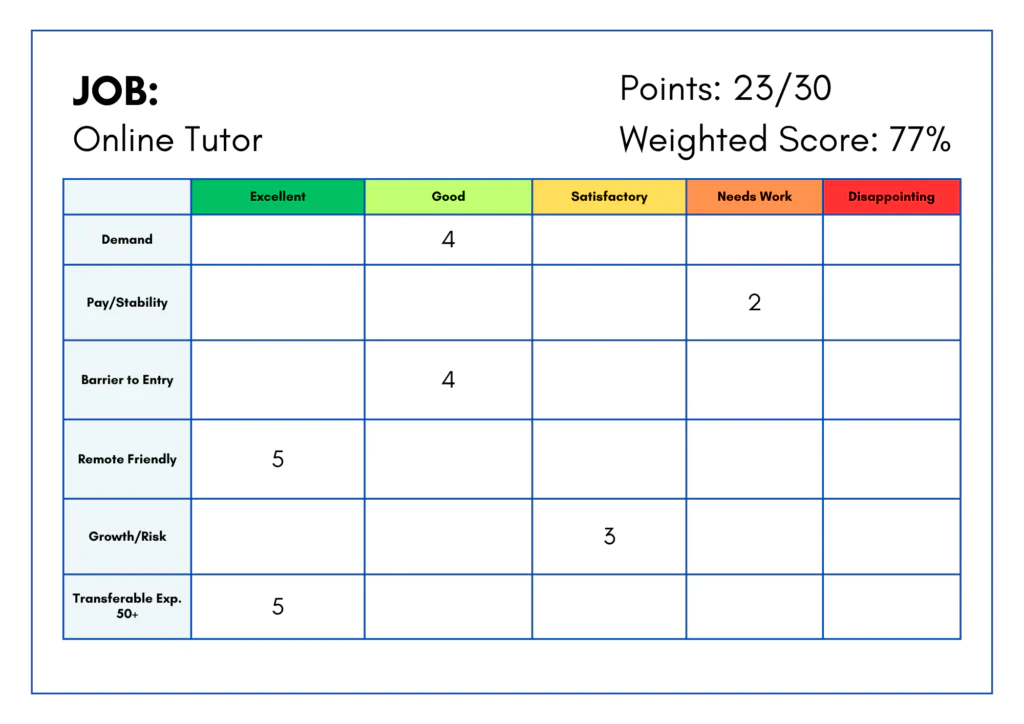
Online tutors explain difficult concepts, reinforce a subject, review assignments, provide feedback, and adapt instruction to individual students. This is not the best-paying option, but it may be the easiest to fit around caregiving, health needs, or another source of income.
- Demand — 4/5: Large platforms recruit across many subjects, but demand varies by subject, season, and student volume.
- Pay/stability — 2/5: Rates and available hours vary substantially, so modeled annual salary figures can be misleading for platform contractors.
- Barrier to entry — 4/5: Subject knowledge and strong communication can be enough for some platforms, though degree, enrollment, teaching, or background-check requirements vary.
- Remote-friendly — 5/5: The job is naturally remote and often lets tutors control their availability and workload.
- Growth/risk — 3/5: Learning support will remain useful, but occupational growth is modest and platforms offer limited advancement.
- Transferable exp for 50+ — 5/5: Patience, mentoring, professional knowledge, and the ability to explain clearly become the product.
Why it ranks here: Online tutoring earns perfect scores for remote friendliness and transferable experience, but inconsistent income keeps it at 23 points. It is the strongest flexibility option in the ranking.
Current example: Tutor.com's active tutoring application offers a remote route with flexible scheduling for eligible U.S. applicants.
Salary evidence: Glassdoor's online tutor salary page displays a modeled annual estimate, but individual platform rates and realistic available hours are more useful than the headline number.
Tied No. 2: Project coordinator — 23/30
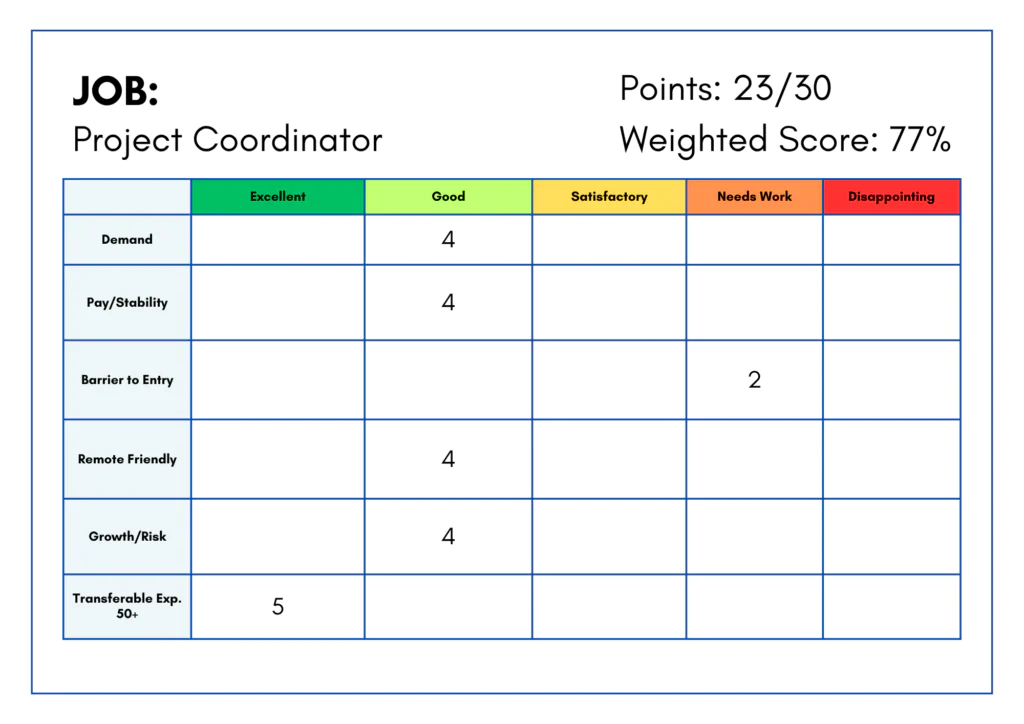
Project coordinators track schedules and deliverables, organize meetings, document decisions, update plans, maintain reports, and follow up with stakeholders. If you have kept a team, client, event, or complicated process on schedule, you may already have the core skill behind this work.
- Demand — 4/5: Project work exists across healthcare, government, technology, construction, and professional services, with positive growth and substantial annual openings.
- Pay/stability — 4/5: Coordinator pay is solid, and the path can lead to higher-paid project management.
- Barrier to entry — 2/5: Employers often ask for two or more years of coordination experience, current project tools, and sometimes a degree or certification.
- Remote friendly — 4/5: Fully remote openings exist, but meetings, time zones, and client schedules make this less flexible than asynchronous work.
- Growth/risk — 4/5: Coordination skills move across industries and can lead to project manager, program coordinator, implementation, or operations roles.
- Transferable exp for 50+ — 5/5: Organization, communication, judgment, follow-through, and anticipating problems are central to the job.
Why it ranks here: Project coordination offers one of the best combinations of pay, portability, growth, and transferable skills. Its experience barrier keeps it from challenging the winner.
Current example: Broadway Ventures' fully remote project coordinator role advertises $45,000 to $60,000 and asks for at least two years of project-coordination experience.
Salary and outlook evidence: Glassdoor estimates average project coordinator pay around $74,979, with a typical range of about $60,166 to $94,410. The broader BLS project management specialist profile supports the positive growth and advancement outlook.
Tied No. 2: Customer onboarding specialist — 23/30
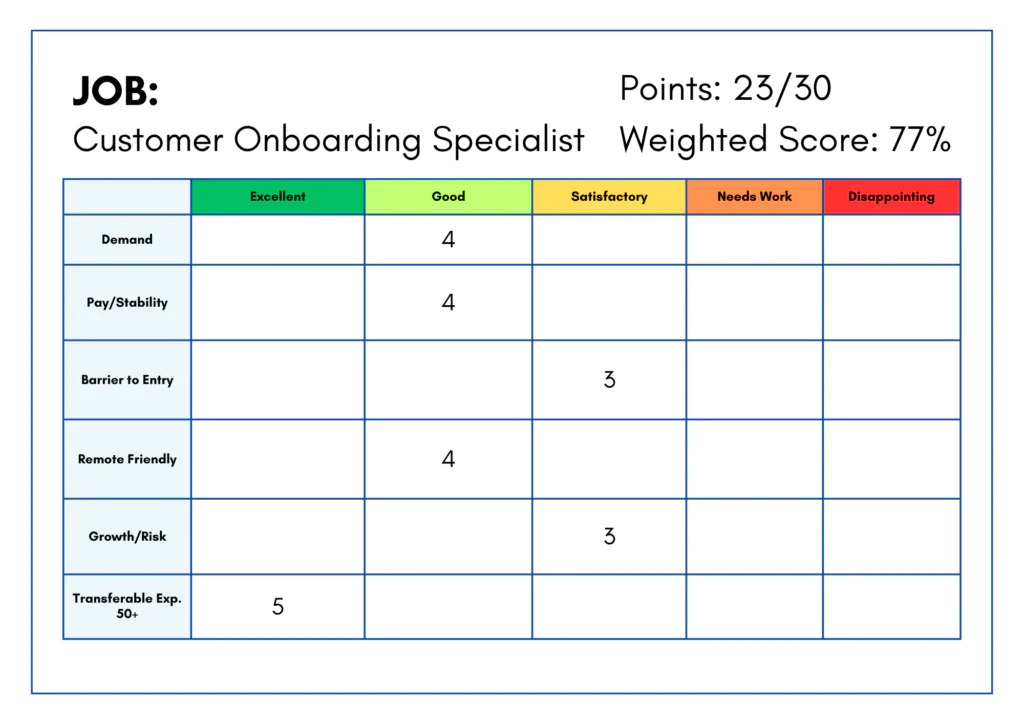
Customer onboarding specialists guide new customers through setup, explain product workflows, lead video calls, troubleshoot problems, track launch milestones, and coordinate with support or implementation teams. It can fit someone who knows how to make an overwhelmed customer feel confident using something new.
- Demand — 4/5: Software and service companies need people who can activate new customers and reduce early churn.
- Pay/stability — 4/5: Many openings are conventional full-time positions with benefits and solid middle-income pay.
- Barrier to entry — 3/5: A degree is not always required, but employers often want two years of onboarding, implementation, customer success, training, or related experience.
- Remote-friendly — 4/5: Distributed companies hire remotely, but the work includes scheduled calls, screen sharing, customer time zones, and performance targets.
- Growth/risk — 3/5: Onboarding remains valuable, but SaaS hiring cycles and AI-assisted support create uncertainty. Advancement can lead to customer success, implementation, enablement, or operations.
- Transferable exp for 50+ — 5/5: Empathy, patience, teaching, communication, problem-solving, and ownership matter more than fitting a young-tech-worker stereotype.
Why it ranks here: This is one of the most balanced options: solid pay, repeated remote hiring, a plausible adjacent-experience route, and an excellent fit for mature professional skills. Its entry and industry risks leave it at 23 points.
Current example: PushPress' remote customer onboarding specialist role is a full-time U.S. opening that asks for at least two years of SaaS onboarding, implementation, or related client-facing experience.
Salary evidence: Glassdoor estimates average customer onboarding specialist pay around $72,199, with a typical range of roughly $56,874 to $92,589.
No. 1: Training or learning specialist — 25/30
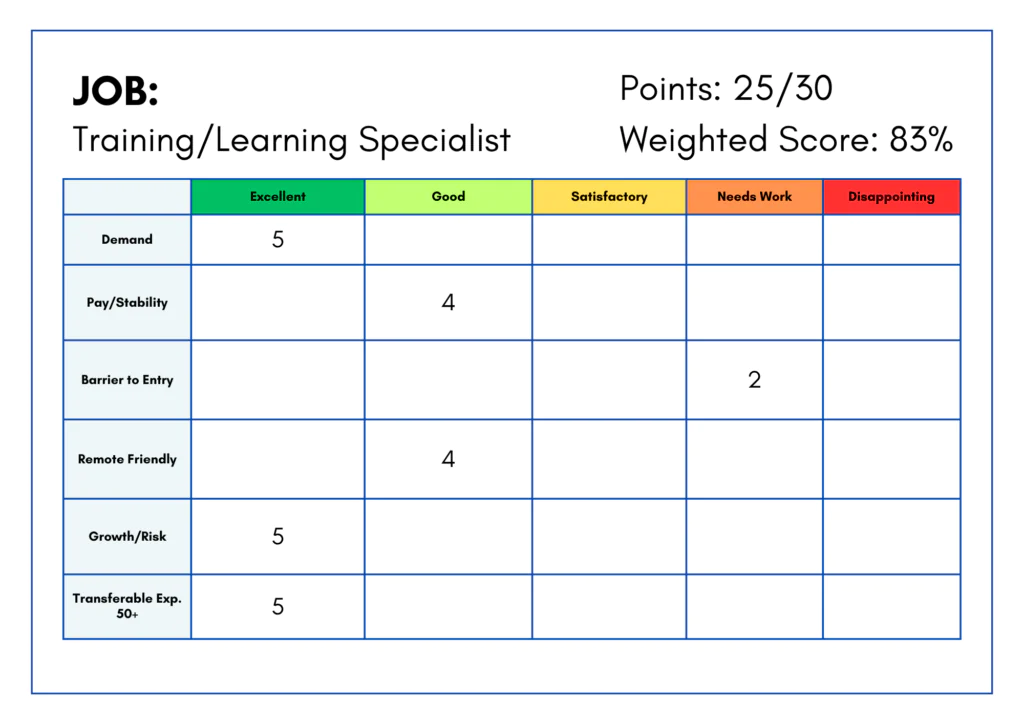
Training and learning specialists identify skill gaps, build training materials, teach employees or customers, manage learning systems, update documentation, and measure results. The best overall job is not about abandoning everything you know. It is about turning what you know into something other people can learn.
- Demand — 5/5: BLS projects 11% growth and about 43,900 openings per year, the strongest authoritative demand evidence in this ranking.
- Pay/stability — 4/5: Federal median pay is $65,850, Glassdoor's estimate is higher, and current salaried remote examples include benefits and dependable employment.
- Barrier to entry — 2/5: This is not a no-experience shortcut. Employers often want a bachelor's degree or equivalent experience plus several years in training, instructional design, or a related field.
- Remote-friendly — 4/5: Virtual training, content development, and learning systems support remote work, though employers may restrict eligible states or require live delivery.
- Growth/risk — 5/5: Organizations continually need reskilling, onboarding, compliance education, and help adopting new technology. The work can lead to instructional design, enablement, knowledge management, or L&D leadership.
- Transferable exp for 50+ — 5/5: Professional expertise, mentoring, communication, facilitation, judgment, and credibility are the core product.
Why it ranks first: Training specialist is not the easiest job to enter, but it earns 5s in demand, growth/risk, and transferable experience. Those strengths give it the highest equal-weight total at 25 out of 30.
Current example: Sidecar Health's remote operations training specialist role advertises $68,000 to $75,000 and asks for at least three years of related experience. It is remote only in specified states, a useful reminder that “remote” does not always mean “work from anywhere.”
Salary and outlook evidence: Glassdoor estimates average training and development specialist pay around $79,194, with a typical range of about $63,489 to $99,947. The Bureau of Labor Statistics reports $65,850 median pay, 11% projected growth, and roughly 43,900 openings per year.
Which remote job should you choose?
The overall ranking is a starting point, not a substitute for matching the work to your background and immediate needs.
- Best overall: Training or learning specialist.
- Best for flexibility: Online tutor or instructional support.
- Best for an experienced technology worker: Quality assurance tester.
- Best for client-facing experience: Customer onboarding specialist.
- Best for organization and follow-through: Project coordinator.
- Best lower-barrier career path: Insurance sales agent, if you are comfortable with licensing and sales goals.
- Best use of deep subject expertise: AI evaluator or domain expert, but only as long as you can tolerate contract uncertainty.
If dependable income is your biggest concern, give extra attention to conventional salaried roles such as training, onboarding, project coordination, medical records, and claims. If schedule control matters more, tutoring, AI evaluation, and contract grant writing offer more flexibility but less certainty.
Frequently asked questions
Are these jobs really remote?
Each category has genuine remote openings, but employers use “remote” in different ways. A role may be limited to certain states, require fixed hours, include occasional travel, or depend on a professional license in the customer's state. Read the location and schedule sections of every posting carefully.
Is 50 too old to start a new remote career?
No. The more useful question is whether the target job values what you already know. Training, onboarding, project coordination, tutoring, claims, grant writing, and payroll can reward judgment, communication, reliability, and industry knowledge. You may still need to translate those strengths into the language used in the job description.
Which job is easiest to enter?
Online tutoring, insurance sales, and bookkeeping or payroll received the highest barrier-to-entry scores in this group. “Easier” does not mean automatic: tutoring platforms screen for subject knowledge, insurance sales requires licensing, and payroll employers often expect relevant software or tax experience.
Which option has the best long-term outlook?
Training or learning specialist and quality assurance tester received the strongest growth/risk scores. Training ranked higher overall because professional and mentoring experience transfers more directly, while QA usually requires a stronger technical background.
Do I need a college degree?
Not for every job. Insurance sales, tutoring, tax preparation, payroll, and some claims roles can be accessible without a four-year degree. However, employers may substitute a license, credential, assessment, portfolio, or several years of related experience. Requirements vary by employer, so prioritize postings where your existing background covers most of the stated needs.
How should I use the salary estimates?
Use them as comparison points, not promises. Glassdoor figures may combine user submissions, modeling, base pay, bonuses, and commissions. Annual estimates can also hide part-time, seasonal, or contract hours. When an active posting gives a pay range, location, and schedule, that information is usually more useful for evaluating the specific opportunity.
Final verdict
Training or learning specialist is the best overall remote job for people over 50 in this ranking. It finished two points ahead because it combines strong demand, lower long-term risk, respectable pay, and a job where accumulated experience becomes an advantage rather than something to hide.
That does not make it the right choice for everyone. Start with the category that solves your biggest problem: entry difficulty, reliable pay, flexibility, or long-term growth. Then look for the job where your previous experience gives you the clearest evidence that you can do the work.
If you are unsure which direction fits your background, take the free Career Reset Quiz. You can also check the latest opportunities on the Self-Made Success remote job board.