
Last Updated on September 18, 2026 by Justin Bryant
Viral side-hustle videos can make almost any business look fast, simple, and profitable. The harder question is whether the strategy still makes sense after you account for startup costs, platform dependence, unpaid work, and the time required to reach a real customer.
I compared six side hustles featured in YouTube Shorts that had collectively generated more than 68 million views at my September 15, 2026 research checkpoint. I ranked the underlying business strategies—not the creators or the quality of their videos.
Mobile car detailing ranked first with 20 out of 30 points. It offers the clearest path to near-term revenue and a direct customer relationship. Vending machines ranked second because the operator owns real assets and can generate repeat sales. Faceless YouTube automation finished last because its low startup cost hides a slow path to income and heavy dependence on one platform.
None of the six reached A or S tier. Every strategy has a meaningful tradeoff, and none should be treated as easy or guaranteed income.

How I Scored These Side Hustles
Each strategy received a score from 1 to 5 in six equally weighted categories. A higher score is always better for the person trying the side hustle.
- Business control and durability: Do you own the customer relationship, distribution, and useful assets, or can one platform, supplier, algorithm, or gatekeeper disrupt the business?
- Startup cost and risk: How much money, inventory, liability, or platform risk must you accept before testing the idea?
- Beginner accessibility: Can an ordinary beginner understand and attempt the strategy without specialized credentials or equipment?
- Speed to realistic income: How quickly could a beginner plausibly reach a paying customer or meaningful revenue?
- Income potential and consistency: Does the model offer a useful earning ceiling and repeatable demand?
- Effort and difficulty: How much physical work, content production, sales, administration, or operational complexity is required?
Business control is separate from income potential. A side hustle can produce good revenue while leaving the operator vulnerable to a marketplace or algorithm. It can also provide strong control without being easy or inexpensive.
The viral clips supplied examples to investigate, but the creators did not receive extra points for showing persuasive screenshots or detailed results. Self-reported revenue is context—not independent proof that another beginner will achieve the same outcome.
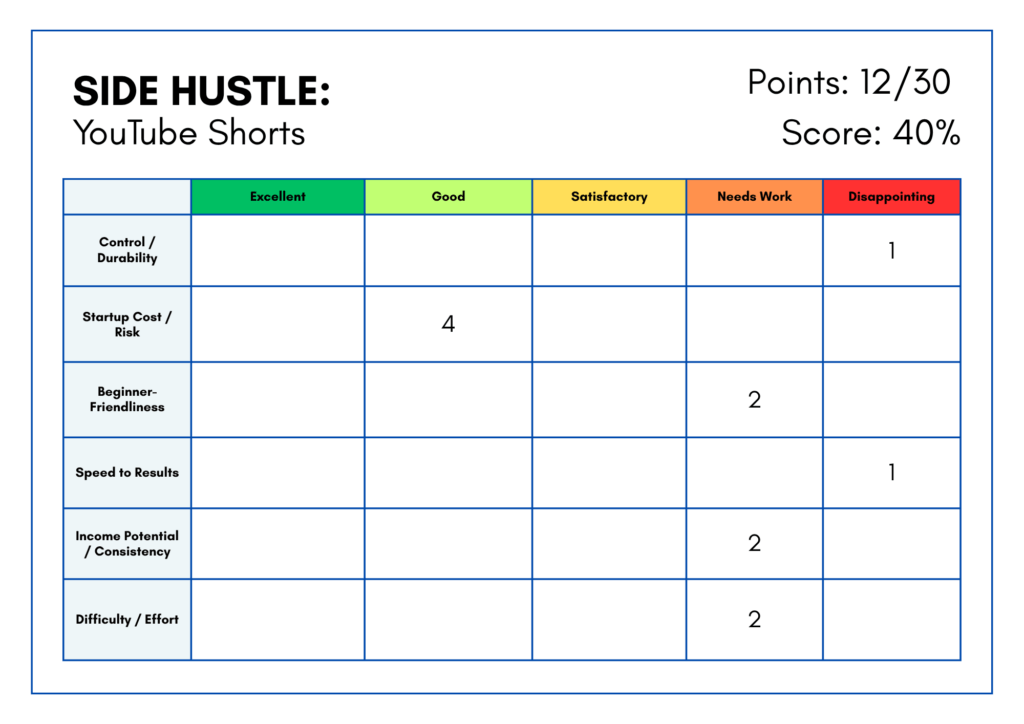
6. YouTube Shorts Automation — 12/30 — D Tier
The faceless YouTube example I reviewed challenges the popular idea that someone can combine stock footage and music, upload videos, and collect passive income. The creator reports that approximately 94,000 Shorts views produced about $17.26 over one 30-day period.
That result should not be treated as a universal Shorts payout, but it illustrates the central problem: generating a large-looking view count does not guarantee meaningful income.
YouTube currently lists the full ad-revenue threshold as 1,000 subscribers plus either 4,000 qualified long-form watch hours in 365 days or 10 million qualified Shorts views in 90 days. Its official monetization page also announces program-term updates beginning February 1, 2027.
The production process is not the main competitive advantage. A real channel still needs topics people care about, original scripting, useful commentary, strong packaging, viewer retention, rights management, and continuous testing. YouTube's monetization policies permit transformed commentary and critical review, but warn that repetitive, mass-produced, or minimally modified reused content may not qualify.
| Category | Score | Reason |
|---|---|---|
| Business control and durability | 1/5 | YouTube controls discovery, policy, and monetization, while the creator has little direct access to viewers. |
| Startup cost and risk | 4/5 | The model can be tested cheaply, although editing, licensing, and outsourcing can raise costs. |
| Beginner accessibility | 2/5 | Uploading is easy; producing original videos people repeatedly choose to watch is not. |
| Speed to realistic income | 1/5 | Audience-building and monetization thresholds create a long runway. |
| Income potential and consistency | 2/5 | There is upside, but Shorts revenue and viral distribution are inconsistent. |
| Effort and difficulty | 2/5 | Research, scripting, editing, packaging, rights, and iteration make this far from passive. |
Best for: Someone who wants to build an original media asset and is prepared to create for months without dependable income.
Skip it if: You need fast cash or expect stock footage and automation tools to replace editorial judgment.
Bottom line: A legitimate faceless channel is possible. “YouTube automation” is a poor income-first recommendation for most beginners because the easy production pitch hides the difficult business.
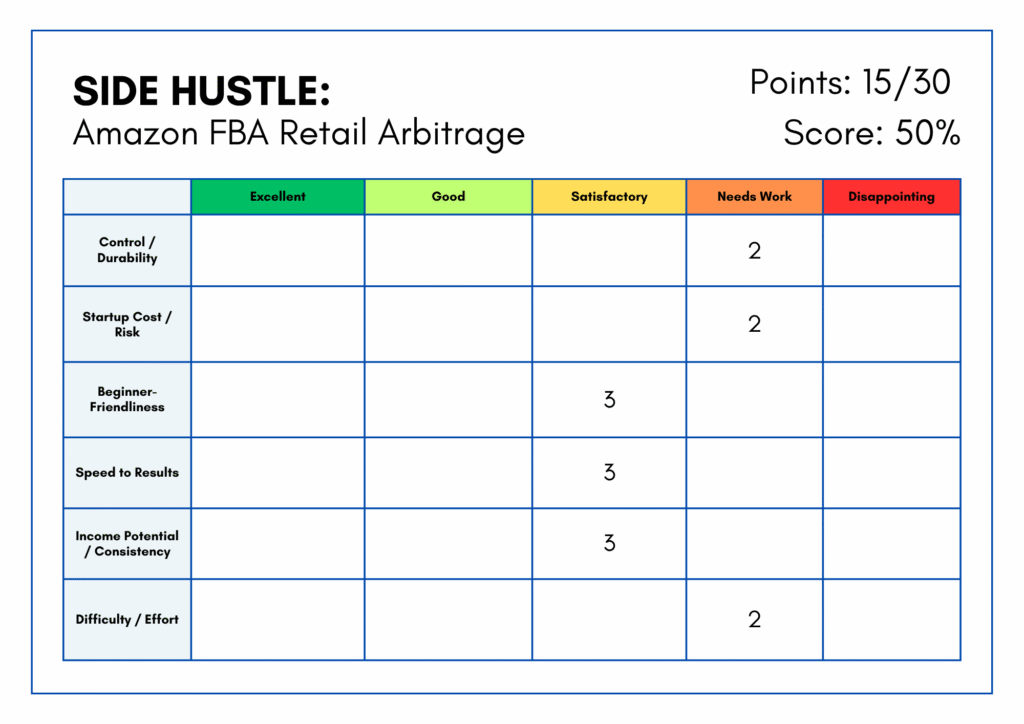
5. Amazon FBA Retail Arbitrage — 15/30 — C Tier
In the UK retail-arbitrage Short, the creator buys 52 label makers for £14.99 each and says they sell on Amazon for £37. The claimed £16 profit per unit produces approximately £832 in projected profit, which the title rounds to £850.
The missing distinction is that purchasing inventory is not the same as earning profit. The initial product cost alone is 52 × £14.99, or £779.48 tied up in inventory. Every unit must still sell at an acceptable price before the projection becomes real.
Amazon UK's official selling-cost page says most referral fees are between 8% and 15%. Sellers may also face selling-plan, fulfillment, storage, advertising, return-processing, and other costs. The exact economics depend on the product, size, weight, price, inventory age, and fulfillment method.
The “one hour” claim also excludes driving, product research, hauling, preparation, labeling, inbound shipping, price monitoring, returns, bookkeeping, and the possibility that the product cannot be replenished.
Best for: A careful reseller who can evaluate fees, protect working capital, and tolerate unsold inventory.
Skip it if: You cannot afford to leave money tied up while waiting for products to sell.
Bottom line: Retail arbitrage is a real business model, but the viral headline confuses estimated inventory profit with completed profit.
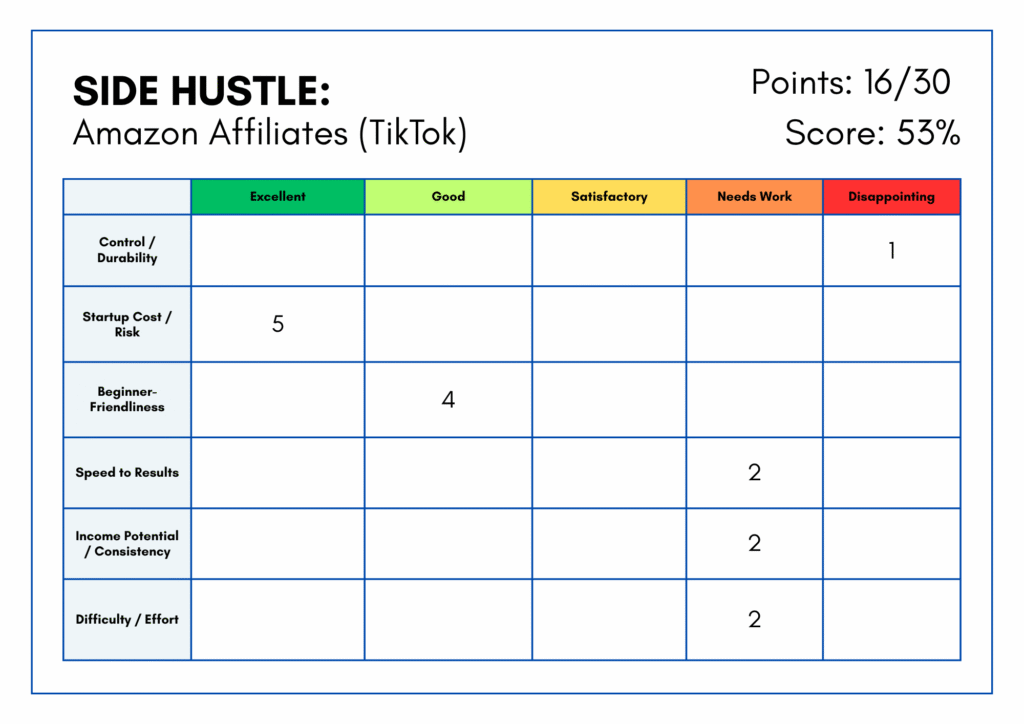
4. Amazon Affiliate Marketing Through TikTok — 16/30 — C Tier
The affiliate-marketing experiment creates a TikTok “Amazon finds” account, publishes nine posts, and reports earning seven cents.
Nine posts from one new account are not enough to prove that affiliate marketing does not work. The result does expose the hidden job: the link is easy to create, but attention and buyer trust are difficult to earn.
Amazon's current standard commission table varies by product category. Many ordinary physical-product categories pay only a small percentage of the qualifying purchase, so meaningful income generally requires substantial buying-intent traffic, higher-priced products, strong conversion, or some combination of the three.
This version of the strategy also has two major gatekeepers. TikTok controls discovery, while Amazon controls the commission, tracking, checkout, program access, and customer relationship. Amazon's operating agreement defines a qualifying session that generally ends after 24 hours, when the shopper orders, or when the shopper follows another affiliate's Amazon link.
If you promote products for compensation, the FTC says the disclosure should be clear, hard to miss, and placed with the endorsement. It should not be hidden in a pile of hashtags or only placed on a profile page.
Best for: Someone who already enjoys creating useful product content and wants a low-cost experiment.
Skip it if: Your entire plan is reposting product clips and dropping links without building trust.
Bottom line: The financial risk is low, but the operator owns very little of the business engine. Building attention is the real work.
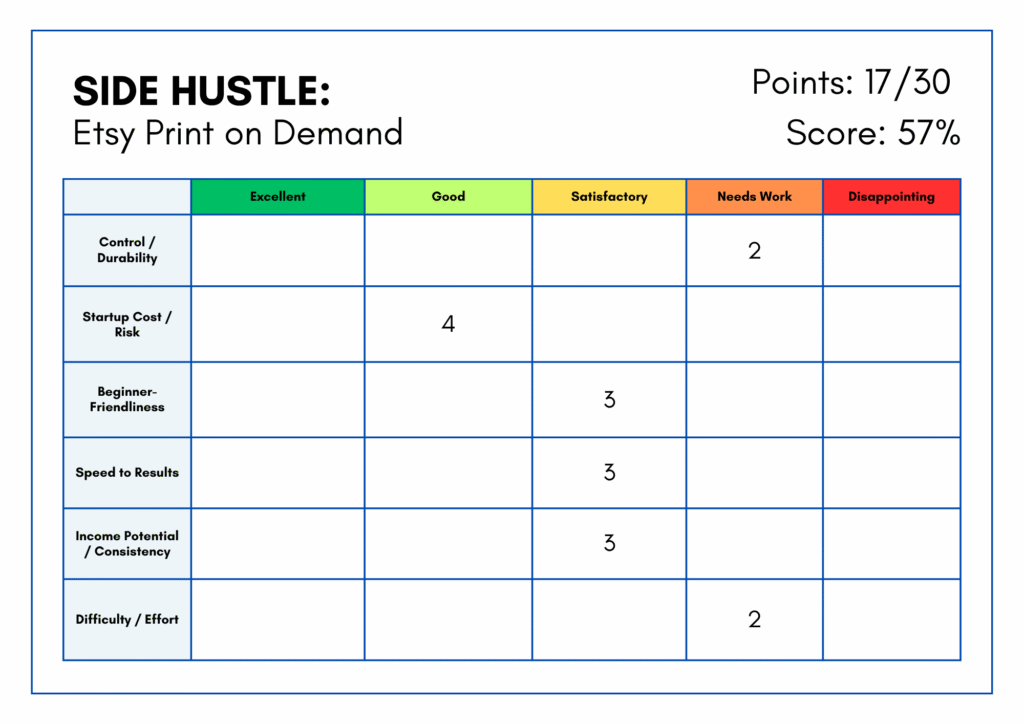
3. Etsy Print on Demand — 17/30 — C Tier
The Etsy print-on-demand example reports more than $5,000 in Christmas-season sales and nearly $2,000 in profit, followed by approximately 30 refunds when products were lost in transit. The creator then shifts from labor-intensive custom orders toward original designs and reports more than $6,500 in cumulative sales after ten weeks.
Print on demand reduces inventory risk because a production partner manufactures and ships an item after a customer orders. It does not remove design work, listing creation, customer service, refunds, marketplace competition, or responsibility for the customer experience.
Etsy's production-partner guidance describes partners as companies or individuals that physically produce items based on the seller's original designs. Sellers must disclose production partners and accurately represent how and where products are made and shipped.
Etsy's current fees policy lists a $0.20 listing fee and a 6.5% transaction fee. Payment processing, advertising, currency conversion, regulatory operating fees, and other charges may also apply depending on the seller and transaction.
Best for: A designer or niche researcher who is comfortable running an ecommerce store and supporting customers.
Skip it if: You expect generic designs and automated fulfillment to create passive sales without marketing or customer service.
Bottom line: Etsy print on demand is the strongest online model in this comparison, but it remains an active ecommerce business with major outside dependencies.
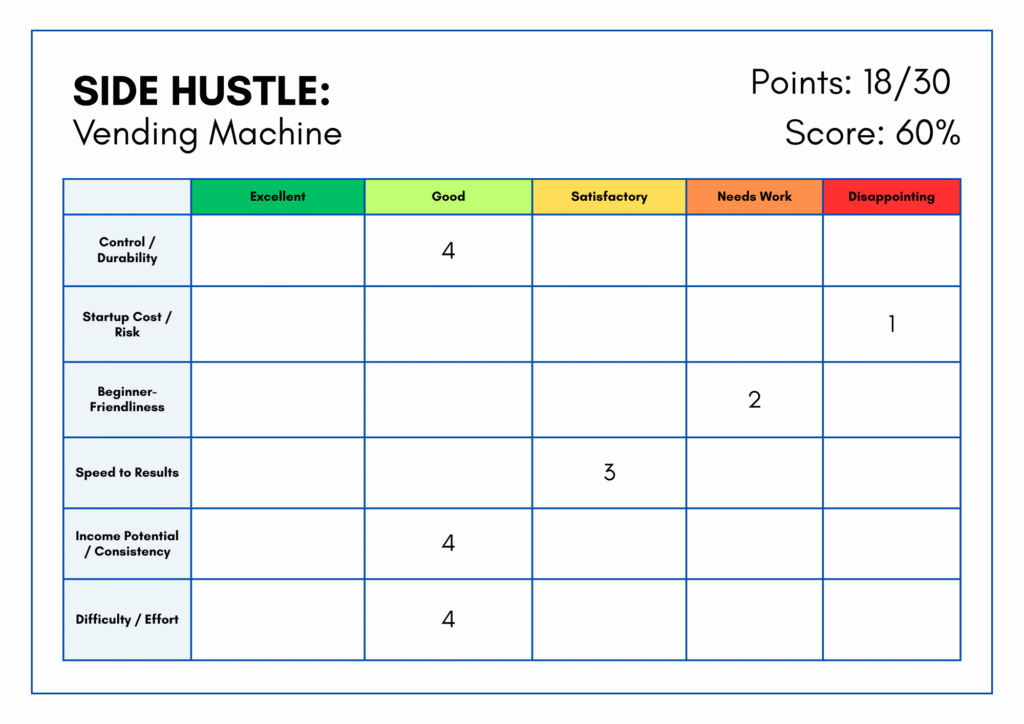
2. Vending-Machine Route — 18/30 — C Tier
In the vending-machine Short, the creator says he negotiated five used machines from $6,500 down to $4,000, secured two locations, and spent $270 stocking them. He reports approximately $1,000 in one-month revenue and calls the remaining $750 profit after product cost. He later says he sold the machines for $5,000.
This is a more durable model than chasing a new viral product every week because the operator owns physical equipment, inventory, and a route that can generate repeat transactions. The machine also has resale value.
The weak point is the location. A great machine in a poor location can still fail. The operator may also depend on a property owner, building access, foot traffic, commission terms, and the continued availability of that placement.
The reported profit calculation does not appear to include every possible cost. Card processing, location commissions or rent, fuel, spoilage, repairs, insurance, taxes, shopping time, transportation, and bookkeeping can reduce the result. One month is also too short to prove year-round consistency.
Best for: Someone with available capital, mechanical confidence, transportation, and the ability to sell location owners on a placement.
Skip it if: You can afford the machines but do not have a realistic path to profitable locations.
Bottom line: Vending can become a legitimate semi-passive route after setup. The expensive and difficult setup should not be edited out of the opportunity.
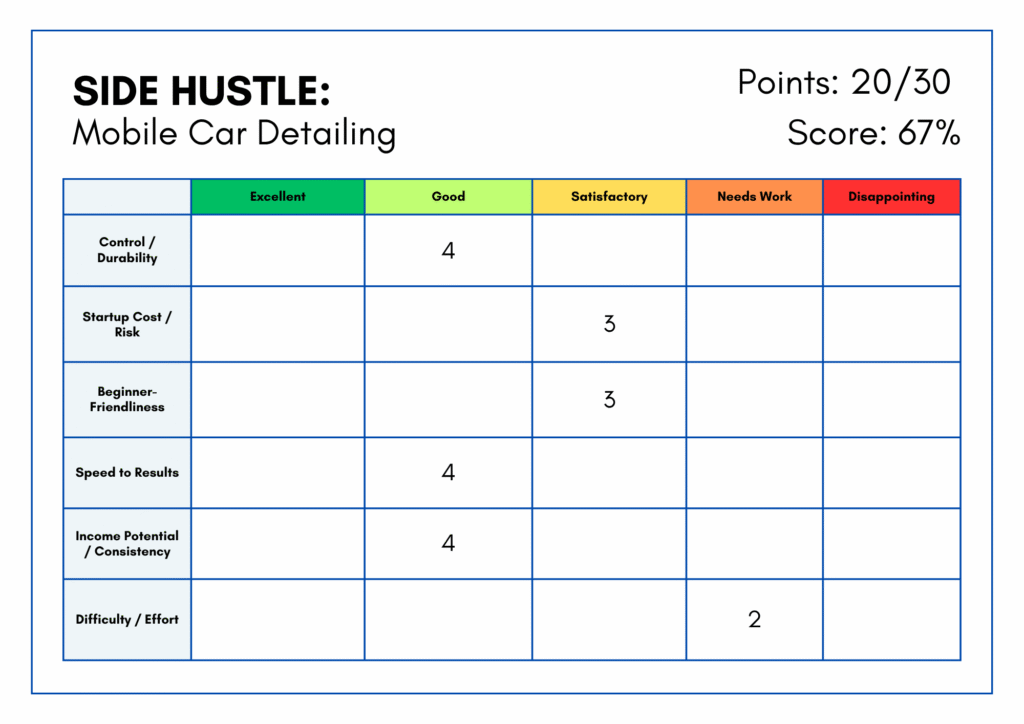
1. Mobile Car Detailing — 20/30 — B Tier
The mobile-detailing example follows two jobs during an approximately nine-hour day. A four-hour Subaru detail brings in $387. A three-and-a-half-hour Mercedes detail, including a $90 decontamination upsell, brings in $437. The total is $824 in gross revenue.
That is approximately $96.75 in gross revenue per service hour for the first job, $124.86 for the second, and $91.56 per total elapsed hour across the full day. Those figures are not take-home profit.
Chemicals, equipment, transportation, water and power arrangements, insurance, marketing, cancellations, taxes, and rework all matter. The work also requires skill, customer trust, physical effort, and enough local demand to schedule premium services.
Mobile detailing wins because the value exchange is direct. A customer has a visible problem, the operator provides a service, and payment can happen immediately. The operator can also build repeat business, referrals, packages, and a customer list instead of waiting for an algorithm to distribute content.
Local operating rules still matter. The EPA's vehicle-washing guidance explains that outdoor wash water can carry detergents, metals, and hydrocarbons into storm drains and notes that state or local requirements may apply.
Best for: Someone who wants a direct local service business and is willing to learn the craft, find customers, and perform physical work.
Skip it if: You specifically need a remote, low-physical-effort, or highly location-independent side hustle.
Bottom line: Mobile car detailing offers the clearest path to a paying customer in this comparison. It wins as an active service business—not as passive income and not because an $824 day is guaranteed.
Which Viral Side Hustle Is Best for You?
- Choose mobile car detailing if you want the fastest plausible path to direct local revenue and do not mind physical work.
- Choose vending machines if you have capital, can evaluate equipment, and already have a credible way to secure strong locations.
- Choose Etsy print on demand if your strengths are design, niche research, ecommerce, and customer service.
- Test affiliate marketing if you already create useful content and want a low-cost experiment, preferably while building an email list or another audience asset you control.
- Consider retail arbitrage if you understand resale economics and can afford inventory risk.
- Build a faceless YouTube channel only if you want to create an original media business—not because you expect automation to make it passive.
The most important pattern is control. Strategies become more durable when you own the customer relationship, an email list, useful intellectual property, equipment, repeat contracts, or another asset that does not disappear when one platform changes its rules.
Frequently Asked Questions
What is the best viral side hustle for beginners?
Mobile car detailing ranked first overall because it can reach a paying customer quickly and gives the operator a direct customer relationship. It is not the easiest option physically. Beginners who need an online model may prefer Etsy print-on-demand, but they should expect design, marketing, customer service, and marketplace work.
Which side hustle has the lowest startup cost?
Amazon affiliate marketing through TikTok received the highest startup-cost score because it can be tested with a phone and time. Its low financial risk is offset by weak business control and the difficulty of building an audience that converts.
Which side hustle is the most passive?
None is truly passive. Vending machines may require relatively little restocking time after a successful route is established, but buying equipment, securing locations, transporting machines, handling repairs, and managing inventory are active work. Print on demand outsources manufacturing, not design, marketing, refunds, or customer service.
Is YouTube automation a good side hustle?
A faceless YouTube channel can become a real business when it provides original value. It is a weak choice for someone seeking quick income because audience growth and monetization take time, revenue is unpredictable, and repetitive or minimally transformed content creates policy and rights risk.
Can these side hustles replace a full-time job?
They can produce meaningful income for some operators, but none guarantees it. Viral examples normally show one person, one time period, or one unusually strong result. Test the model at a small scale, track complete expenses and unpaid time, and expand only when your own numbers support it.
How should I evaluate a viral income claim?
First, separate revenue, profit, projected profit, and cash actually received. Then add startup capital, fees, refunds, taxes, customer-acquisition time, setup work, and platform risk. Finally, ask whether the result can be repeated without relying on one viral post, temporary product, or unusually favorable month.
Final Verdict
Mobile car detailing is my winner because it combines a fast path to revenue with direct customer ownership and repeat-business potential. Vending machines offer stronger semi-passive potential after setup, but the capital and location barrier are substantial. Etsy print-on-demand is the best online option here, although the operator still depends heavily on Etsy and a fulfillment partner.
The lowest-risk ideas are not automatically the best businesses. Affiliate marketing and faceless YouTube can be started cheaply, but both require attention from platforms the operator does not control. Retail arbitrage can make money faster, yet it puts cash into inventory before demand is proven.
Use the Self-Made Success Side Hustle Finder to compare more income opportunities and choose a strategy that fits your skills, available capital, preferred work style, and tolerance for uncertainty.