
Last Updated on April 15, 2026 by Justin Bryant
One of the biggest questions right now is why it feels almost impossible to get a job even when the economy, at least on the surface, seems okay.
That tension is what makes this moment so confusing. Unemployment is still relatively low compared with the worst economic crises in modern history. Stocks have stayed strong. Corporate profits are still rising. Yet many people cannot find work, hiring feels frozen, and even strong candidates feel stuck.
That disconnect is the real story.
When I compare today’s job market with the biggest crises of the past century, the first thing that stands out is that this does not look like a normal collapse. It does not look like the Great Depression, where everything broke at once. It does not fully look like the dot-com bubble either, where hype got out ahead of profits, but companies still hired aggressively as they built new infrastructure. And it does not neatly match 2008, when GDP recovered before jobs did.
What is happening now looks more like a structural shift. The economy can keep growing, top companies can keep getting richer, and the stock market can stay elevated even while the labor market gets weaker underneath it. That is what makes this period feel so different, and in some ways more unsettling.

The Great Depression comparison
The Great Depression is still the clearest example of total systemic collapse.
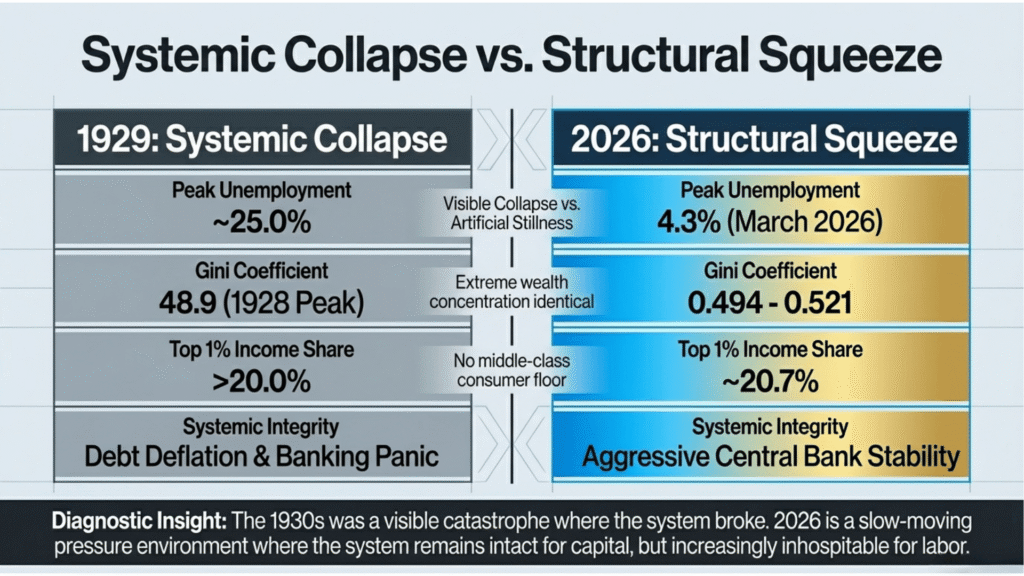
In 1929 and the years that followed, the stock market crashed, banks failed, liquidity disappeared, and unemployment exploded. At its worst, unemployment reached around 25%. That was not a slow squeeze. It was a visible catastrophe. Nearly every part of the system broke at once.
By comparison, today’s unemployment rate is nowhere near that level. The data puts it around 4.3% to 4.5%, which sounds relatively healthy on paper. But that number does not tell the full story. It does not fully capture people who have stopped looking, people who are underemployed, or people who are technically attached to the labor force but effectively shut out of stable work. That is part of why the official number feels so disconnected from lived experience.
This is where the comparison gets more interesting.
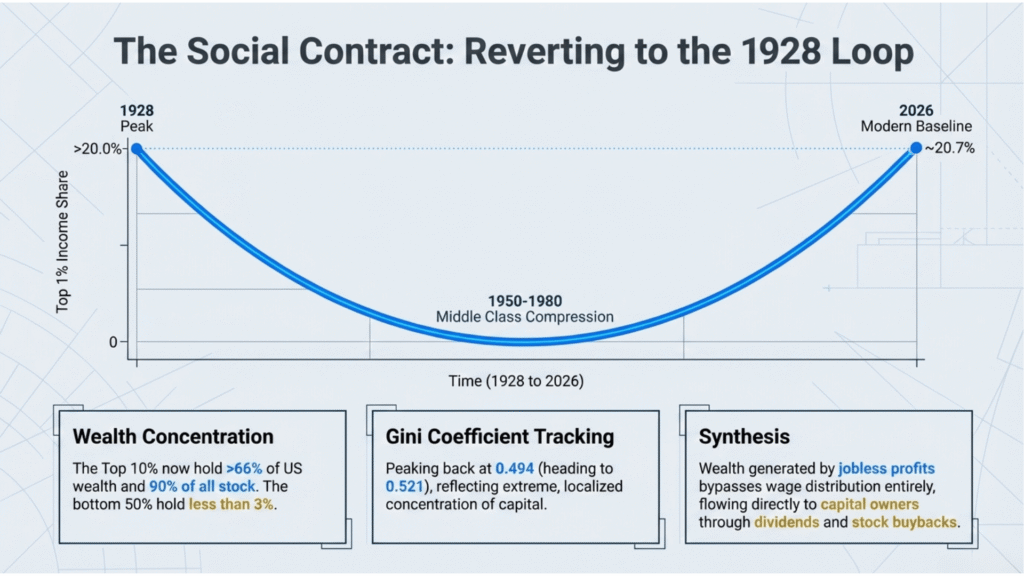
Some of the deeper structural warning signs today look surprisingly close to the Depression era. One of them is inequality. Around 1928, the Gini coefficient was about 48.9. In the modern era, research suggests the modern figure reached 0.494 in 2021 and is projected even higher on an adjusted basis. In simple terms, inequality is back near levels associated with the late 1920s. The top 1% income share is also very close to Depression era levels, around 20% or more.
That matters because extreme inequality makes an economy more fragile. When wealth is concentrated too heavily at the top, the middle class becomes less capable of supporting broad demand. In the Depression, that helped make the crash far worse. Today, it creates a different kind of problem. The system does not need broad wage growth to keep profits rising because gains can flow directly to capital owners.
That is one of the clearest similarities between now and the late 1920s. Wealth concentration is severe. The top 10% now hold more than 66% of U.S. wealth and about 90% of all stock holdings, while the bottom 50% hold less than 3%. That means even if the market keeps going up, most people are only weakly connected to that upside.
Still, there is one huge difference from the Great Depression.
We have not seen a complete collapse in markets or banking. The biggest firms today are not failing in the same way banks and businesses failed in the 1930s. In fact, many of the top companies are improving profits even while reducing headcount. During the Depression era, scaling still required more human labor. Today, technology lets companies expand output, margins, and market power without hiring nearly as many people.
That is why the Great Depression comparison only goes so far. We may share some of the inequality risk, but we are not watching the whole system implode all at once. What we are seeing instead is a labor market that weakens while capital stays strong.
The dot-com bubble comparison
The dot-com bubble is one of the most useful comparisons because today’s AI era also has a massive technology narrative behind it.
In the late 1990s and around 2000, investors poured money into internet companies based on future potential. There was real innovation, but there was also a great deal of hype. Many firms had weak fundamentals, little revenue, and no clear path to sustainable profits. At the peak, only about 10% to 15% of those firms were actually profitable. Valuations ran far ahead of reality, and eventually the bubble burst.
That sounds familiar at first.
Today’s market also has a powerful technology story. AI is being treated as a transformative force, just as the internet once was. There is excitement, big capital spending, huge valuation gains, and a sense that a new era is being built. But this is where the key difference appears.
The dot-com era had hype without much profit.
The current AI era has hype with real profit.
That distinction matters a lot. According to my research, the Nasdaq forward P/E ratio around the 2000 peak was roughly 60x. In the current cycle, valuations are elevated, but much lower than that. More importantly, the top firms driving this cycle are highly profitable. Companies like Nvidia, Microsoft, and Alphabet are not speculative startups with no earnings. They are already massive cash-generating businesses. Nvidia alone reportedly crossed a $5 trillion market cap while posting 65% year over year revenue growth.
That means today’s technology boom is not built on fake growth in the same way the dot-com bubble was.
But there is another side to this, and this is where today may actually be worse for workers.
During the dot-com era, even if valuations were excessive, tech growth still created jobs. Companies hired aggressively. They needed engineers, marketers, operations people, support teams, infrastructure builders, and a wide range of staff to scale the internet economy. It was labor-intensive. The hype turned into overbuilding, but that overbuilding still pulled a lot of people into employment.
Now the pattern is different.
Today’s tech leaders are becoming more profitable with fewer people. Instead of technology acting mainly as a tool that helps workers do more, it is increasingly acting as a substitute for labor. So the same kind of excitement that once led to mass hiring is now leading to layoffs, hiring freezes, and tighter staffing models.
That is why it does not feel like the dot-com era to job seekers. The hype is there, but the labor absorption is not.
In the dot-com bubble, the market got ahead of profitability, but firms still needed people.
In the AI cycle, firms have profitability first and increasingly need fewer people.
That is a major structural break.
Why today may be more dangerous than the dot-com bubble for workers
I think this is the heart of the comparison.
The dot-com bubble eventually burst because valuations were too far disconnected from earnings. In today’s market, the biggest companies are actually delivering earnings. That makes the system more stable for investors, at least compared with 2000. But it may also make it more dangerous for labor because these firms do not need a hiring boom to justify their valuations.
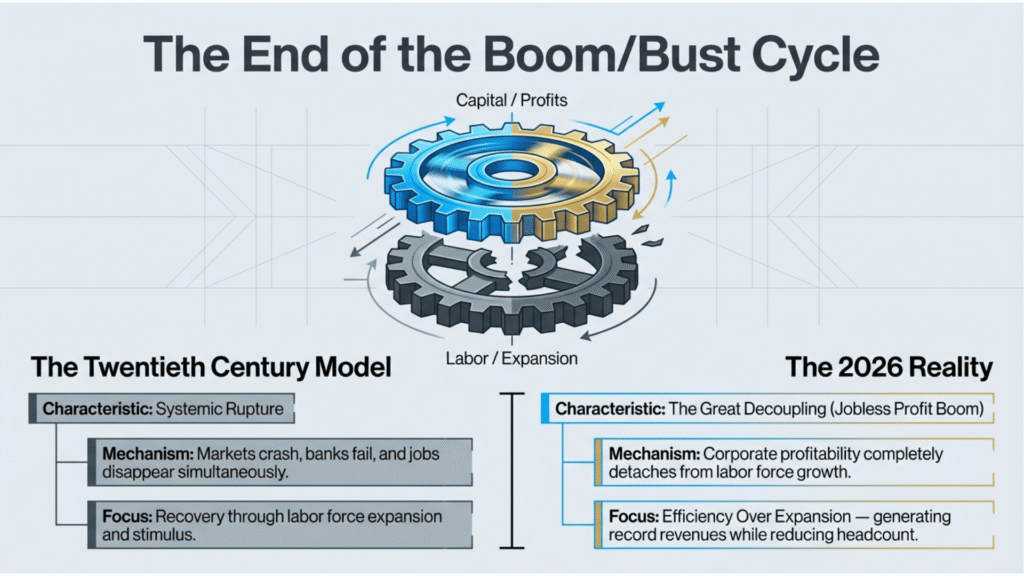
Some refer to this as the “jobless profit boom.”
In past technology cycles, growth and hiring tended to move together. A company made more money, expanded operations, and hired more people. That relationship is now weakening. Profit growth no longer reliably produces payroll growth.
That is why even strong corporate earnings do not create the usual sense of labor market recovery.

What happened in 2008 and why it matters here
The 2008 financial crisis introduced the idea of a jobless recovery to a wider public.
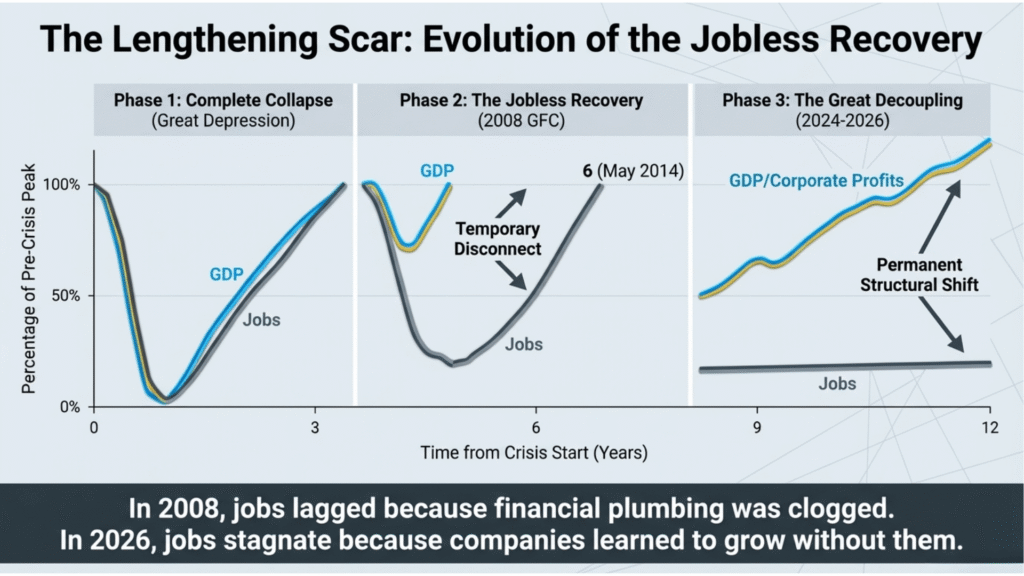
After the housing bubble collapsed and the credit system seized up, GDP eventually began to recover. But the labor market lagged badly. Real GDP returned to its pre-crisis level long before jobs did. The source notes that jobs did not fully recover until May 2014.
That was already a warning sign that growth and employment could temporarily disconnect.
But the current period looks more extreme because the disconnect may not be temporary. In 2008, jobs lagged because the system was damaged and needed time to heal. In 2024 through 2026, jobs may be lagging because companies have learned how to grow without adding many workers at all.
That is a much bigger deal.
The data hints that this is uncharted territory, and I think that is accurate. During the Great Depression, GDP and jobs recovered more or less together once the recovery took hold. In 2008, GDP recovered faster, while jobs took longer. Today, GDP and corporate profits are still rising, but jobs are no longer following the same path. They are separating.
That is the decoupling.
The Great Decoupling and the jobless profit boom
The modern labor market is not defined by a sudden crash. It is defined by a squeeze.
Jobs are slowly getting harder to find. Competition is increasing. White-collar hiring feels frozen in many fields. Entry-level candidates are struggling to get in. Mid-career professionals feel trapped. And yet the broader economy keeps posting enough decent-looking numbers to avoid the kind of panic that might trigger a major intervention.
This is a dangerous mix because it creates hidden weakness.
There seems to be a major shift in how companies measure success. Instead of linking growth to headcount, companies are increasingly optimizing around efficiency. Revenue per employee is a good example.
In 1991, S and P 500 companies needed about 2.46 employees for every $1 million in inflation-adjusted revenue. By 2025, that figure had fallen to 1.55. Average revenue per employee reached about $642,000. In other words, firms are generating much more output per worker than before, and in many cases, they are doing it by keeping teams lean rather than expanding them.
That helps explain why stocks and profits can look strong while the job market feels weak.
If a company can raise margins, automate tasks, and keep revenue climbing without adding staff, then labor becomes less central to growth. That breaks one of the old assumptions many people still carry from earlier cycles. A healthy company no longer necessarily means more jobs.
Why entry-level workers are getting hit first
One of the clearest signs of structural change is the pressure on entry-level work.
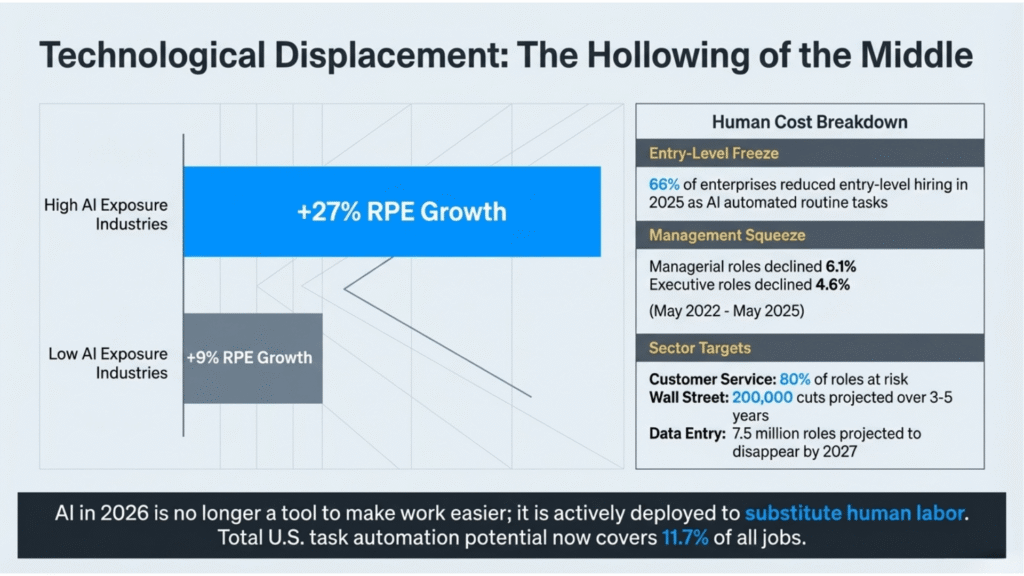
According to my research, 66% of enterprises reduced entry-level hiring in 2025 as AI automated routine tasks.
That is huge.
Entry-level jobs have historically been the way people broke into industries. They handled routine work, learned systems, built skills, and moved upward over time. But if AI tools can now do a growing share of those routine tasks, companies have less incentive to hire junior workers in the first place.
This creates a serious bottleneck.
Young graduates come out of school and find fewer openings. Career changers hit a wall because the easiest ramp into a new field has narrowed. Employers still want experience, but they are cutting the jobs that used to create that experience.
That is why so many people feel stuck at the starting line.
The squeeze on management and white-collar work
The problem is not limited to entry-level jobs.
In fact, managerial roles fell about 6% from May 2022 to May 2025, and executive roles declined about 4.6% over that window.
This matters because it shows the pressure is moving upward through the hierarchy.
For years, many people assumed white-collar jobs were safer from automation than blue-collar work. In reality, AI is moving quickly into cognitive and administrative tasks that sit at the heart of many professional roles. It can summarize, analyze, route, classify, draft, and support decision-making in ways that reduce the need for large white-collar teams.
This is especially disruptive because white-collar workers often have high fixed costs, student loans, and expectations built around stable career progression. When these roles shrink, the financial shock can be severe.
The sectors most at risk
Customer service is one of the clearest examples, with about 80% of roles considered at risk from automation. Data entry is another major target, with 7.5 million roles projected to disappear by 2027. Wall Street and financial firms are also under pressure, with around 200,000 cuts projected over three to five years as firms use AI to replace entry-level and back-office tasks.
These are not small niche categories. They represent millions of roles and major pipelines into the middle class.
And this is where the current period becomes more concerning than older crises. The losses are not just coming from recession-driven demand weakness. They are also coming from technology-driven substitution. That means even if the economy avoids a classic recession, labor demand can still weaken.
Why the unemployment rate may be misleading
Historically, the economy often needed to add around 100,000 to 150,000 jobs per month to keep unemployment stable. But the source says that by 2025, the break-even rate had collapsed to around 22,000 jobs per month because of slower population growth, negative unauthorized immigration flows, and an aging workforce.
That sounds like good news at first, but it is really a mixed signal.
It means unemployment can stay relatively low even while the labor market is weak. Fewer job gains are now needed to keep the headline rate from rising. That creates what the source calls a mirage of momentum. The market looks stable from a distance, but underneath that stillness are low mobility, trapped workers, and a shortage of real opportunity.
So when people say unemployment is only around 4.3%, they are not necessarily wrong. But they may be interpreting that figure in a way that no longer fits the new labor market.
The labor market can look calm while still being deeply unhealthy.
Interest rates, tariffs, and added pressure
AI is not the only force shaping this job market.

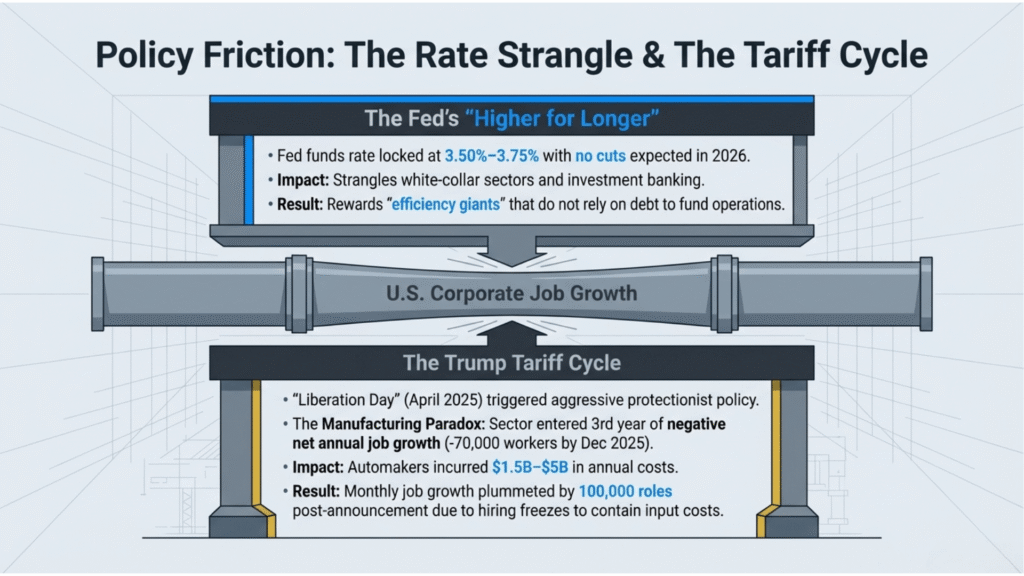
The data also points to high interest rates and tariff-related costs as additional pressures. It also describes how the federal funds rate stayed around 3.50% to 3.75% with no cuts expected in 2026. That higher-for-longer environment hurts rate-sensitive sectors, especially white-collar industries tied to financing, investment activity, and expansion plans.
At the same time, tariffs are adding cost and uncertainty. Manufacturing, which many people hoped would strengthen under protectionist policies, has still experienced weak job growth. The source says manufacturing entered a third straight year of negative net annual job growth, with 70,000 fewer workers by December 2025. Average monthly job growth reportedly fell by around 100,000 roles after major tariff announcements, largely because businesses froze hiring to contain input costs.
This matters because it means the job market is being squeezed from several directions at once.
AI reduces the need for labor.
High rates reduce expansion and borrowing.
Tariffs increase costs and uncertainty.
Together, those forces make it harder for companies to justify new hiring even when profits remain intact.
Why corporate profits no longer guarantee labor demand
This is probably the single most important difference between today and past crises.
For much of the last century, there was a broad expectation that when profits recovered, jobs would eventually follow. It might take time, but growth would feed back into employment.
Now that link is weakening.
S&P 500 firms have posted strong earnings growth, and net margins have remained elevated. But the benefit is not being spread through payroll in the way many people expect. Instead, gains are flowing heavily to shareholders through buybacks, dividends, and capital appreciation.
That becomes much more unequal when stock ownership is already concentrated among wealthy households.
So even if the market rises, the people losing access to stable jobs do not necessarily share much in that upside. The result is a widening gap between the strength of capital and the weakness of labor.
That is why this period feels so strange. It is possible for the economy to look successful while a large share of people feel like they are falling behind.
The wealth gap and why it matters to the job market
This is not just a job story. It is also a distribution story.
When companies can produce more profit with fewer people, less money has to flow through wages. More of it can flow to owners of capital. If stock ownership is concentrated, that process increases inequality almost by default.
The data is striking.
The top 10% hold more than 66% of wealth and 90% of all stock.
The bottom 50% hold less than 3% of wealth.
The top 1% income share is back near late 1920s levels.
The Gini coefficient is also near the highest levels in modern history.
That means the people who benefit most from the jobless profit boom are the people who already own large amounts of financial assets. Meanwhile, people who rely mainly on wages are under pressure from stagnant mobility, weak hiring, and automation risk.
This is part of why the job market feels worse than the unemployment rate suggests. The broader system is producing gains, but those gains are not reaching labor evenly.
The wage problem even for people who still have jobs
Even workers who remain employed are not necessarily keeping up.
The data shows nominal wages rose by about 4.26% in early 2026, but real average hourly earnings increased by only about 0.3% year over year in March 2026. That means inflation is absorbing almost all of the gains.
The lower half of the labor market looks even weaker. Purchasing power for the bottom 40% grew from 2019 to 2024, but then stalled in 2025. At the 10th percentile, real hourly wages declined by $0.04 in the third quarter of 2025, marking the first non-pandemic decline in more than a decade.
So even people who are hanging on to their jobs are still being squeezed.
If you lose your job, reentry is hard.
If you keep your job, your purchasing power may still erode.
That two-sided pressure is a big reason so many people feel stuck.

Why this is different from older cycles
When people compare today with the Great Depression, the dot-com bust, or 2008, they are usually asking a reasonable question. They want to know whether this is just another painful cycle that will eventually reset.
The answer may be yes in some ways, but not in the old sense.
The Great Depression was a collapse.
The dot-com bubble was a speculative mania that still created jobs on the way up.
The 2008 crisis was a financial breakdown followed by a jobless recovery.
Today looks more like a permanent optimization cycle.
The system is not obviously breaking. It is becoming more efficient for capital and less dependent on labor. That is why there is no clear light at the end of the tunnel in the usual sense. If corporate profits are no longer tied to headcount, then waiting for profits to recover is not enough. They are already strong.
That is the unsettling part.
The usual signal of recovery is already here, but the labor rebound is not.
What this likely means for workers
First, emergency funds matter more now. If hiring cycles are slower and the time to fill roles is longer, workers may need more buffer than before. A six-month emergency fund may no longer feel excessive. In some cases, 6 to 12 months may be more realistic.
Second, AI literacy is becoming less optional, especially in white-collar work. If firms are restructuring around fewer workers who can do more with AI, then workers who understand these tools will have an advantage over workers who resist them.
Third, second income streams may become more common. When primary job security weakens, people often look for freelance work, independent business models, content creation, consulting, or side projects. That does not mean all of those will succeed, but it does mean more people will likely experiment with them.
Fourth, referrals may matter more than cold applications. In a crowded labor market, direct trust signals become more valuable. People may need stronger networks, more targeted outreach, and more personal connections rather than relying only on mass application platforms.
Fifth, cost structures matter. If job recovery remains slow and wage gains stay weak, then lower fixed expenses become more important. That could mean more roommates, living with family longer, delaying major purchases, or generally becoming more conservative with spending.
These are not dramatic conclusions. They are just rational responses to a market where labor has less bargaining power than it used to.
The real takeaway
The biggest mistake would be treating today’s job market like a standard recession signal and assuming it will resolve the way older cycles did.
This is not just a weak patch.
It may be the beginning of a long period in which economic growth, stock market gains, and corporate profitability remain much less connected to broad-based hiring than they were in the past.
That is why comparing today with the Great Depression and the dot-com bubble is useful, but only up to a point.
The Great Depression shows us what extreme inequality and systemic fragility can look like.
The dot-com bubble shows us what happens when technology hype runs ahead of fundamentals.
But today’s job market combines a few features we do not usually see together.
We have strong profits.
We have concentrated market leadership.
We have real technology-driven labor substitution.
We have relatively low unemployment on paper.
And we have widespread difficulty finding work.
That combination is what makes this moment feel so disorienting.
It is not a classic crash. It is a slow squeeze.
And for workers, that may turn out to be one of the defining economic stories of this era.
Sources:
- The Great Decoupling: How the ‘Jobless Profit Boom' of 2024 Redefined Corporate Success, https://markets.financialcontent.com/stocks/article/marketminute-2026-1-23-the-great-decoupling-how-the-jobless-profit-boom-of-2024-redefined-corporate-success
- Why fewer workers add up to more growth for corporate America: report, https://www.hcamag.com/ca/specialization/leadership/why-fewer-workers-add-up-to-more-growth-for-corporate-america-report/539601
- Compare and contrast the current financial crisis with that which started the Great Depression Jacob Miller 10, https://www1.essex.ac.uk/economics/documents/eesj/miller.pdf
- Was the Great Recession More Damaging Than the Great Depression? – Milken Institute Review, https://www.milkenreview.org/articles/was-the-great-recession-more-damaging-than-the-great-depression
- Comparisons between the Great Recession and the Great Depression – Wikipedia, https://en.wikipedia.org/wiki/Comparisons_between_the_Great_Recession_and_the_Great_Depression
- Income inequality in the United States – Wikipedia, https://en.wikipedia.org/wiki/Income_inequality_in_the_United_States
- United States Employment Rate – Trading Economics, https://tradingeconomics.com/united-states/employment-rate
- Great Recession in the United States – Wikipedia, https://en.wikipedia.org/wiki/Great_Recession_in_the_United_States
- March 2026 Jobs Report: A Bumpy Road and a Moving Finish Line …, https://www.hiringlab.org/2026/04/03/march-2026-jobs-report-a-bumpy-road-and-a-moving-finish-line/
- AI Bubble vs. Dot-com Bubble: A Data-Driven Comparison …, https://intuitionlabs.ai/articles/ai-bubble-vs-dot-com-comparison
- The Dot-AI Bubble: Why 2026 Feels Like 2000 All Over Again | Investing.com, https://www.investing.com/analysis/the-dotai-bubble-why-2026-feels-like-2000-all-over-again-200668624
- Will the US Stock Market Collapse with the AI Bubble? The 2026 Reality Check – KuCoin, https://www.kucoin.com/blog/will-the-us-stock-market-collapse-with-the-ai-bubble-the-2026-reality-check
- The AI Boom vs. The Dot-Com Bubble: Is a 2026 Crash Likely? – Elston Consulting, https://www.elstonsolutions.co.uk/insights/is-ai-a-bubble
- AI bubble – Wikipedia, https://en.wikipedia.org/wiki/AI_bubble
- The New Rule: $500K ARR Per Employee is the New $200K | SaaStr, https://www.saastr.com/the-new-rule-500k-arr-per-employee-is-the-new-200k/
- AI and Automation Job Loss Statistics in the U.S. (2024-2026 …, https://high5test.com/jobs-lost-to-automation-statistics/
- March 2026 Jobs Report: A Surprise Surge Complicates the Fed's Path, https://markets.financialcontent.com/stocks/article/marketminute-2026-4-10-march-2026-jobs-report-a-surprise-surge-complicates-the-feds-path
- FactSet Earnings Insight, https://www.factset.com/earningsinsight
- Are S&P 500 Companies Really Doing More With Less?, https://chartkidmatt.com/p/are-s-p-500-companies-really-doing-more-with-less
- Revenue per Employee (RPE): Lifecycle Trends and Industry Benchmarks – FRANKI T, https://www.francescatabor.com/articles/2025/6/1/revenue-per-employee-rpe-lifecycle-trends-and-industry-benchmarks
- 60+ Shocking AI Job Replacing Statistics Relevant for 2026 – Tenet UI UX, https://www.wearetenet.com/blog/ai-job-replacing-statistics
- U.S. businesses report that tariff policies will likely lead to price increases and labor market impacts in 2026 – Equitable Growth, https://equitablegrowth.org/u-s-businesses-report-that-tariff-policies-will-likely-lead-to-price-increases-and-labor-market-impacts-in-2026/
- Trump's Tariff Legacy: A Year After ‘Liberation Day', What's Changed? – Denver Today, https://nationaltoday.com/us/co/denver/news/2026/04/11/trumps-tariff-legacy-a-year-after-liberation-day-whats-changed/
- Trump-Era Tariffs and Uncertainty Are Weakening the Job Market and Hollowing Out the Middle Class – Joint Economic Committee, https://www.jec.senate.gov/public/_cache/files/4e485d42-7161-4889-b589-2267c0ce5dc9/jec-minority-labor-market-report.pdf
- Manufacturing Employment Data Confirm the Concentrated Benefits—and Dispersed Costs—of Trump's Tariffs | Cato at Liberty Blog, https://www.cato.org/blog/manufacturing-employment-data-confirms-concentrated-benefits-dispersed-costs-trumps-tariffs
- The Employment Situation – March 2026 – Bureau of Labor Statistics, https://www.bls.gov/news.release/pdf/empsit.pdf
- Is there more of a wealth gap today or 100 years ago. : r/EconomicHistory – Reddit, https://www.reddit.com/r/EconomicHistory/comments/1onde8f/is_there_more_of_a_wealth_gap_today_or_100_years/
- Wealth Inequality in the United States since 1913, https://eml.berkeley.edu/~saez/SaezZucman14slides.pdf
- 2026 Business Leaders Outlook: Expectations & Trends – J.P. Morgan, https://www.jpmorgan.com/insights/markets-and-economy/business-leaders-outlook/2026-us-business-leaders-outlook
- United States Wages and Salaries Growth – Trading Economics, https://tradingeconomics.com/united-states/wage-growth
- Dollars and Cents: Real Hourly Wage Growth across the Lower Half of the Wage Distribution, https://www.clevelandfed.org/publications/cd-reports/2026/20260218-real-hourly-wage-growth-across-lower-half-of-wage-distribution
- Real Earnings Summary – 2026 M03 Results – Bureau of Labor Statistics, https://www.bls.gov/news.release/realer.nr0.htm
- Average Time To Fill (2026 Update) | Corporate Navigators, https://www.corporatenavigators.com/articles/recruiting-trends/the-average-time-to-fill-by-industry-in-2024/
- Average Time To Hire & 2026 Recruitment Statistics | TSP, https://blog.mytsp.net/average-time-to-hire-recruitment-statistics
- 2026 Recruiting Benchmarks – JobScore, https://www.jobscore.com/articles/recruiting-benchmarks/
- Candidate Experience Statistics Every Recruiter Must Know in 2026 – RecruitBPM, https://recruitbpm.com/blog/candidate-experience-statistics